

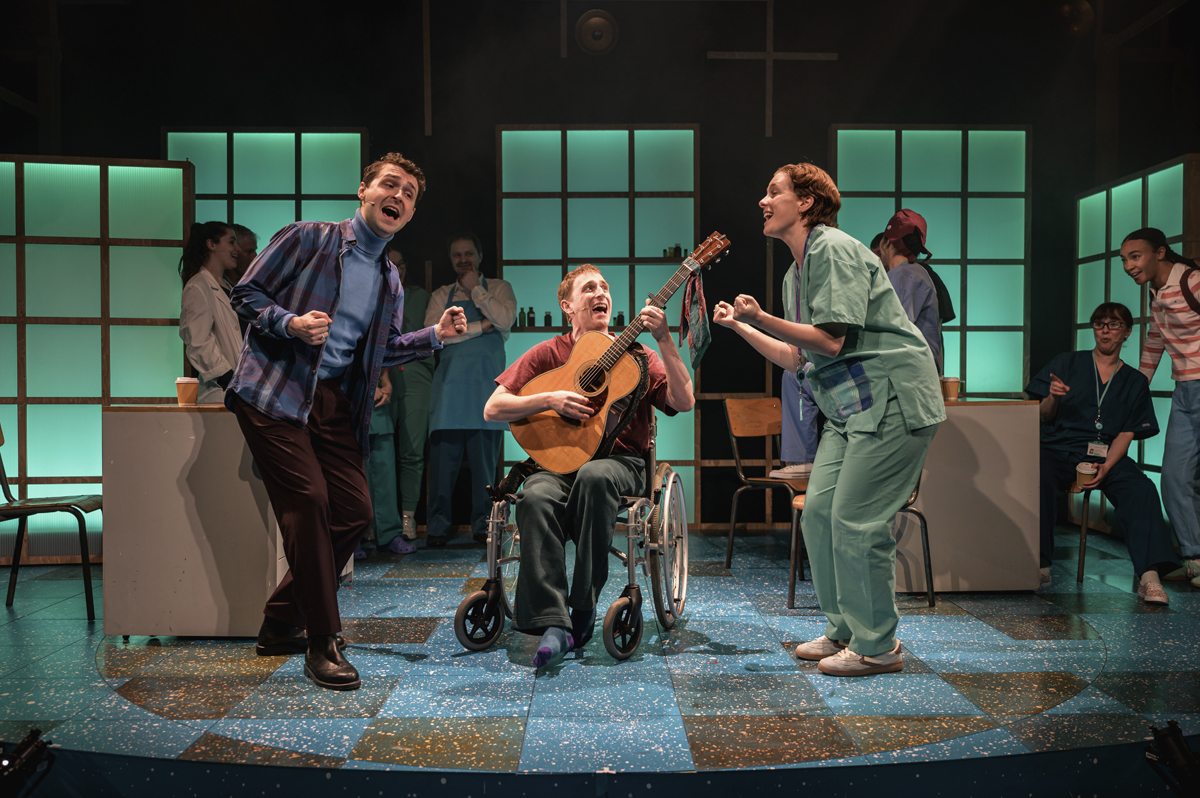

There are some genuinely effecting moments in Lifeline which has just opened at Southwark Playhouse’s Elephant, but when it comes down to brass tacks it’s the message which is the star rather than the actual show.
It is – so far – the only musical ever to have been performed on the floor of the UN, and given that its subject matter is regarding the potential danger that lies ahead with the overuse of antibiotics, and the underlying threat to humankind as a result, it’s not hard to see why this campaigning work should have been afforded that honour.
Lifeline attempts to weave together two stories.
One fictional, and set in the present, where a young musician, Aaron (an energetic Nathan Salstone), contracts a ‘superbug’ immune to antibiotics and (spoiler alert) dies.
The other set between 1949 and 1953 where a newly widowed Alexander Fleming (a dryly humorous and loveable Alan Vicary), fresh from having jointly received the Nobel Prize for Medicine in 1945, recognises the danger coming from the overuse of Penicillin, and goes on a lone quest to save the world from itself, whilst at the same time not recognising that he’d be better off both professionally and personally by letting his young research assistant, Amalia Voureka (a crystal clear Kelly Glyptis) into his life, something that to the evident joy of the audience he eventually does, as he did in real life, barely two years before his death from a heart attack in 1955.
As if that wasn’t enough various of the subsidiary roles in the show are taken on a revolving voluntary basis by members of the NHS, healthcare sector, and research community who fill out the cast and give it probably the largest ensemble ever seen at the Elephant. Bravo, both for your singing which was generally excellent, and for the continuing work you do for us.
So, why only three stars?
Well, although there are a good few lyrical issues, and the music at times
overpowers what’s happening on stage, the real problem is that the book doesn’t work as it should.
It’s a lot harder to craft a coherent and functioning superstructure for a musical than it is to pound together two disparate stories in a stage play that are only tenuously linked in the first place.
We see the musician, Aaron, collapse on stage and get carted off to hospital then, just as we’re starting to invest in his narrative thread we’re transported back seventy years to the world of Alexander Fleming and his infinitely more interesting life.
Aaron is set up as the protagonist where, functionally, he’s only a cipher to the broader story. Fleming, who has the character arc, isn’t set up with a tangible want. In dramatic terms, you can’t have your cake and eat it…
My advice to the team would be that when you do the re-writes – and hopefully this production is a stepping stone, rather than an end in itself – you have the confidence to ditch the modern day soap-opera level storyline, and concentrate on the Fleming storyline.
The flashback moments to his time in the armed services, as a doctor working in WWI, and his genuine sense of loss and helplessness at not being able to save his comrades, all work very well.
The Fleming world you’ve created – and a shout out to Kieran Brown whose first entrance as Fleming’s colleague Merlin Pryce gives the evening its much-needed first shot of adrenalin – are funny, believable, relatable, and far better written than the modern-day sections. Stick with them.
Answer those three most important questions, Whose story is it? What do they want? And what’s stopping them from getting it? And you might just have a hit on your hands.
Venue: Southwark Playhouse, Elephant
Director: Alex Howarth
Book: Becky Hope-Palmer
Music & Lyrics: Robin Hiley
Cast: Alan Vicary, Maz McGinley, Nathan Salstone, Robbie Scott, Kelly Glyptis, Helen Logan, Kieran Brown, Hannah Visocchi, Jasmine Junes Andrews, Graham Richardson, and a cast of NHS and research staff
Until 2nd May 2026
Running time: 120 minutes with 1 x 20 minute interval
Date Seen: 2nd April 2026
Photo credit: Charlie Flint