


SHERMAN THEATRE CARDIFF
I always think there’s something a bit confrontational about a one-person show. Like stand-up, there seems to be an unintentional hostility in the air. Comedians step on stage having made a promise to make you laugh and no matter how eager you are for them to succeed, you can’t help but think: ‘go on then’.
It’s similar with monologues. Perhaps it’s because there’s just a sole person up there in such an expansive space. There’s an implication that they think whatever they have to say will be enough to fill it, and somewhere in your mind there’s that cynical voice again daring them to prove it.
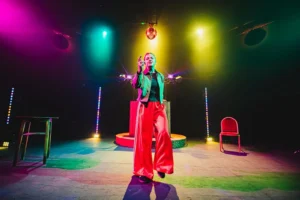
My Mix(ed up) Tape follows Phoebe, a woman who has returned to her hometown of Pontypridd for a wedding. Inside a chaotic Working Men’s Club, complete with beige buffet and simmering grudges, she tries to make it through the evening without any drama, but consistently gets in her own way.
Writer and performer Katie Payne possesses a kind of magnetism that’s probably unteachable. As Phoebe, there’s an undeniable spark to her performance, a combination of her sense of humour, physicality and emotional precision which makes her story irresistibly compelling.
The moment she steps on stage, she holds the audience in her grasp, introducing us to a protagonist who behaves, at times, pretty reprehensibly, and yet somehow becomes more likeable with every poor decision she makes. From an aloof, fag-wielding aunt to an insincere former best friend, Payne also conjures varied and vivid characters, all with a simple whip of a ponytail or an incessant cradling of a baby bump.
The set is minimal, essentially a bare stage, with only a raised platform of DJ decks at its centre. Occupied by DJ ONAI, the music initially provides a backdrop of wedding dancefloor staples, but gradually this gives way to something far more intimate.
We often talk about inner monologues, but far less about inner soundtracks, and I’d bet most of us have one. That internal rhythm that energises or soothes. Melodies which define our memories and moods. It’s an idea which Payne, ONAI and the creative team tap into so effectively in this show.
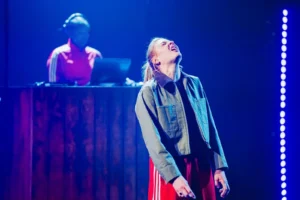
The DJ becomes a kind of externalised conscience, rewinding moments when Phoebe distorts the truth or scratching records as a raised eyebrow after she makes an off-key remark.
It’s most powerful when the music offers her comfort or escape. In one standout moment, Payne and ONAI dance together in a way that is both playful and tender. It feels as though Phoebe could be dancing with her own reflection, granting herself a brief moment of much-needed self-love.
Directed by Stef O’Driscoll, the blocking and choreography feels meticulous, as do the distinctions that are drawn between Payne’s characters. The pace of Payne’s performance has clearly been refined and polished with O’Driscoll’s input, ensuring the audience is never lost, even as characters and settings shift at pace.
Payne’s script is packed with sharp, observational Valleys humour and functions, as intended, as a love letter to Pontypridd. She writes these characters with affection, allowing their eccentricities to shine without ever reducing them to caricature.
What’s most striking is the script’s refusal to soften Phoebe. By her own eventual admission, she behaves appallingly, and whilst the play offers context for her anger, it never quite provides enough to excuse it. Her frustrations – fertility struggles, limited opportunities shaped by class and a sense of having hit the ceiling of her own ambition, are understandable, but not nearly sufficient to justify her acts of violence.
It’s a brave choice to present that kind of narcissism so plainly, and even braver to leave it largely unredeemed. And yet, Phoebe remains compellingly likeable, a reminder of how amiable but morally inconsistent people can be. It’s a refusal by Payne to adhere to the neat narrative rules that so often insist on a protagonist’s redemption.
Because Payne doesn’t ask us to forgive Phoebe, she simply asks us to see her. Maybe that’s why Phoebe must occupy all that stage space alone without any accessories or distractions, so that she can confront us with an uncomfortable truth that is impossible to ignore, a mirror revealing a reflection many in the audience won’t want to admit they recognise.
It’s a courageous story, both funny and furious, and by its end, more than proves itself worthy of holding its space.
My Mix(ed up) Tape is currently on tour. For more information, please visit:
https://www.mymixeduptape.com/