

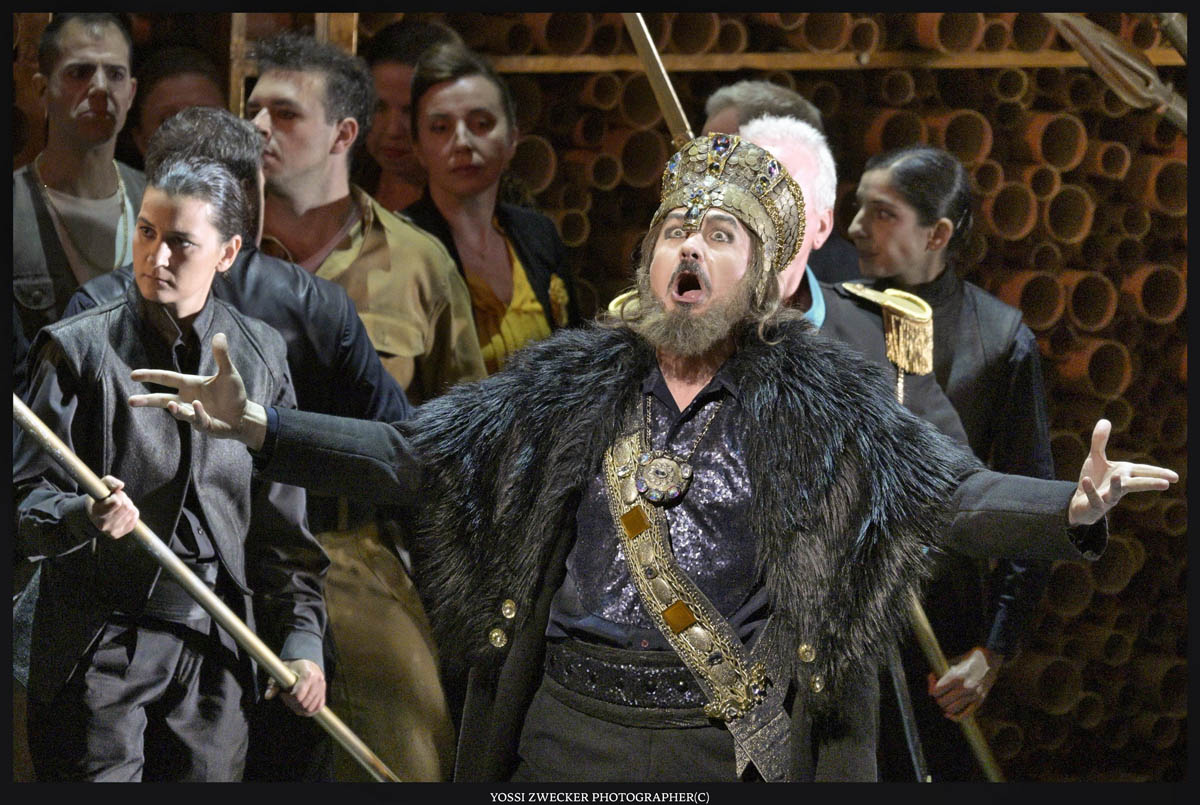

Nabucco, Giuseppe Verdi’s 1842 “Zionist opera,” was his first major success. At the time, it was embraced by Italian audiences, who identified with the plight of the Israelites exiled from their homeland, seeing in it a reflection of their own longing for a unified Italy. Unlike most operas that have endured in the repertory, Nabucco contains no truly famous arias. Instead, its most memorable music belongs to the chorus.
The best-known number is, of course, the “Chorus of the Hebrew Slaves” (“Va, pensiero, sull’ali dorate” / “Fly, thought, on golden wings”). But the opera contains several other powerful choral moments, including the final a cappella passage, in which everyone on stage – Jews and Babylonians alike – joins in praise of Jehovah.
The opera also offers three compelling solo roles, but its dramatic structure is uneven. The young star-crossed lovers from opposing nations, who seem central to the plot in the first act, are gradually pushed aside as more ruthless antagonists take over. Nabucco himself is a vengeful Babylonian king who declares himself a god before descending into madness and learning humility. Abigaille, his ambitious and jealous elder daughter, discovers that she is not in fact his child but the daughter of slaves – a plot point that is left unexplained. And Zaccaria, the zealous high priest of the Jews, is a fundamentalist figure whose fanaticism leads him to attempt the murder of the king’s other daughter, Fenena.
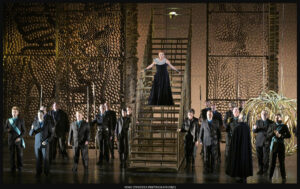
André Heller-Lopes’s production shifts the action from biblical antiquity to an unspecified period, creating a deliberately ambiguous setting. The costumes are similarly hybrid, combining contemporary dress with stylized elements. In the first act, set in Jerusalem before its conquest by the Babylonian army, some of the men as well as women wear the Tallit – a choice likely to provoke objections from Orthodox Jews. One character even wears a rainbow-colored tallit, an overtly modern intervention.
The set design by Renato Theobaldo reinforces this layered symbolism. The backdrop is made of coulisses resembling towering bookshelves filled with papyrus scrolls, evoking the ancient Hebrew scriptures. Later, as these structures are shifted across the stage, they reveal from certain angles reliefs of Assyrian gods and horses, suggesting the latent presence – and eventual dominance – of Babylonian power embedded within the world of Jerusalem itself.
When the action shifts to Babylon, a golden lion enclosed in a spherical cage descends from the ceiling, a potent symbol of the Babylonians’ pagan world. The image is both arresting and theatrically effective, encapsulating the production’s visual language of stylized allegory. The atmosphere is further enhanced by the striking lighting design of Nadav Barnea, whose work gives the production much of its shifting mood and dramatic intensity. Yet when Nabucco renounces his pagan beliefs and turns to the God of the Jews, the lion simply drops to the ground in silence – a moment that should register as climactic, but instead feels oddly weightless, dissipating much of the scene’s symbolic force.
As is customary at the Israeli Opera, Nabucco is performed with two alternating casts. On the evening I attended, the standout performer was Latvian soprano Julija Vasiljeva as Abigaille. Fierce and vengeful in her characterization, she matched her dramatic intensity with a voice of striking beauty – powerful, incisive, and thrillingly sharp at the top.
Armenian-German bass Vazgen Gazaryan also made a strong impression as Zaccaria, his deep and resonant voice giving the role considerable authority and weight. In the title role, baritone Ionut Pascu, a regular presence at the Israeli Opera, was less consistent. Though he had moments of strength, his voice at times sounded hollow and metallic, lacking the fullness the role demands.
In the secondary roles, Belarusian tenor Pavel Petrov brought a warm and appealing voice to Ismaele, the nephew of the King of Jerusalem. Israeli mezzo-soprano Rachel Frenkel was solid as his love interest, Fenena, lending the role dignity and warmth. Unfortunately, the staging saddled her with a brief and rather absurd duel with Abigaille, who covets both her status and her power – a directorial choice that felt more unintentionally comic than dramatically convincing.
As noted above, in Nabucco the most important role belongs to the chorus, and happily the 70-member ensemble rose to the challenge magnificently. They also received some of the production’s most effective stage imagery. During “Va, pensiero,” they sang from behind bars lowered onto the stage, an arresting visual that underscored the lament of exile at the heart of the opera.
The orchestra, too, performed solidly under the direction of Carlo Montanaro. Yet Verdi’s orchestral writing here – particularly in the symphonic passages and the overture – offers less excitement than one might expect from his later works, and even a committed performance cannot entirely overcome that limitation.
All in all, despite its weaker moments and occasional lapses in judgment, this is a beautifully mounted and musically accomplished production, well worth seeing.
The Israeli Opera Tel-Aviv-Yafo האופרה הישראלית תל-אביב-יפו
Music by Giuseppe Verdi
Director: André Heller-Lopes
Conductor: Carlo Montanaro
Sung in Italian with Hebrew and English surtitles
Cast includes Ionat Pascu, Julija Vasiljeva, Vazgen Gazaryan, Pavel Petrov, Rachel Frenkel,
The Israeli Opera Tel-Aviv-Yafo האופרה הישראלית תל-אביב-יפו
Running time: 2 hour and 45 minutes