

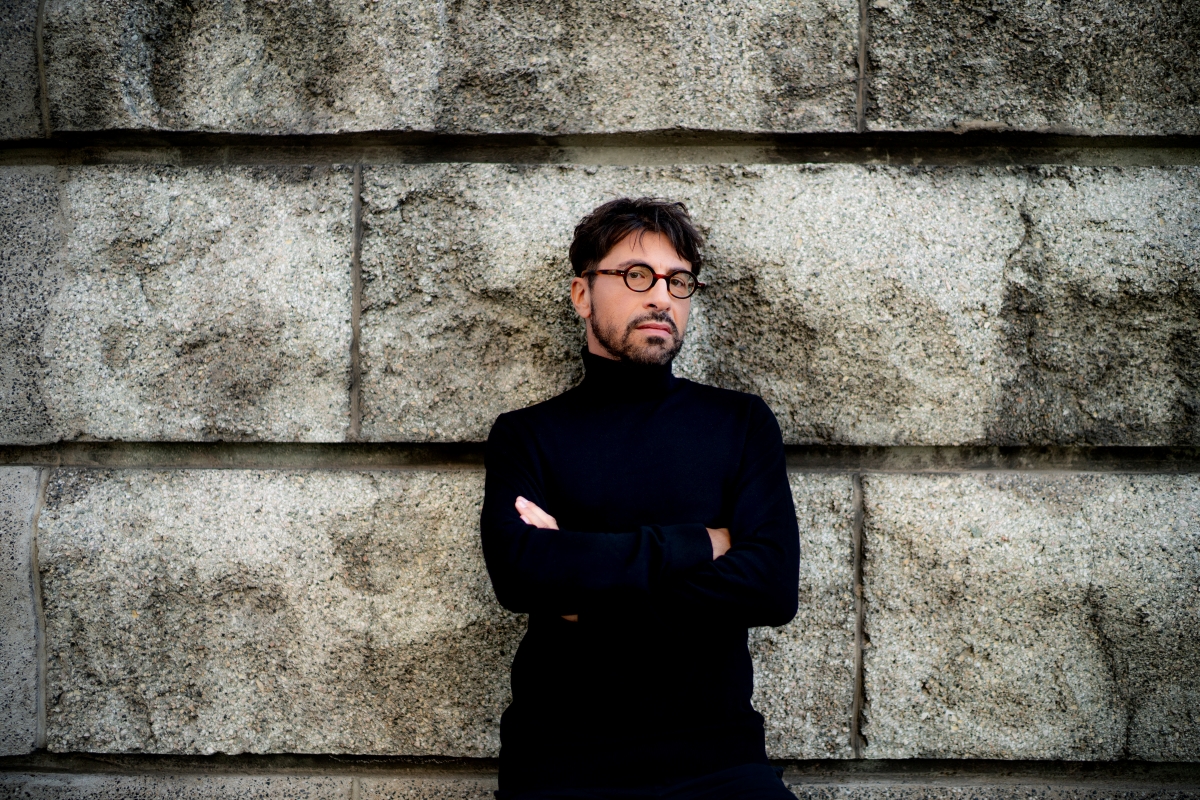
There is a familiar complaint about contemporary opera: that somewhere after the war it stopped speaking to its audience, and that the people who fill a theatre on a July evening remain more at ease with operas written two centuries ago than with anything composed in their own lifetime. Francesco Filidei does not dispute the diagnosis. What is striking is his explanation of it. The operas of the avant-garde, he argues, did not survive, and they did not survive because they gave up the one thing opera cannot do without, which is a story. He also gives an enlightening insight into his creative process.
Born in Pisa in 1973 and an organist long before he was a composer, Filidei has lived in Paris for twenty-six years and is now, on the strength of Giordano Bruno, L’Inondation and last year’s Il nome della rosa at La Scala, among the most widely performed composers of his generation. Accabadora, his fourth opera, received its world premiere at the Théâtre du Jeu de Paume this July: a chamber work drawn from Michela Murgia’s novel about the woman who, in the villages of 1950s Sardinia, was called upon to bring an end to the lives of the dying. It is also, as he explains here, the most personal thing he has written. We met in Aix a few days after the premiere.
AZ: Many of our readers will be coming to your work for the first time. Could you tell us something about your background, where the music came from, and when you understood that composing was your vocation?
FF: Nothing out of the ordinary. I don’t come from a family of musicians. There was an uncle on the Sardinian side who played at weddings, and an uncle of an uncle, a priest in Sardinia, who played the organ in church — that is the only link. On that same side of the family there was always an attention to art, to drawing and painting. I think that was the push, and I was put to study the piano. I grew up in Pisa, with my grandmother. My piano teacher also directed the church choir, so I began accompanying the choir, and from there I moved to the organ. I met the organist of Pisa cathedral, who asked me: why don’t you study the organ too? I began with him, then at the Conservatory in Florence, and there I went from the organ to composition, because Salvatore Sciarrino was teaching and he interested me a great deal. Then organ in Zurich, and composition at the Paris Conservatoire and at IRCAM. And from Paris, everything else.
AZ: And you stayed in France.
FF: Twenty-six years. Lately I’ve bought a place in Milan as well, so I divide myself. And when I can, I go to Sardinia.
AZ: The festival programme booklet places you in a line of Italian composer-organists: Verdi, Puccini. How do you see that? As continuity, evolution, inheritance?
FF: The first opera I saw, I must have been fifteen, was a Madama Butterfly in Pisa. At the time I was very caustic about the libretto. Obviously: raised on Luigi Nono and Luciano Berio, it seemed to me something for the bourgeoisie. Later, I fell for it completely. I think precisely because of my initial rejection, because of the irony I had made: I felt deceived by myself. At the beginning I hadn’t understood, but once I understood the power behind it, it took me entirely. What mattered was that I had heard something truly alive and true inside that score, in that moment. I perceived it. And in fact, we now know it was something Puccini had lived himself: a relationship with a girl who was a minor.
AZ: And Sciarrino? Stylistically, is that where the influence lies?
FF: Sciarrino was important above all for the sense of form, of construction in time. And for the ambiguity between music and life. Mostly that.
AZ: So where do you place yourself in relation to Sciarrino and Berio, the other obvious point of reference?
FF: For many years I kept my work as an organist separate from my work as a composer. With the organ I improvised everything, as best I could, in all sorts of styles. In composition I was trying to work with very few elements, to build with the bare minimum, and to eliminate the problem of pitch, which I probably didn’t yet know how to handle, trying instead to make noises sing. Little by little I managed to reintegrate everything I had been doing improvisationally at the organ. I’d say that comes closer to Berio, whereas before it was closer to Sciarrino, if we want to take those two as points of reference. And now I think I have built a language that passes from one thing to another without making too many problems about it, but with a certain coherence of writing, I hope.
AZ: You and Valentina Carrasco have both spoken about a return to narrative. Is that a renewal, or a retreat from something the avant-garde was right to attempt?
FF: It isn’t even that, because I don’t believe any avant-garde operas have survived. The ones that survived had to do with narrative, willingly or not. Take Ligeti’s Le Grand Macabre, or George Benjamin’s Written on Skin, or Sciarrino’s Luci mie traditrici: these great masterpieces all have a directionality. They all have a story, first of all. They didn’t renounce that. Berio’s operas, on the other hand, have not survived. It isn’t by chance. Berio is a very great composer, but opera is not, in my view, the most suitable instrument for what he wanted to do.
AZ: You have described opera as a space of catharsis, where trauma is replayed and may be resolved. In Accabadora, whose trauma is it: yours, Sardinia’s, the audience’s?
FF: You spend your whole life trying to resolve the vision of the world you form in your first years of life, and to confront it. Music is an excellent instrument for digging, for trying to recover your things. For me the seventies were a mystery, because I didn’t understand, and, above all, there were the killings, Aldo Moro, the Red Brigades, the Monster of Florence, all of that. Moreover, there is the mystery of where you come from. Who you are. The roots. I grew up with this Sardinian grandmother who had strong roots, and appeared as a dark, woody block, always dressed in black from the death of my grandfather. I remember this scene: my grandfather dead, and my grandmother beating on the coffin. The relationship of the wood with the hand, and the relationship with death. I had absolutely no idea how to relate to it. Well, I don’t know even now, but at the time it was worse. I think that image has haunted me all my life. As has the time I spent at my grandmother’s house: I’ve realised, for example, that the cuckoo clock there meant a great deal to me. It’s what generates all the singing in L’Inondation, and it is in Accabadora too. So, all of this was a way of trying to understand my own roots.
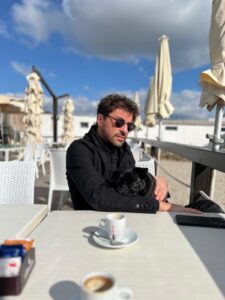
AZ: And the project with Michela Murgia began there.
FF: It began because I read the book and I said to myself: but this is my grandmother. I hope, for my sake, that she never killed anyone but flies. But it is her. So I contacted Michela. It took a long time before I managed to speak to her, and then I understood why it had struck me: we came from the same little village. Our grandfathers worked at the Montevecchio mines, where my mother was born. Mine baked the bread for the miners; hers was a miner. The two grandmothers are the same figure. And Michela too had absorbed her grandmother, the one who raised her.
AZ: The flour and the bread become almost structural in the staging.
FF: It’s in the book, of course, but it is always present. Half my family makes bread. And my grandmother wove; she had the loom as well. Those are the activities, in Sardinia: weaving, kneading, and then the sheep and the goats. Furthermore, Sardinia never really had an opera of its own. There is nothing. Whereas Sicily has an avalanche of them, works that have lasted, from Les Vêpres siciliennes to Cavalleria rusticana.
AZ: You were to have written the libretto with Murgia and finished it alone. Were there disagreements?
FF: We didn’t work together much, because there wasn’t time. But I set out my project to her. At the beginning we were supposed to write the libretto together, this was many years ago, and then the project collapsed. Later I went to see her, I explained what I wanted to do, and she agreed completely. At first, she proposed a Sardinian writer she particularly admired, but it didn’t work out. The problem is that Italian writers today have no idea what opera is, and still less what writing a libretto means. You must also find a writer willing to be at the service of the composer, and that is harder still.
AZ: One thinks of Boito and Verdi. Illica and Giacosa with Puccini. Da Ponte and Mozart.
FF: But today, no. Even Berio and Italo Calvino never really understood each other. And he had Umberto Eco too, he had all the great writers, who certainly knew more about music than today’s, who are disastrous. There is nothing to be done: I am forced to do it alone, or with people I know well and with whom I can fight and argue freely. It is the only system. For L’Inondation there was Joël Pommerat, who is a genius, although I don’t think he will write another opera, he was traumatised. But he is truly a dramaturg, and at the service of the thing: he really wrote for the music, for the project, not for himself.
AZ: How did you recreate Sardinia in music?
FF: Unlike Il nome della rosa, which is in practice a collage of direct quotations, from Gregorian chant to Karlheinz Stockhausen, there are no real quotations in Accabadora. It is all recreated, evoking the environment. On one side there is the traditional Sardinian canto a tenore, which informs the audience, not directly, but rather like a Greek chorus. And on the other there is everything that is the sound of wild Sardinia, as I live it when I go there in winter to work: the wind, the waves, the goats, the sound of the bells. And the accordion, which dresses the orchestration of many scenes, written bitonally, with chords a semitone apart.
AZ: Each character has their own way of singing. When they are together, for example Maria’s diatonic lines against Bonaria’s chromaticism, how do those worlds resolve?
FF: That is the most enjoyable part. The beauty of these novels — Accabadora, but Il nome della rosa and L’Inondation too — is that they have a world that existed well before a word of them was written. This world can be read through other keys, and one of those keys is music. In Il nome della rosa the question of the labyrinth emerges far better in music than in the prose, because with counterpoint you can synthesise it in a single page. The detective element, on the other hand, doesn’t come out well. Eco spent two years making only drawings and maps before he began to write. And then he said the writing went by itself: the characters moved through that world along obligatory paths. The most beautiful thing about working like this is seeing the characters speak by themselves, in their own language, without your consenting to it. You discover that Maria always sings like Maria, the Accabadora always like the Accabadora. It comes out of the writing, after a long period in which one’s brain has built the world, even without its awareness. Another important aspect is trying to work with singers for a week, once part of the libretto is ready: it is like a painter having a model in front of him. It changes the perspective. It gives the score a different life. Joël Pommerat taught me this, he works that way with actors.
AZ: Is that a historical approach — Mozart writing arias for particular singers, or Rossini?
FF: No, it is different. They wrote for. They didn’t write with. During the writing of L’Inondation we met one week a month with the singers. I discovered the scene as it was written, together with them. We sat around a table, each read his part, sometimes I had fragments repeated, and built from there. Pommerat would change a word here and there. Then straight after that kind of reading I would go to the piano and quickly write the melodies for each part, only that. In the afternoon I improvised the accompaniment, they sang what I had written, and Pommerat gave the cues according to the movements on stage: if someone had to cross from one side to the other, he gave me the timing of it. It was perfect for building something really organic, a scale model I could then work on at home. When I had several singers who I knew would have to sing together, they improvised according to rules I gave them. Through that improvisation I got an idea of how it might sound, and then I took the concept and worked it out.
AZ: In Accabadora the scene of Andría’s declaration of love to Maria during his brother’s funeral is where several singers have to converge, and seems to be the point where the opera becomes fully itself.
FF: It is the most complex. I felt there had to be this funeral, in order to have that contrast between the voices. But it wasn’t simple, because the voices mustn’t overlap, otherwise one can’t hear what is happening, and yet at the same time they had to sound together. So, at a certain point I used the basses, to open a space above them where Maria and Andría could sing. Then I brought the female voices back in and combined them together with the bells and the basso continuo.
AZ: What comes next?
FF: I have three more operas. But I can’t talk about them yet. One is about Boccaccio.
AZ: Thank you, Francesco, for sharing your thoughts with Plays to See — and for an opera that gives Sardinia, at last, a work of its own.
Accabadora received its world premiere at the Festival d’Aix-en-Provence, Théâtre du Jeu de Paume, on 4 July 2026.
IMAGE CREDITS:
- Casa Ricordi, Harald-Hoffmann, 2023
- Francesco Filidei‘s private collection