

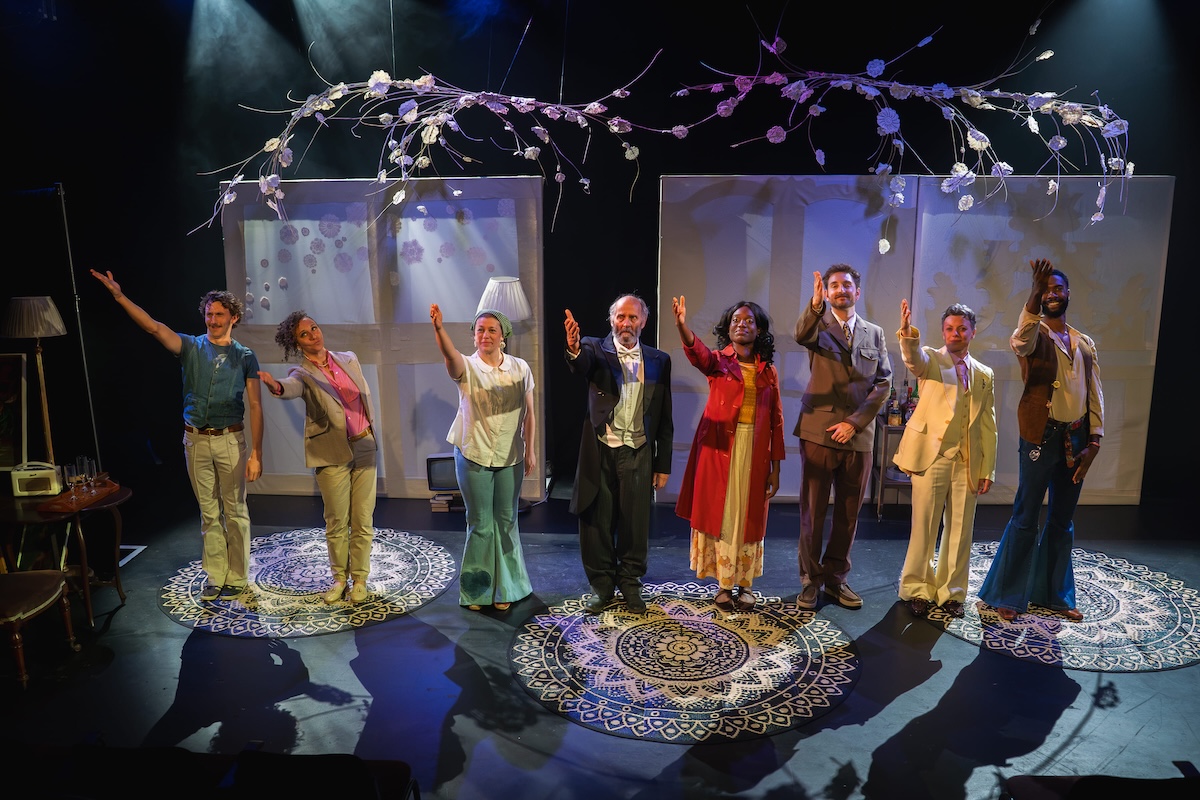

There is something familiar about the set of The Cherry Orchard at Riverside Studios. It resembles a grandmother’s living room, with the orchard fashioned from doilies: objects I associate with Eastern European homes, carefully kept and rarely disturbed. It is an effective expression of nostalgia, suggesting a household whose attachment to the past extends to its smallest possessions.
This was my first encounter with The Cherry Orchard on stage, although I had read the play beforehand. I suspect I might have enjoyed the production more had I not done so. There are good performances and welcome moments of comedy. Yet I missed the complexity I had found in Chekhov’s treatment of memory, responsibility and social change. The reinterpretation offered less insight into these themes than I had hoped.
The story remains intact. Faced with mounting debts, Ranevskaya and her family must sell their estate unless they accept Lopakhin’s proposal to clear the orchard and lease the land for summer cottages. They cannot bring themselves to act. Lopakhin buys the estate where her ancestors were serfs, turning the owners’ financial failure into a painful reversal of social position.
The compression of four acts makes the production feel cramped. The events remain clear, but the relationships have less time to develop. Charlotta, the governess, and Yasha, the young servant, are absent, while Dunyasha is reduced to little beyond the prospect of marriage. These cuts narrow our view of the household. In the play, the servants have their own aspirations, attachments and uncertainties; their experiences reveal how social change reaches beyond the people who own the estate. Lopakhin’s purchase remains central, but the diminished presence of the servants leaves the family’s reluctance to relinquish its privileged life more fully explored than the lives surrounding it.
The production’s reworking of gender felt arbitrary to me. Rachel-Leah Hosker’s Lopakhin is presented as a woman, while Conor Dumbrell plays Dunyasha as a gay man. These changes introduce different relationship dynamics, but the production does little to explore them. I struggled to see what they added to our understanding of the characters or the play’s treatment of class and desire.
The interpretation of Maggie Bain’s Ranevskaya felt incomplete. Her nostalgia and extravagance registered, but I missed the tension between affection and irresponsibility. Her troubled marriage and continued attachment to the lover who mistreated her felt like background information, with too little sense of how those experiences shaped her behaviour. I wanted to understand what kept drawing her back, both to him and to the estate. Without that complexity, her loss carried less emotional weight.
Jessica Temple gives Varya a strong, credible presence, while Elliot Pritchard’s Gaev provides welcome comic relief. Jaemon Anthony Crosby delivers Trofimov’s speeches with conviction, although his connection with Cash Holland’s Anya is less believable. Anya feels lightly drawn. Her movement from distress at the threatened sale to acceptance of life beyond the orchard feels abrupt; the hope she finds in letting go needs more space to become convincing.
Paul Bentall’s Firs is particularly affecting. He creates a believable figure whose attachment to the old order complicates any straightforward account of progress. For Firs, even emancipation represents a loss. His abandonment in the house exposes the neglect beneath the family’s affection for its familiar world: they can mourn the orchard while forgetting the person who has spent his life serving them.
The production creates a convincing atmosphere of nostalgia and offers much to appreciate in its performances. My reservations concern the limited development of the relationships and themes that make Chekhov’s play compelling. The orchard’s loss is clear, but the conflicting experiences of the people whose lives are bound to it emerge less fully. Enjoyable in parts, the production left me wanting more of that complexity.
Drama / Tragicomedy
By Anton Chekhov
Directed by Benedict Esdale
Cast includes: Maggie Bain, Paul Bentall, Jaemon Anthony Crosby, Conor Dumbrell, Cash Holland, Rachel-Leah Hosker, Elliot Pritchard, Jessica Temple
Designer: Rebecca Ward
Until: 12 September 2026
Running time: approximately 70 minutes, no interval
Photo credit: Miranda Mazzarella