

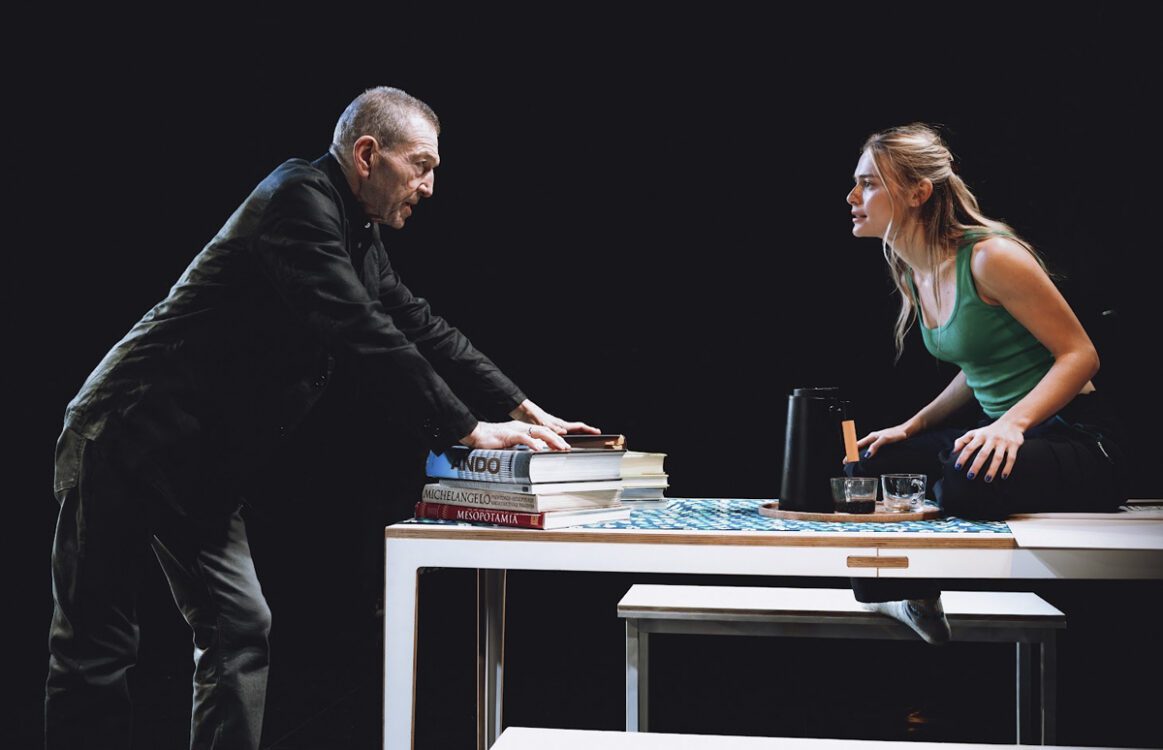

An ageing dramatist reinventing himself as a fictional Master Builder lies at the root of this autobiographical play; written by Ibsen on his return to Norway after 27 nomadic years of exile.
When the play opens, we join the Master Builder in the autumn of his life. So it is fitting that the action too should start during autumn, on 19 September to be precise. Ten years earlier to the day the Master Builder, Halvard Solness, had wrapped a ceremonial wreath around a high church spire, to the rapturous acclaim of local people.
These included little girls dressed in white. One of them was the then thirteen-year-old Hilde Wangel. She it is who now turns up at Solness’s house, to claim her ‘kingdom’, her ‘castle in the air’: the one that Solness promised to build for her when, after the celebratory completion dinner at the time, he allegedly held her and kissed her repeatedly, while bending her over backwards.
Or so she claims. The play is almost a two-hander, to the extent that the Master Builder and the young woman occupy centre-stage in a prolonged sparring match, which revolves around his fear of ageing and her fantastical desires. Did Solness really kiss and make sexual advances to a little girl ten years earlier? Is that why the old man is now so vulnerable and susceptible to her stories? For they may be stories: none of this may have happened, as Solness claims to have no recollection of any of it. The alleged encounter may all be a fantasy of Hilde’s, the same young woman who thinks that it must have been exciting for women ‘to be taken’ by Viking marauders. ‘Taken’ here means being carried off as booty, but the other sense of ‘taken’ resonates just beneath the surface. At this point Solness and Hilde are discussing Norse sagas: Solness stares her for a moment – did she really, he is wondering, say that? and if so, is she the right person for him to confide in so freely?
At the end of A Doll’s House Nora walks out on her husband and her children, banging the door as she leaves. Here, in a play written twenty-three years later, a loud knocking at the door of Solness’s house announces a visitor. The family’s doctor friend, played with nuanced understatement by Peter Guinness, and Solness have just been discussing the Master Builder’s fear of age, of letting go, of a talented young successor taking over the business. Just as he had done years before, supplanting the now dying father of the young man who works for him and whose fiancée Kaja the Master Builder is employing as both bookkeeper and not so Platonic mistress.
Hilde Wangel, beautiful, instantly desirable, enters with a bang. Unlike Nora, who believes in ‘duty’, a concept scornfully dismissed by Hilde, Hilde runs with her dreams. It is as if a female Peer Gynt had suddenly materialised on the stage. Hilde is played superbly by Louisa Binder: a seductive fantasist, irresistibly young, bursting with life and health, but also possibly a bird of prey, as she is called, who will bring down (literally as it happens) the Master Builder. For a successful, ‘lucky’ man in the grip of what might now be called as mid-life crisis, Hilde can only ever be a toxic companion; and we never figure out whether she is there for vengeance, to punish Solness for kissing (dare one say ‘abuse’?) her as a child; or because she too cannot let go; anymore so than Solness.
Greg Hicks puts in a terrific performance as the Master Builder, a man on the verge of a nervous breakdown; a man haunted by the memory of dead children: there will be no continuity for him and his tragic wife Aline, hence his desperate desire to be himself his own future.
Ibsen was 64 when he wrote this play with echoes of his own infatuation with the 27-year-old Emilie Bardach three years earlier. Our first sight of Greg Hicks’s Master Builder is of a nervy, intense older man, in trendy grunge, in stark contrast to his former partner, a formally dressed, buttoned-up Ibsen look-alike. A ponytail, a Hawaiian shirt, and an ear-ring might have completed the picture? But then this production is too sensitively calibrated for that: like Ibsen’s play, this is a deeply subtle interpretation. It prefers to hint, running with the flow of a nuanced text where almost everything carries a symbolic charge. Greg Hicks appears to have plummeted the depths of Ibsen’s confused, angry, vulnerable Master Builder, who takes on God, the ‘Almighty One’; because He cannot be trusted since, on His watch, terrible things just happen: to innocent children, to women like Aline whose only offence was to nurse her babies when she was herself sick.
The play’s apocalyptic imagery and setting turn the Master Builder into a Faustian anti-hero. Hicks is right there at the heart of this Hamlet-like searcher for meaning. It is not too far-fetched then to see the glamorous Hilde Wangel as a Mephistophelean figure come to strike a bargain with him. The chemistry between Hicks and Binder is electrifying: you forget that they are actors speaking lines; instead they are Solness and Hilde. The way their movements are choreographed on a bare, intimate stage is a tribute to the director’s insights into Ibsen’s script. The Master Builder’s wife Aline (Sally George), his student Ragnar (Ryan Wichert), his fiancée Kaja (Jade Williams), Ragnar’s father Knut (Robin Hooper) all deliver accomplished performances. If timing is everything in live theatre, this production has to be admired for its wonderfully integrated playing. Catch it if you can.
The Master Builder by Henrik Ibsen
translated and adapted by David Edgar
Director: Mehmet Ergen
Cast includes: Greg Hicks, Louisa Binder, Peter Guinness, Sally George, Ryan Wichert, Jade Williams, Robin Hooper
Until: 21 November 2026
Running time: 2 hrs 30 mins inc. interval.
Photo credit: Alex Brenner