

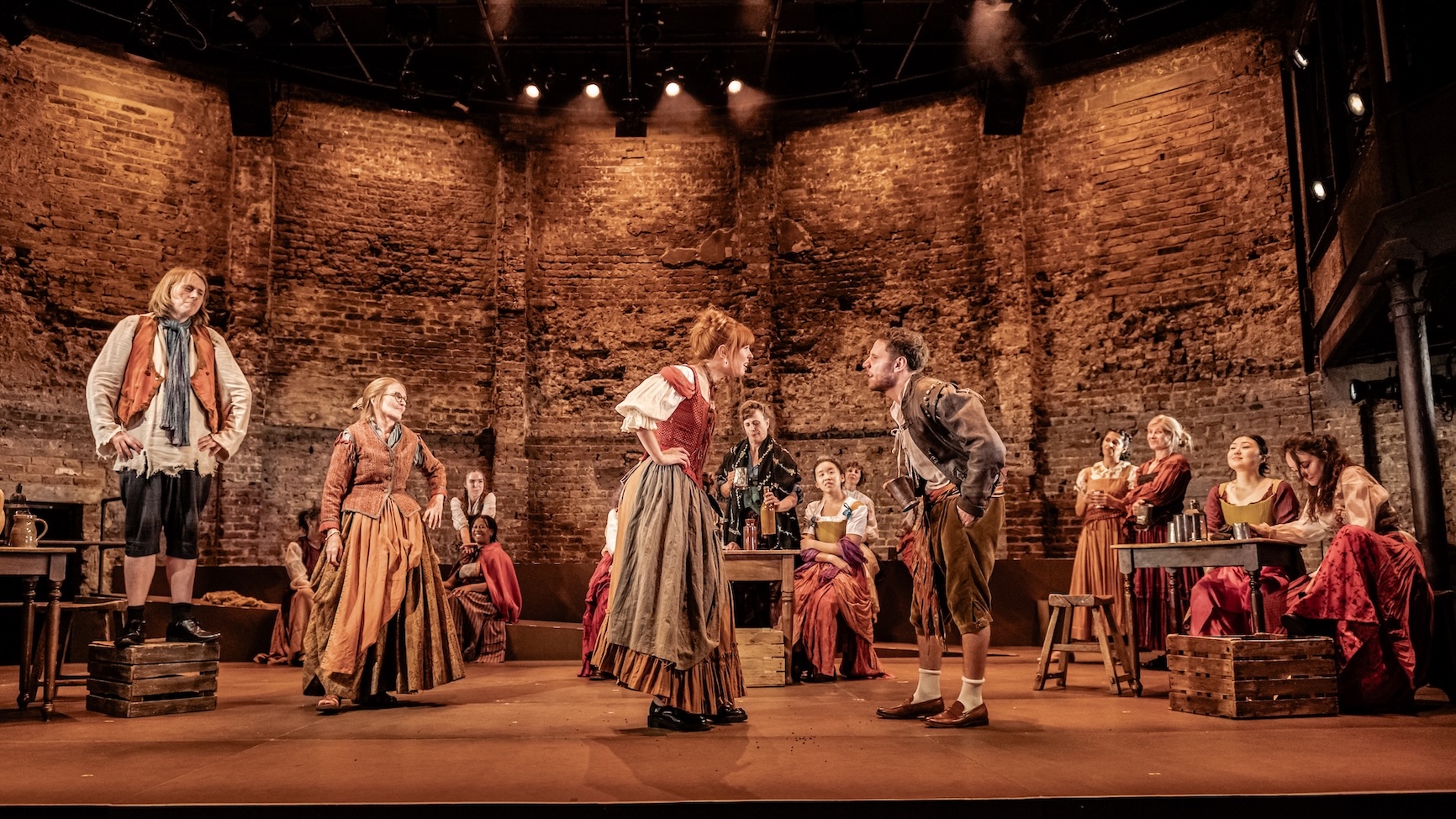


Before the Almeida was a theatre, it was a monastery, a pub, a scientific society hub. Could it one day become a drug-induced centre of efficiency, an underwater restaurant, a moon colony? The indomitable Stephanie Bain is obsessed with time, this instalment being the latest in a trilogy of plays dedicated to the unstoppable cycle: 24 (Day) and 81 (Life). The theatre is such a quintessential part of Islington, and this is the dramatised history of its people in the past, present, and future. Characters arrive and disappear across centuries, each leaving some faint residue for those who follow.
The opening hour has a generosity that one finds genuinely affecting. Audiences are moved through a sequence of tableaux that rarely settle for long, and while the constant movement is initially disorienting, there is a pleasure in slowly recognising the geography of the Almeida itself. The space becomes a palimpsest. Medieval monks pass through rooms that will one day host drinkers, Londoners sheltering from the Blitz occupy ground where actors will eventually stand, and a New Year’s Eve gathering on the cusp of 2000.
Under Dani Parr’s creative direction, the production must accommodate a cast of eighty performers. As such, individual characters rarely have the chance to settle into full dramatic lives. Most register as brief impressions (a bawdy joke, a moment of fear, an act of kindness) before they vanish again. The viewing experience is that of a pageant, or a local commemorative performance where the pleasure comes from seeing a whole community gather to honour itself. This warmth is felt, although it comes at the significant expense of dramatic investment.
The production finds its emotional centre in a pair of monks in the year 1537 who quietly discover feelings for one another while one experiences a vision. Their scenes possess a stillness that much of the play otherwise avoids. Earlier generations haunt later ones without becoming ghosts in any literal sense: the monks are put in the background against a group of schoolgirls in the foreground in the year 2400, seeking to guide them through the veneer of time and space as the two converge in the sighting of the same vision.
This same freedom with chronology becomes much less persuasive after the interval. The play begins making ever larger leaps, landing in imagined futures set in the years 2100 and beyond. Each future exists largely as an opportunity to rehearse contemporary anxieties: youth disillusionment, climate collapse, economic precarity, the ethics of leaving Earth, the prospect of colonising Mars. The difficulty is that each receives only a brief hearing before another arrives; it’s difficult to see a good portion of the script as little more than a mishmash of buzzwords to keep the modern viewer listening. Does the millennium ahead of us exist for us to comment upon newspaper headlines from today?
The transformation of Islington itself, and of the Almeida as both physical structure and civic institution, feels much richer than speculative futures that inevitably flatten into allegory. The jumps from the wartime shelter to 1999 already cover enormous social change. Remaining within that historical terrain would have allowed the production to trace subtler shifts in class, architecture, memory and community, all qualities embedded in the building itself. Instead, whole generations disappear between scenes, and the sense of accumulated inheritance becomes uninterestingly abstract. Nearly 3 hours are given to this endeavour (and it feels a good deal longer than that).
Visually, though, the production remains consistently handsome. Directors and designers make elegant use of the Almeida’s architecture, allowing entrances to emerge from unexpected corners and filling the stage with constantly shifting configurations of bodies. One finds much to admire in the scale of the undertaking more than the finished drama. There is obvious affection for Islington, for the Almeida, and for the generations who have passed through this patch of London. The first half understands that local history acquires its force through particular lives. The second becomes increasingly tempted by grand statements about humanity itself, and in widening its scope it loses some of the intimacy that had quietly sustained it.
The production asks whether a building can remember. The answer the Almeida gives is a resounding yes. Whether every memory belongs in the same play is a rather more complicated question.
Written by Stephanie Bain
Creative direction by Dani Parr
Running time: 2 hrs 55 mins including 15-minute interval