

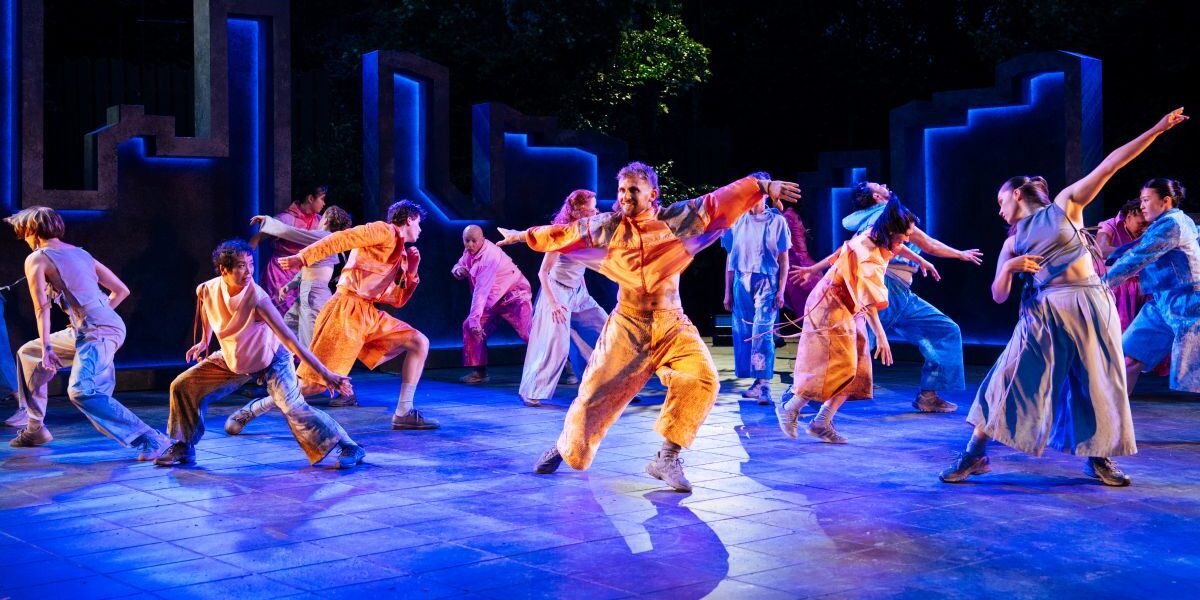

One of the marvels of dance, of whatever kind, is its aesthetic suppleness. It can tell stories, or embody symbolism or just depict the beauty of movement in abstraction. But it is unusual to get all three in combination, and that was the great achievement of A Life in Four Seasons, currently running for an all-too-brief residency in Regent’s Park. It is a rare inspiration.
Taking Vivaldi’s famous instrumental concerto sequence as its foundation, the creative team have created a meditation on the four ages of man and the transitions between them, a symbolic representation of how head, heart and gut make up human identity, and a presentation of the abstract beauty of the body in motion, as presented inclusively by dancers or all ages from young to old.
We all think we know this work by Vivaldi, whether as telephone jingle or as an over-performed piece on the concert platform; but composer DJ Walde has cleverly taken the original and added electronic lines or extra contrpuntal beats which make it seem unfamiliar, even confronting, Moreover there are transitional sequences which help to shift the emotional gears just as the ‘season’ or age of the dancers moves forwards from Spring, through Summer to a second half of Autumn and Winter. The fierce energy and sprightliness of the original is there but made more complex as the accumulation of age and knowledge proceeds through the dance. We begin with a school bell and sparky diffuse energy, then expand into summer’s lease, before experiencing the gradual contraction of middle age and autumn chills, before finding the restrictions but also final wisdom of winter.
Each of the four movements is danced by three leads, embodying head, heart and gut, dressed in blue, pink and orange respectively. And just as Dr Who regenerates, so they morph into older versions of themselves as the life-cycle progresses. Woven around them is a corps de ballet dressed in more muted tones, some of whom then assume the lead roles in due course. What impresses particularly is the graduated nature of the choreography, full of showy exuberance on all sides in the first half devoted to youth and maturity, and more modest, intentional movement in the second, as physical limitations, or at least their intimations, begin to intrude.
There is little scope here for detailed commentary on individual performers, but I was struck by the contrast between the wild, explosive interventions by Michael Naylor as ‘Summer Gut’, and the graceful, calm, elegant poise of Susan Kempster as ‘Winter Head.’ As you observed the whole company what stood out as remarkable was the individuation of character achieved with great economy of gesture, and, at the same time, the integration of these differences within the overall mood of each ‘season.’
A set of basic polygonal screens is sufficient for the set, and discreet lighting and mist effects enhance the daylight setting. No more is needed, as the choreography and direction rightly trust the dancers to deliver.
This is a short programme, its length dictated by the original music, but it is one that contains worlds. You immediately want to sit down and see it again to catch what you may have missed first time around. It evokes comparisons with Poussin’s Dance to the Music of Time, just down the road in the Wallace Collection, or Matisse’s Dance I, both works of art that embody dynamism while freezing and distilling its thrill in the living moment.
Catch it while you can.
Regent’s Park Open Air Theatre
Director: Tinuke Craig
Choreographer: Alexzandra Sarmiento
Dancers: Tanesha Aba, Kazmin Borrer, Robia Brown, Emi Ichikawa, Carrie-Anne Ingrouille, Jacqui Jameson, Susan Kempster, Louis Mackrodt, Christie Lee Manning, Michael Naylor, Laura Dawn Pyatt, Mark Smith, Nadia Sohawon, Beryl Tay, Mami Tomotani and Ethan Vijn.
Until 14 June 2026
1 hour 20 minutes with interval
Photo Credit: Helen Murray