


Since its famous first production there have been many revivals of this play, generally acknowledged to be Stoppard’s masterpiece, but none for a while now. So this is a chance to gauge how well it stands up after three decades. I came away admiring it as much as I did before, but perhaps for different reasons, which may reflect on how I have changed as much or as well as the play itself.
Back in 1993, as a young academic myself, I was delighted by the sly satire of academic method and the technical bravura with which the author wove science and mathematics into the dramatic texture, balancing uncompromising exposition and dramatic point. Now I am more struck by the gentle, humane wit of the comedy and the warmth of the characterisations and especially, in the present age of Bridgerton, the evocation of eighteenth-century literary and aristocratic life, giving equal due to accuracy of detail and width of imagination.
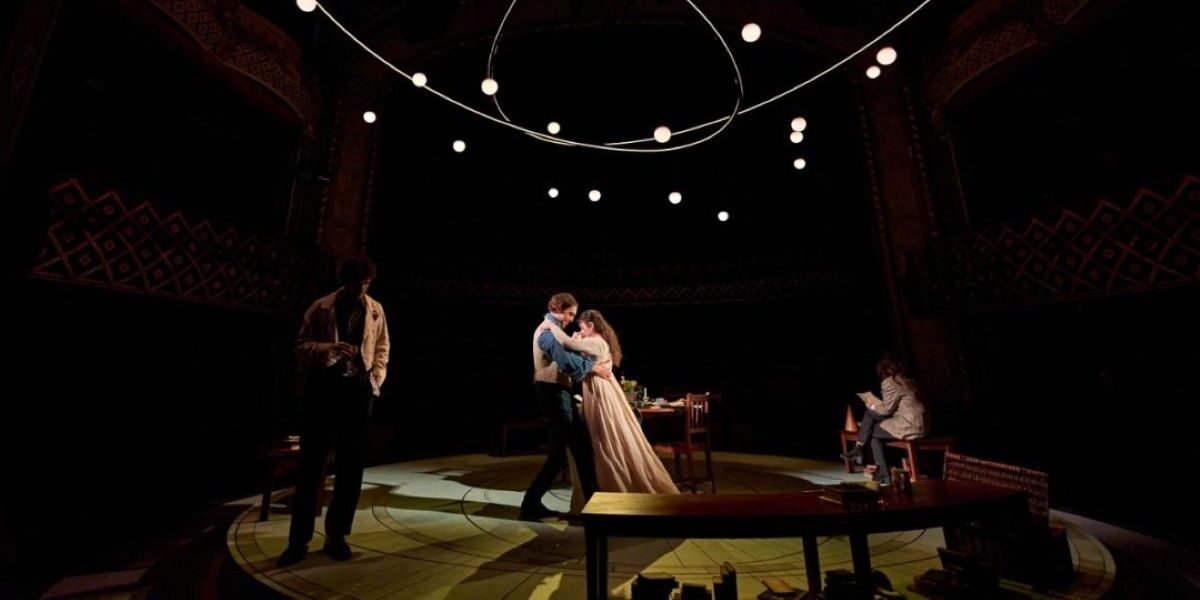
Many of these strengths are emphasised in this production which offers a very precise and focused directorial take by Carrie Cracknell, carrying with it key advantages, but at the expense of at least one theme I would consider essential. The Old Vic is reconfigured in the round, and intimacy and engagement are emphasised a second time through a stage set built around two revolves that do a lot of work. Not only are the eighteenth and twentieth century plots intertwined, but we are all the more intensely enmeshed ourselves in the detail of text and stage business.
Undoubtedly this helps the actors gets the complex maths and thermodynamics across more readily, and no one will complain about that especially when the set is topped off with a couple of ellipses and multiple baubles of light like a planetarium or Calder mobile which come into their own magically at the end. But the great loss here is a sense of place: Sidley Park the evolving country-house arcadia of the title is missing in action. This matters, not only because the characters refer to it so much, but because the house and grounds are characters in the drama, not merely a quaint period reference point.
The key characters in the action are convincingly portrayed by the cast. Isis Hainsworth is a beguiling Thomasina, fizzing with ideas and teenage enthusiasm and energy, and amply fulfilling her crucial role in embodying both the enlightened and romantic aspects of the play’s intellectual symbolism. As her tutor, Septimus Hodge, Seamus Dillane, captures the crafty chameleon aspect of the clever charmer while also revealing an emerging admiration and respect for his exceptional charge. Fiona Button, as Lady Croom, is the pick of the supporting cast in the 1809 thread of the drama, though Colin Steer delivers a lovely cameo too as the overrated poet Ezra Chater.
In the contemporary cast Angus Cooper stands out as Valentine, the spokesman for science who carries the main burden in getting the gist of chaos theory across to the audience. He not only caught the slightly goofy charm of the character, but was able to pace and point the long expository speeches with rare skill. I was less convinced by Leila Farzad’s sharp, but world-weary depiction of literary detective, Hannah Jarvis. I have a memory of Felicity Kendal investing this role with an infectious bounce and energy that made her a more effective foil to the the bumptious narcissist of a literary critic, Bernard Nightingale, here played with impressive self-conceit by Prasanna Puwanarajah. For the laughs and the satire to work his pretensions need to be pricked more pertly and expertly than happens here.
But this is a relatively small cavil in the playing. What still impresses most is just how many-sided the intricate structure of the play is. Every time I see it another layer of interwoven meaning, irony and correlation looms into view like the workings of an astrolabe. Spliced into the evening somewhere are several of the key theories of modern science, the history of garden design and the country house, Romantic poetry, whether sumptuous or shabby, the foibles of modern literary criticism, and a study of the nature of intuitive creativity. But this would count for little without the shrewd and humane portrayal of human nature, its follies and aspirations, that ties it all together in a parallel narrative of surpassing skill and perfect balance between intellect and feeling.
Tom Stoppard
Director: Carrie Cracknell
Cast: Gabriel Akuwudike, Fiona Button, Angus Cooper, Seamus Dillane, Leila Farzad, Tim Francis, Holly Godliman, Isis Hainsworth, William Lawlor, Colin Mace, Prasanna Puwanarajah, Colin Steer
Until 21 March 2026
2 hrs 40 minutes with interval
Photo Credit: Manuel Harlan