

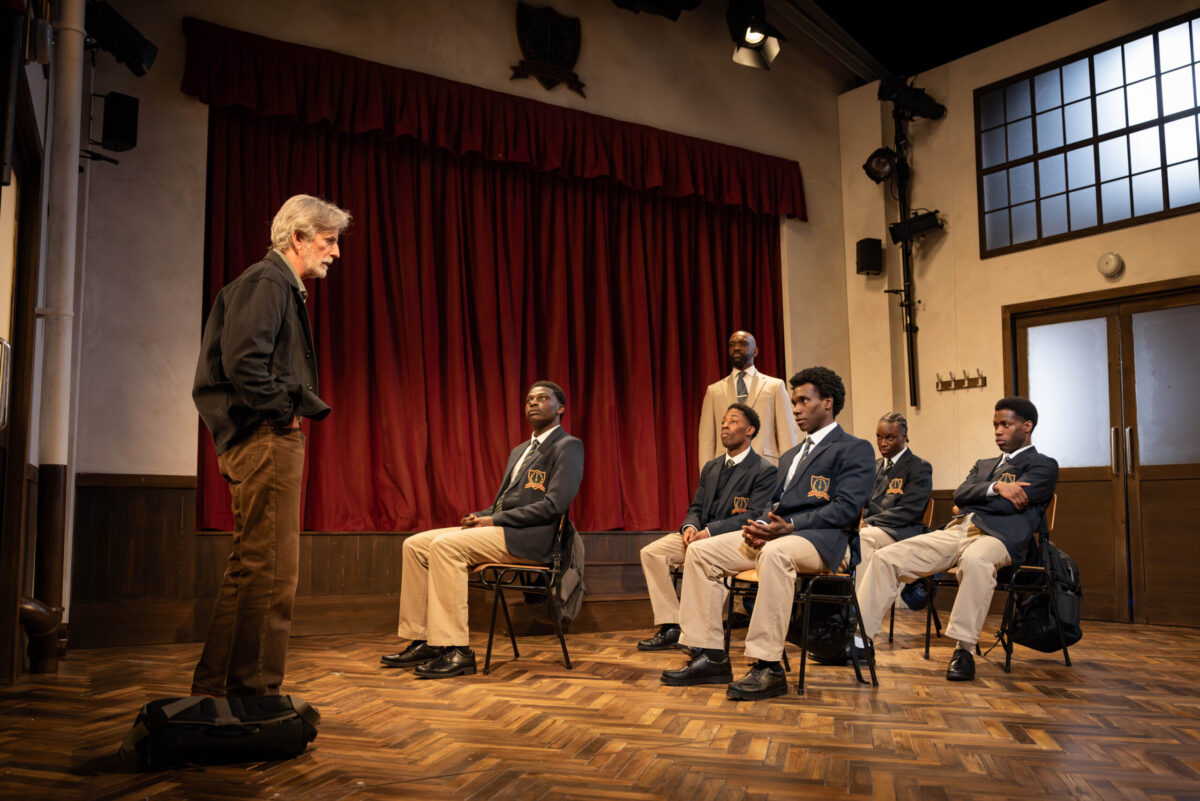

Tarrell Alvin McCraney, Chair of Playwriting at Yale, Academy Award winner for co-writing the screenplay of his play ‘Moonlight’, is, as one might expect from such credentials, a man who knows his stagecraft. This is no slight thing. Robert McKee, the great story teacher, says that while that staple of the GSCE syllabus, ‘An Inspector Calls’, is not a great play, it is a perfectly structured play in a time when playwrights have not learnt/ have forgotten what’s required to stitch a play together. Contrary to the entire audience on the evening I went, I don’t think this is a great play but I think it’s a beautifully structured one, with some amazing songs and vocals and some superb moments of acting.
As the curtain opens on a group of young men in Prep school uniforms, I thought this was going to be a Black version of ‘The History Boys’, and in many ways, the two plays are similar, with similar concerns.
Pharus is a poor scholarship boy who has been elected Head of the Choir. Funding from choir events supports the school, so the stakes of the choir doing well are high, not only for Pharus, but the school. Pharus has a foe in Bobby, another choir member, who is the nephew of the Headmaster. Both boys have a secret. Pharus is gay; a hard thing to be in a non-white liberal environment. And Bobby’s mother is dead.
The play starts with the choir in high melodic form and then Bobby, like someone yanking a needle off a record, calls Pharus the N-word. As the fight between the two boys intensify, we see that everyone is, in some way or another, trying to hold their head up above the water. The characters are sharply defined: Pharus and Bobby, like Ralph and Jack in ‘Lord of the Flies’ are born leaders, each with something broken about them (Pharus even calls the boys to attention with a conch like whistle). Junior is Bobby’s ‘yes-man’; a young man who can’t, as he says, hold out to pressure, until, of course, that moment when he finds out that he can. AJ is Pharus’ lovingly supportive roomie and David, who has chosen to become a pastor when he graduates, has a secret that is revealed only towards the end of the play. The two older men, the Headmaster and the white teacher, Mr Pendelton or Mr P, who comes in to not teach but to get the boys to creatively think for themselves, are less well coloured in.
The acting and directing (Nancy Medina) are fine, very fine. The singing and the musical arrangement (Femi Temowo). are gorgeous, and the emotional virtuosity of Junior’s (Khalid Daley) and David’s (Michael Ahomka-Lindsay) singing, particularly remarkable. Though having less dialogue than the main two characters, Khalid Daley as Junior, is the one I watched as he watched and listened to the other boys; subtle, but poignant acting. A lovely moment is when AJ, towards the end of the play, unearths a whole barbershop from under his bed. The choreography (Movement director and intimacy coordinator: Nao Nagai) when Bobby and Junior dance and sing together in class and the choreography of the boys’ phone time, when they’re allowed to, finally, call home, is beautifully done. When the curtain rises to a shower room and the boys are wrapped in towels, the tension is high. A gay man in a shower of straight men is bound to be in trouble. McCraney’s artistry shines in such moments, as it does in the lines that end the first half of the play. ‘I walk with Lord,’ says David. ‘ In other hands, this would be the awful spotlight moment with which the curtain falls. McCraney jolts it and Pharus replies, ‘And I hear he didn’t keep the best company.’ The class Mr Pendelton leads, in which Pharus makes the spiked argument that the Spiritual songs they sing, though powerful, are not, as has been touted, secret signposts for escaping enslavement, felt like a lesson: Slavery 101. I understand why McCraney wanted to put it in, but like Tolstoy’s treatise on agriculture in ‘War and Peace’, it could have been shortened.
This play was written in 2012. When I saw McCraney’s ‘The Brother’s Size’ (The Young Vic; 2007) and ‘In the Brown and Red Water’ (2008, in which the set designer had magnificently flooded the Young Vic), I was stunned by the poetry of McCraney’s work. This, too, has poetry, and the warmth of human relationships and it has, of course, tightly knit drama, as well as some lovely and some very funny lines (Bobby: ‘Let the good times roll,/ Mr P: Where did you see that- on a box of matches?/ Bobby: On a box of condoms’ but ultimately (and I know I’m in a minority of one here), it feels too safe. I’d love to see a modern McCraney play; just to see which way he’s flown.
McCraney has the dramatic skill of a Miller, a Wilson. All he needs is a little, maybe not so gentle push.