

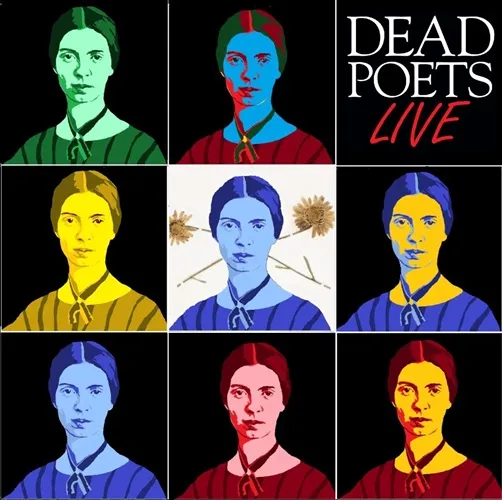
Emily Dickinson liked being inscrutable. For those that knew her, it must have been infuriating. She repurposed the metre of hymns for poems, mocked the syntactic strictures of verse with invasive dashes, and felt that the outside world was unworthy of her attention. Her eccentric ways and commitment to solitude earnt her the title of the ‘Nun of Amherst’. Thomas Wentworth Higginson, who served as her literary mentor and friend, was just as perplexed by Dickinson’s oddity—she was the ‘partially cracked poetess’. Dead Poets Live, a powerhouse touring company that keeps classic poetry alive through performance in schools and regional theatres, makes an intriguing choice in bringing Dickinson before an audience, for in her gnomic poems she remains, always, compellingly, half out of sight.
Patsy Ferran, who plays Dickinson, knows how to retain the writer’s spectral magnetism. Her stage presence holds reticence and instinctual guardedness while unveiling Dickinson’s rebellious inclinations. One gets the sense every word is well-chosen, arising from deep contemplation, or is shot, piercingly, like an arrow with a target in view. Her domestic solitude has formed a hard shell around her personality; from her cherry wood writing desk, looking at a potted lily and staring into the possibility of a blank page, she has fixed her opinions and understood her genius. ‘It was given to me by the Gods’ she asserts in poem 454, ‘Rich! ‘Twas Myself—was rich’. Intellectual exceptionality gives her licence and overturns any facile perception of Dickinson, the writer synonymous with crisp white Puritan collars and cotton dresses. Before us, instead, is an insouciant swaggerer: ‘The Difference—made me bold—’.
Accompanying Ferran’s recitations of verse is James Lever, who takes on the role of lecturer and teacher for the audience and for Dickinson. He has a raffish, Nick Cave air about him, which adds a welcome bohemianism to scenes in the stuffy Amherst College school room and the First Congregational Church. Theatregoers in possession of mellifluous voices will no doubt delight at the opportunity to sing Dickinson’s prosody as a member of a mock congregation. It is an interactive element of the show that ironically embraces and exploits a practice Dickinson—who was profoundly sceptical about organised religion—would have rejected. ‘With no disrespect to Genesis, Paradise remains,’ she once mused with playful mischief after looking at ‘blissful’ flowers.
Production values are kept to a minimum—in this space, it is the writing that speaks. Ferran sits studiously behind a desk, commendably similar to the poet’s real one which is held at Harvard’s Houghton Library. A single lectern is used by Lever. From this he guides the audience through analyses of the poems and provides context about Dickinson’s characterful quirks. (She was an amateur baker with a prize-winning Rye and Indian loaf recipe – of course it might have helped that her sister Lavinia was the judge.) Lever also sketches the contours of nineteenth-century social mores, with a particular focus on the expectations placed on women. They are, in Dickinson’s words, ‘Soft Cherubic Creatures’ (poem 401) who are taught to be frictionless—to obey the church, obey their husbands, and then spend the sunlight hours alone in unending dullness. When seen through the eyes of a spirited and astringent young poetess, satire was inevitable.
This piquancy and relish in the perverse are glimpsed, most obviously, in Dickinson’s signature dashes. Lever sees in them a premonition of Beckett’s pauses of nihilistic emptiness and Pinter’s evasive silences. They reflect, he observes, a chaotic world with no organising principle. This is mirrored in the lighting which blacks out rhythmically in time with these lyrical fissures. But Lever’s reading is perhaps too limiting an interpretation; these ubiquitous little lines are a grammatical incarnation of the ‘solid [gold] bars’ that Dickinson writes about keeping in her hand (poem 454)—stored up like treasure, ready to be spent in art.
Surely the purpose of Dead Poets Live: Emily Dickinson was to stir this kind of debate, to get me peeling through volumes of the poet’s writing, hoping to pinpoint Dickinson once and for all. But her shadow is the poem on the page. And posterity’s inheritance remains her cryptic, sphinx-like wisdom, compressed into the parameters of envelope covers, dashed out by burning candlelight. It is thanks to the Dickinson scholars who brought her never-accurately- published poems to view in the 1955 edition and initiatives like Dead Poets Live that we hear them still.
Dead Poets Live: Emily Dickinson ☆☆☆☆
Director: James Lever and Oliver Rowse
Producer: Clare Reihill
Cast includes: Patsy Ferran and James Lever
Until: Sunday 8th March 2026
Running Time: 80 minutes with no interval