


In his excellent programme note Michael Burden points out that we know very little about the origins and performance circumstances of this famous opera and that the traditional association with a Chelsea school for girls may mislead as much as inform. More relevantly, we know that there are missing sections, including an allegorical prelude that shift the work decisively in the direction of contemporary French operatic conventions and a court milieu. Given the unresolved nature of the score, and the fact that what we have runs to no more than an hour of music, it was a brilliant idea to interpolate the Funeral Sentences and Music for the Funeral of Queen Mary. Not only do these weighty, plangent pieces speak intertextually to the theme and burdens of ‘queenship’, but their insertion at key points in the drama also underscores the key role of the chorus as commentator and participant in the action in a wholly idiomatic fashion. Moreover all the music represents Purcell at the top of his game in the final phase of his all-too-short career.
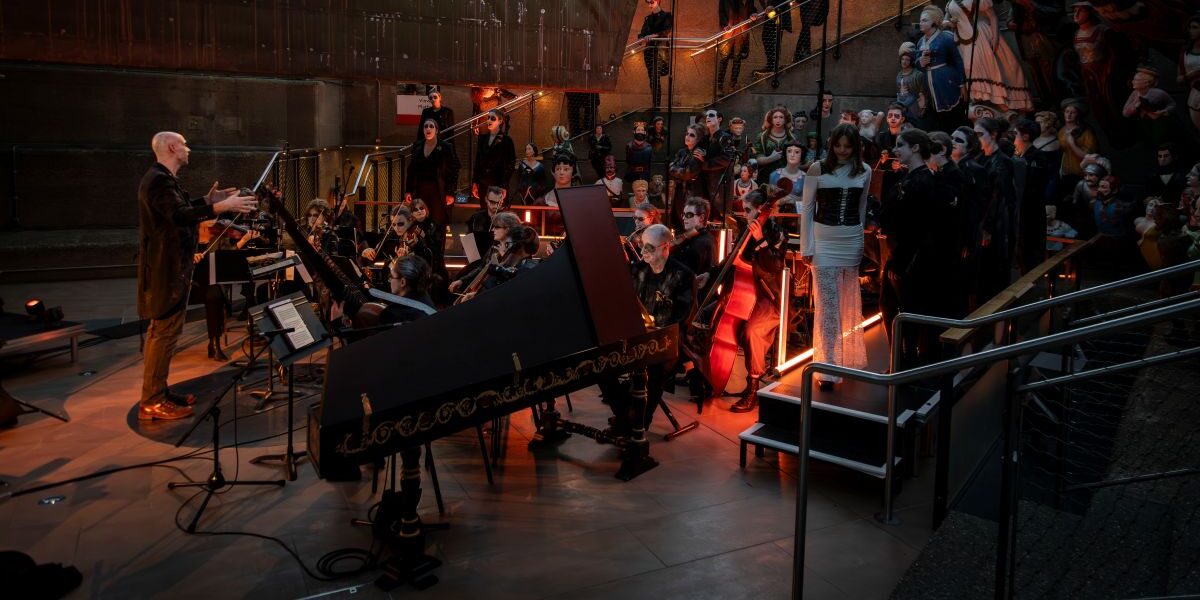
The setting in the dry dock of the Cutty Sark under the keel of the ship is remarkable in various ways. The nautical background complements the implied locale of the port of Carthage with Aeneas’ fleet at anchor, and the cavernous acoustic lends weight and resonance to the majesty and dignity of much of the music. Director Andrew Staples has made good use of the walkways at the bow end of the dock and finds further flexibility in the processional opportunities of the space and temporary raised platforms and walkway either side of the orchestra. While the result is technically semi-staged, there is no need for more scenic suggestion especially when the projection of the principals is so vivid and characterful. A stark black and white Gothic vive distinguishes both make-up and costumes.
All credit to the conductor, Jonathan Sells, for controlling the dynamics so well in such an unpredictable space. The English Baroque Soloists found a wide range right at the start with the contrast between the implacable weight of the valveless trumpets and the feathery string sussuration of the overture. The dance movements were projected with real verve and panache, and the choice of tempi was consistently apt, not least in Dido’s Lament, which was not as slow and dragging, as often is the case. Similarly fine judgement governed the interventions of the Monteverdi Choir, who bobbed and jigged credibly in the jollier moments that come close to the pert, knowing manner of Purcell’s secular songs, while maintaining a stauesque, impeccably uniform dignity, in the moments of specific tragedy. The diminuendo of the fade in the final chorus was exquisitely judged.
All the leads came across powerfully in a setting where there is no room to hide. There was strength in depth here too as the parts of the Second Woman, the Sailor and Two Witches were just as accomplished, reminding us that some of the most compelling music is assigned to supporting roles – it was very good to hear these numbers delivered with such ease and skill. Likewise, it was refreshing to have the role of Aeneas, underwritten, you might say, both by Purcell and in Virgil’s original, projected far beyond the norm. Hubert Zapior was far more sympathetic a figure than usual, demonstrating the conflict of duty versus desire, in a way wholly true both to Baroque conventions and present-day naturalism. Bethany Horak-Hallett made a lot of the Sorceress’ interventions too – while it is a small role she made it count through her highly specific acting skills.
In many ways the success of a production of this opera depends on the credibility of the relationship between Dido and Belinda, and here there was a true rapport between Karima el Demerdasch and Johanna Wallroth. There was a mutual empathy there that convinced, while both projected the text with precise diction, rhythmic incisiveness and a polished, purity of tone. In the culminating Lament, Demerdasch constructed a convincing architecture through the introductory recitative and into an emerging arc of sound that did not peak too soon and used ornamentation with great delicacy and refinement.
I have witnessed many productions of thsi masterly work, but this one stands tall, not just through its subtle innovations but also through its respect for the core challenges and opportunities within the pre-existing score.
Libretto: Nahum Tate
Music: Henry Purcell
Monteverdi Choir and English Baroque Soloists
Conductor: Jonathan Sells
Director: Andrew Staples
Cast includes: Karima el Demerdasch, Bethany Horak-Hallett, Johanna Wallroth, Hubert Zapior
5 May 2026 and 4 June (Bergen)
1 hours 10 mins, no interval
Photo Credit: Paul Marc Mitchell