

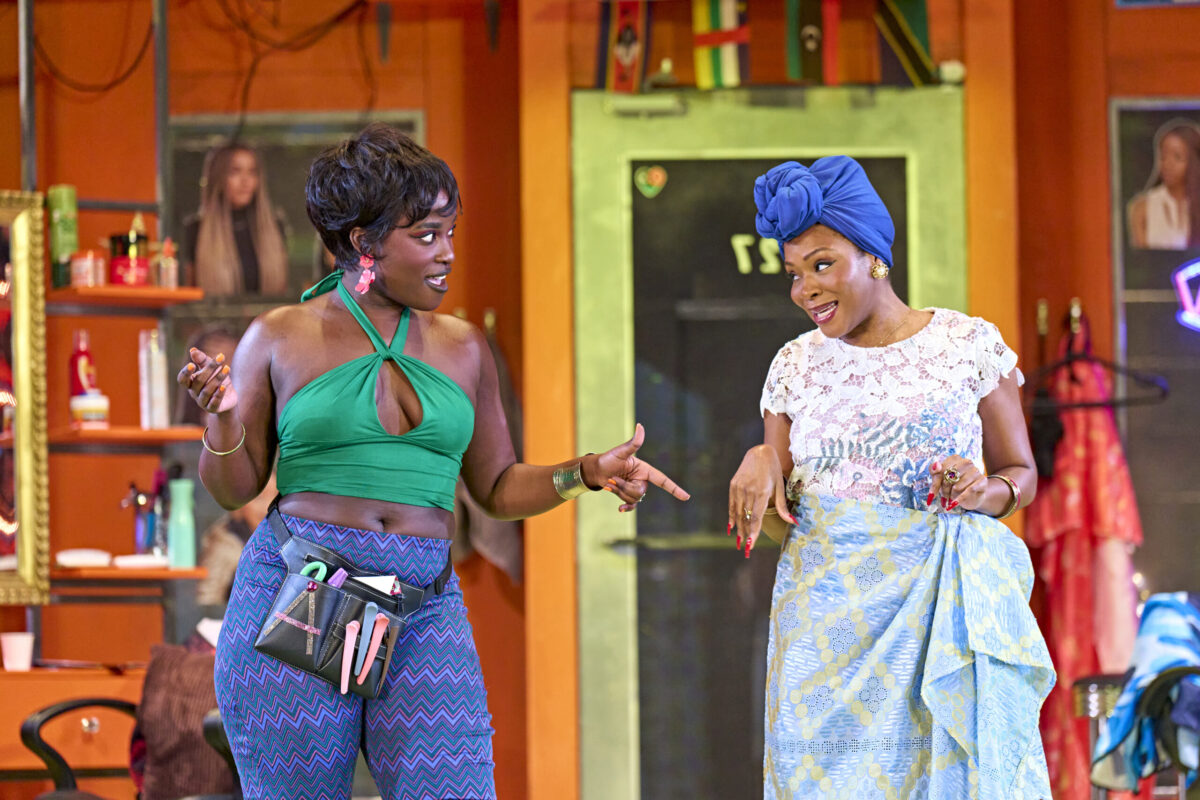

In Jocelyn Bioh’s Tony Award-winning play, a Harlem hair-braiding shop becomes a lively hub of gossip, camaraderie, and warm-hearted rivalry for the West African women who gather there. High school valedictorian Marie (Sewa Zamba) manages the shop for her mother, Jaja (Zainab Jah), and tries—rather unsuccessfully—to keep order among the harem of braiders who work there. As they transform clients’ hair into cornrows or long blonde braids à la Beyoncé, customers drift in and out—or else fall fast asleep—while the braiders negotiate, weave and work.
The evening is crammed with incident—perhaps too much to find a dramatic focus. The play looks head-on at issues of identity, the immigrant experience, and status among West African women living in New York – or by extension, London. Stylist Bea (Dolapo Oni) succumbs to boyfriend (Dani Mosely – also deftly playing multiple roles) who drops by largely to ask her for money. Aminata (babirye bukilwa) harbours ambitions to open her own shop, setting up both a humorous and biting rivalry with fellow braider Miriam (Jadesola Odunjo). Meanwhile, Marie is confronted by a former high school classmate, a reminder that her academic promise has not translated into the future she once imagined.
Jaja herself doesn’t appear until late in the evening, but she makes a striking entrance: dressed in an outrageously elegant white wedding ensemble, she passes through the shop en route to her marriage to an American—and, with it, her hoped-for route to legality and citizenship.
Between scenes, the cast dance and shimmy to lively funk and house music (sound designed by Tony Gayle) lending the production an infectious energy. On press night, the audience felt almost part of the action, responding audibly and enthusiastically to the unfolding drama.
The shop itself—a delightful and colourful revolving set beautifully designed by Paul Wills—provides an ideal stage for the steady flow of characters passing through, and the costume design by Jessica Cabassa is full of colourful flair, and perfectly attuned to each character. Special mention goes to Cynthia De La Rose for the array of intricate and luxurious hairstyles worn by the shop’s varied clientele.
For all its energy and charm, however, the play feels somewhat over-layered — an entertaining hodgepodge of ideas and themes. No single threat fully takes hold, instead, each character’s story jostles against the next. The ending in particular feels reverse-engineered—an eleventh-hour attempt to graft on references to the current American president’s anti-immigration policies, without the groundwork needed to make them feel fully earned.
There is a great deal of fun to be had here, with lively performances and a strong sense of atmosphere. And while the play feels more episodic than fully cohesive, its warmth and energy carry it a long way.
By: Jocelyn Bioh
Directed by: Monique Touko
Set Design by: Paul Wills
Wigs, Hair and Make-up Design by: Cynthia De La Rosa
Costume Design by: Jessica Cabassa
Sound Design by: Tony Gayle
Cast includes: Bola Akeju, barbirye bukilwa, Zainab Jah, Demmy Lapido, Jadesola Odunjo, Dolapo Oni, Sewa Zamba
To: 25 April
Photo Credit: Manual Harlan