

In this new production of Romeo and Juliet, presented by Hackney Empire, the eternal war between name and essence is laid bare, as tenderly as it is ferociously. This is not merely a retelling. It is a meditation on the superimposed structures we call identity; on how ego, title, and competition consume the purity of the heart until only tragedy remains.
The text remains Shakespeare’s. The music is rap, R&B, soul. But the beating soul of the play; the aching confrontation between the infinite tenderness of love and the hard, ridiculous rigidity of “name”, shines brighter than ever. What’s in a name? Juliet asks. And here, the question hangs not as poetry, but as a wound. Montague, Capulet: what are they but empty emblems of human vanity? They are not hand, nor foot. They are not love. They are names. And names, in this production, are shown for what they truly are: fragile cages that fracture the living spirit.
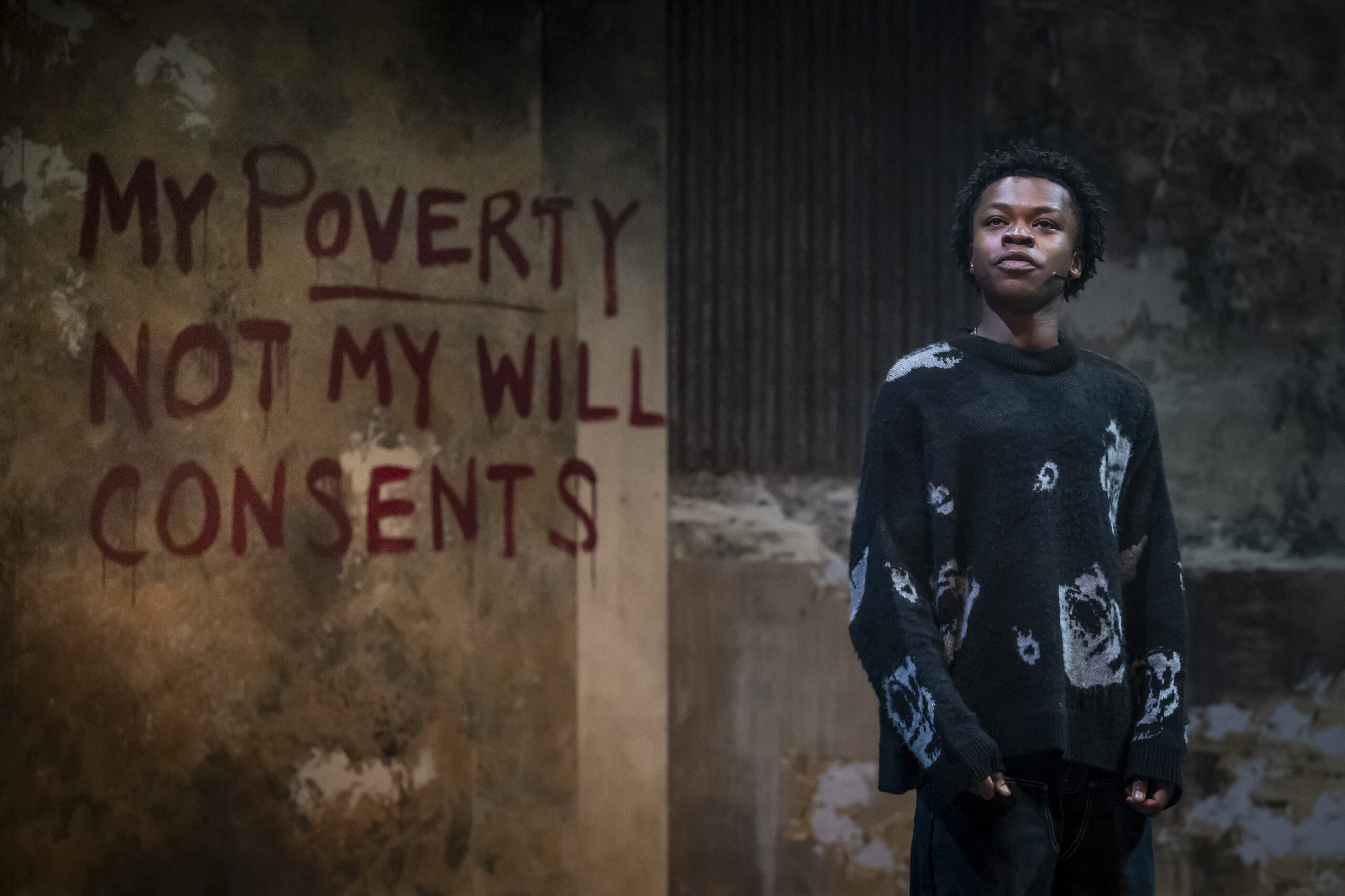
Under Corey Campbell’s direction, Romeo and Juliet becomes a delicate yet searing political critique. The rivalry between houses becomes a metaphor for societal domination, for the false divisions that power erects between human beings. The struggle we see is not only that of two lovers against a cruel fate – it is the struggle of the human heart against the noise of ego, against the blinding glitter of self-importance. It is a subtle, devastating reminder that the need for power, recognition, and victory has always been the great saboteur of tenderness.
And yet it is beauty that remains the unifying trend within this chaos. At the stated thesis of rivalry (family rivalry, rivalry between names) we see not a simple external opposite, but an internal response that emerges dialectically: the yearning for love. A force that does not merely oppose but exposes the inadequacy of rivalry, revealing within it a contradiction – a desire for recognition that turns destructive in the absence of mutuality. And we then reach a terrible and clarifying moment: not a synthesis in the naïve sense, but a sublation in which both rivalry and love are transformed. That moment is death – not as mere negation, but as the negative power that exposes the vanity of pride, empties the banners of houses and names, and reveals the futility of our worldly games. It is a tragic resolution in which Spirit recognises itself, painfully, through loss. A Hegelian cunning of history: the dialectic unfolding on the small, sweating stage of Verona, and on the larger, infinite stage of human experience. What is revealed is not simply the horror of the end, but the truth of the beginning: the rotten nature of the original thesis, a rivalry based on models of pettiness and inherited loss. This sublation brings to light what was always already there, hidden to the eye: the horror resulting from the accumulation of dishonour, the weight of compounding daily acts of hatred. And both families were to discover that it had all counted. Every insult, every offence, every lost hour. That they were both, unwittingly, contributors to a shared history – sharpening together the knife that would cause the fatal wound.
Kyle Ndukuba’s Romeo is a soul on fire; wide-eyed, impulsive, radiant with sincerity. Mia Khan’s Juliet is luminous and aching, at once fierce and heartbreakingly tender. Their chemistry is less theatrical passion than desperate human need. Dillon Scott-Lewis’s Mercutio is an uncontainable force, a comet that burns too brightly to last. Samuel Gosrani’s Tybalt pulses with anger that feels almost sacred, the anger of generations. Every performance is charged, trembling at the edges.
Simon Kenny’s set is spare but evocative, allowing the bodies and words to carve the space with meaning. Chris Swain’s lighting sculpts the stage like a second set of hands, moving characters in and out of shadow like thoughts from a restless mind. The choreography, led by Annie-Lunnette Deakin-Foster, allows the physicality of the piece to breathe without ever overshadowing the words. The rhythms crafted by That’s A Rap vibrate naturally through Shakespeare’s lines, proving once again that all true poetry belongs to all true hearts.
This Romeo and Juliet is not just a play. It is a whisper in the ear of our own time. It says: the world still teaches us to raise banners and sharpen knives for things that are as fragile as breath. It says: love is still punished. It says: ego still wins too often. But it also says: perhaps there is something stronger than pride, something buried under centuries of blood and sorrow, something tender, and pure, and enduring.
A brave, necessary production; and a moving testament to why art must always exist: to show us, even in our ruin, what we might still be.
Hackney Empire
Director: Corey Campbell
Lyricists: That’s A Rap (Keiren Hamilton-Amos and Corey Weekes)
Cast: Kyle Ndukuba (Romeo), Mia Khan (Juliet), Samuel Gosrani (Tybalt), Dillon Scott-Lewis (Mercutio), Natasha Lewis (Nurse), Ellena Vincent (Montague), Asheq Akhtar (Lord Capulet), Ayesha Patel (Rosalind), Andre Antonio (Benvolio), Pete Ashmore (Prince Escalus), Elwyn Williams (Paris), Yasmin Wilde (Friar Laurence), Lauren Moakes (Lady Capulet)
Until: 26 April 2025
Running time: Approx. 2 hours 20 minutes (including interval)