

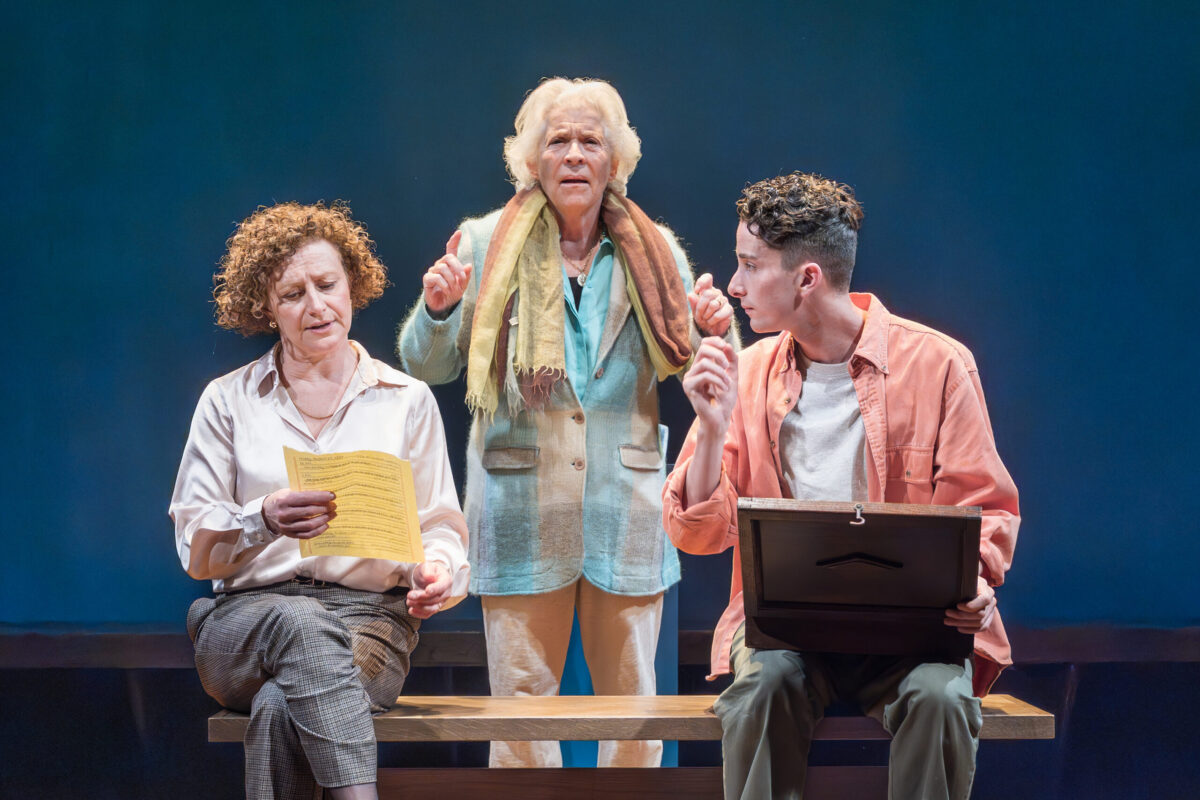

From Eugene O’Neill’s Long Day’s Journey into Night to Tennessee Williams’s The Glass Menagerie, the theatrical canon is rich with playwrights who have mined their own dysfunctional families for autobiographical material. In Joshua Harmon’s We Had a World, Joshua (Ryan Kopel) is a young playwright writing about the triangular relationship between himself, his mother Ellen (Anna Francolini), and his grandmother Renee (Suzanne Bertish).
Set in New York, the play moves back and forth between the 1980s and the mid-2000s. As Joshua looks back over his family history, we watch the evolution of these complicated relationships—particularly the fraught dynamic between Ellen and Renee, her sharp-tongued, alcoholic mother. Their turbulent bond stands in marked contrast to Joshua’s special relationship with Renee. It is Renee who introduces him to New York’s bohemian downtown culture, taking Joshua to arthouse films and even to a definitely age-inappropriate Robert Mapplethorpe exhibition.
Harmon’s rapid-fire writing captures the ways that love, loyalty, and resentment coexist within families. Scenes shift quickly from Renee’s acerbic wit and wonderfully cutting one-liners to fierce arguments between mother and daughter that expose deep, unhealed hurts. As Ellen, Anna Francolini is superb. With a flawless New York accent, she coveys the exhausting tension that sits between obligation and frustration based on the absence of her mother’s approval. As Renee, Suzanne Bertish delivers many of the evening’s sharpest lines with impeccable comic timing. Whether playing Renee herself or briefly inhabiting other characters, such as a jaded Italian landlady, Bertish is consistently entertaining. Even on her deathbed, Renee faces her demise with characteristic bravado, armed with a ready supply of put downs and bon mots.
Throughout the play Joshua sorts through an old wooden box of letters and mementoes, and many seem to be verbatim missives and transcripts of exchanges — a neat metaphor for the playwright’s attempt to make sense of his family history. Throughout, we sense Harmon wrestling with the challenge of shaping the messy complexity of real life into a coherent dramatic narrative. The raw material is certainly compelling, but too often the play feels like a collection of memories and incidents rather than a fully realised dramatic work. At one hour and forty-five minutes without an interval, it also struggles at times to maintain momentum and would benefit from some judicious trimming.
Running through the evening is occasional mention of Joshua’s anxiety about climate change. The play’s title itself points to Joshua’s nostalgic golden memories with Renee in New York, alongside grander meditations on loss: the disappearance of a family world, the erosion of American idealism and the threat posed by a warming planet.
Throughout the play, a block of ice slowly melts on a plinth at the back of the stage, an evocative image whose changing shape marks the passage of time and suggests a world in decline. Yet, as with much of the material drawn from Joshua’s family history, the metaphor feels more intriguing than illuminating. While rich in family drama, the evening never quite develops into something more substantial, reflecting a story whose many vivid memories and insights struggle to form a fully satisfying dramatic whole.
Hampstead Theatre – Downstairs
By: Joshua Harmon
Directed by: Josh Seymour
Designer: Sarah Beaton
Cast: Suzanne Bertish, Anna Francolini, Ryan Kopel
Until: 4 July
Running time: 1 hour and 45 minutes, without interval
Photo Credit: Marc Brenner