

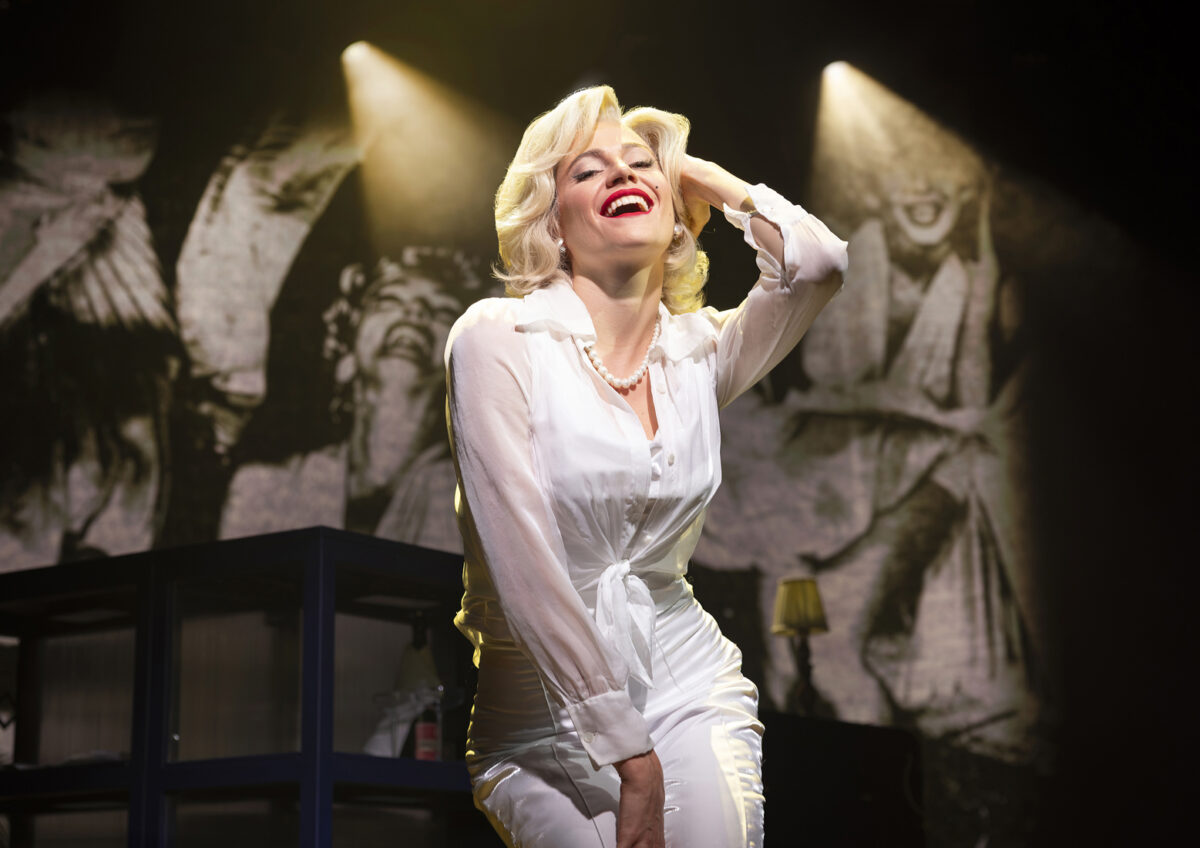

Written by Sharleen Cooper Cohen and directed by Philip Wm McKinley, Who Killed Marilyn? promises to look beyond the blonde bombshell and explore the woman behind one of the most recognisable images of the twentieth century. The problem is that, while examining the circumstances surrounding her death and the conspiracy theories that have followed it, it never quite manages to escape the very image it claims to challenge.
Pixie Lott certainly looks the part. More importantly, she has a presence that makes it easy to understand the extraordinary fascination Monroe inspired. There is something captivating about watching her command the stage, and her emotional scenes are often convincing. The final scene, in particular, is exceptionally well performed, with Lott delivering a genuinely affecting breakdown.
But the interpretation of Marilyn itself is much harder to defend. Lott repeatedly bends down as if posing, winks at the audience, smiles cheekily and adopts the familiar breathy, flirtatious mannerisms associated with Monroe. At first, I wondered whether this exaggerated performance was deliberate. Perhaps the point was to show the Marilyn the public had constructed before revealing Norma Jeane beneath her. But that never really happens. Instead, the character remains almost entirely within the confines of the Marilyn caricature.
That feels particularly strange given the production’s stated intention. The play wants us to see Monroe as intelligent, complicated and more than a sex symbol, yet it spends an enormous amount of time focusing on her sexuality and her relationships with famous men. We are told that she reads and that she is intelligent, but the script rarely allows us to actually see that intelligence. It tells us who Marilyn was rather than showing us.
This is ultimately where the writing and direction fall short. The play is remarkably two-dimensional for something supposedly concerned with revealing a woman who has been flattened into an image for decades. Norma Jeane barely exists. Her name is not given the significance it deserves, and the production offers little sense of her friendships with women, her upbringing or the less famous relationships that might have helped construct a fuller portrait. Instead, she is almost constantly surrounded by men.
There are moments when the staging makes this particularly clear. As Marilyn breaks the fourth wall, the male cast frequently sit behind her, watching. It is an obvious visual representation of the male gaze, with Marilyn constantly being observed and consumed, but it also makes the already cramped stage feel unnecessarily crowded. The supporting cast are competent, but none of the other characters leave much of an impression, making the world around Marilyn feel surprisingly thin.
The same lack of depth extends to the play’s supposedly profound revelations. Its final message is that fame is meaningless and that Marilyn needs to learn to love herself. It is an emotionally obvious conclusion, and hardly the revelation the play seems to believe it is. The script repeatedly reaches for depth without quite succeeding.
The conspiracy at the centre of the play is potentially fascinating. The question of whether Monroe was murdered, rather than dying by suicide, has fascinated people for decades. But the production seems unsure whether it wants the audience to interrogate the theory or believe it. It repeatedly invites us to make up our own minds, only to essentially tell us that Monroe was killed by the mob on the orders of the Kennedys.
There are some effective elements within the production, particularly in the more intense scenes, where the lighting and sound work well together. At other times, however, the lighting felt less considered, with the light occasionally failing to find the cast properly and leaving performers partially in darkness. Others are less successful, with a particularly obvious fake slap reminding you rather too clearly that you are watching a performance.
The hair and costumes do a convincing job of recreating the familiar Monroe image, but there is also an odd recurring use of blue paint across the cast’s costumes, seemingly referencing reports that Monroe’s body was found blue. It ends up being more distracting than meaningful.
The casting also presents an interesting missed opportunity. Monroe’s famously curvier figure was a significant part of her image, and it would have been interesting to see a production about her today embrace a body type that challenges the increasingly narrow beauty standards of the present, particularly at a time when extreme thinness is so heavily promoted. Casting Lott, a recognisable name who can sell the image of Marilyn, is understandable commercially, but it does mean the production misses an opportunity to say something more interesting about Monroe’s body and the way it has been viewed.
Despite all of this, I found myself wondering whether some aspects of the production had been scrutinised a little too harshly. I never found myself checking my phone to see how long was left, usually a good sign, and, as someone who knew relatively little about Marilyn Monroe beyond the familiar image, I found myself genuinely interested in what the play had to say.
That is perhaps the most frustrating thing about Who Killed Marilyn?. It sets out to show us the real Marilyn Monroe, yet ultimately gives us another version of the Marilyn we already know: sexualised, surrounded by men, emotionally troubled and constantly performing for an audience.
It is not a play to write home about, and I can understand why the production has left critics so disappointed. But it was engaging enough to hold my attention, and Lott has enough presence and emotional strength to make parts of it genuinely affecting.
Three stars therefore feels about right. There is plenty to criticise, but there is also enough here to make it worth watching.