


This play is another of the Finborough’s acts of revival, taking a long forgotten work and giving it another airing in a scrupulously faithful production with top-notch casting. Sometimes the results are more of a curiosity than a resurrection, but more often than not a perennial theme receives an original twist or two that really persuades and illumines. The Old Ladies is in large measure in this latter category.
The play started life in an adaptation by Rodney Ackland of a novel by Hugh Walpole. Ackland, as the programme notes, has never really received the recognition his well-made, hard-hitting plays deserve, perhaps because the milieu of most of them is seedy, down-at-heel and unglamorous, and not what the critics of the day, fed on Coward and Rattigan, were used to. This one is no exception, being a study of the quiet desperation that genteel poverty commonly involves.
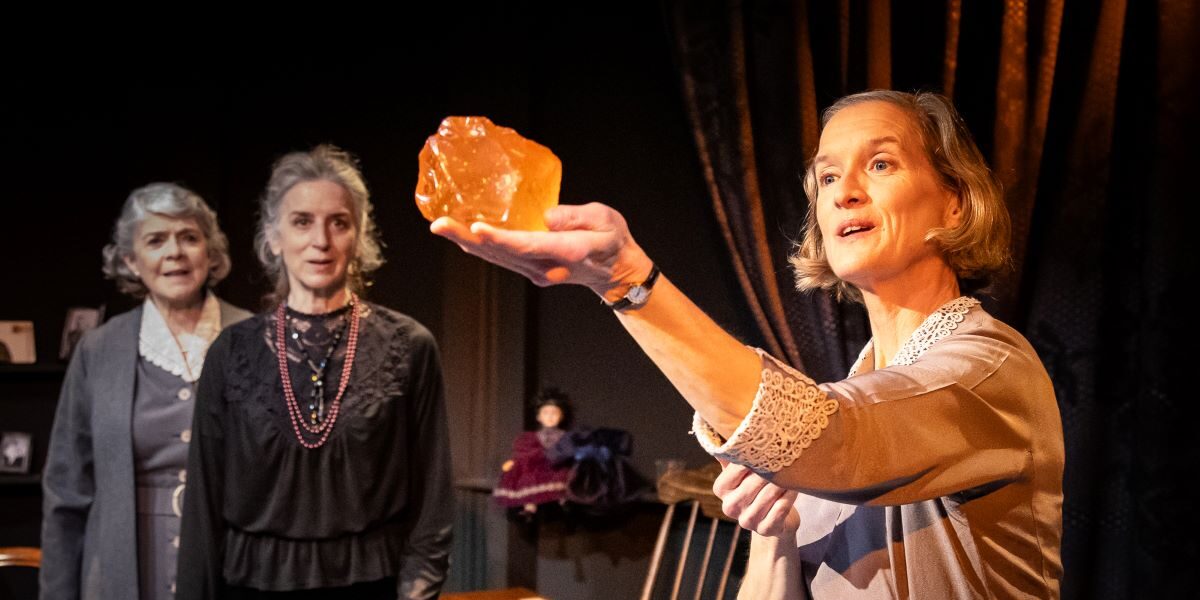
Three elderly ladies have rooms in a faded boarding house in a Cathedral City. All struggle to keep up appearances while eroded by anxieties, real or imagined, or both. Mrs Amorest (Julia Watson) is amiable and active but hoping against hope for the return home of her son from what appears to be one hapless venture after another. Miss Beringer (Catherine Cusack) is a constant shiver and shudder of timorous retreat, frightened by every aspect of life beyond her own door, and comforted only by possession of a glowing piece of translucent amber given to her by a friend (anticipations of The Glass Menagerie?). The most imposing of the trio is eccentric Agatha (Abigail Thaw), who appears to be frail and fey but in fact has lived a varied and rackety life very different from the others.
Petty jealousies and social jousting emerge – the worlds of Mapp and Lucia or Barbara Pym are not far away – but then things get interestingly weird and creepy – a touch of Hitchcock appears. A fine soundscape emerges as the building creaks and groans in and beyond the weather, and Agatha’s behaviour becomes more assertive and sinister especially when Mrs Amorest seems likely to inherit some money.
All three performances are delightfully detailed, and, as desperation mounts, so too does a degree of hysteria which is very well controlled and channelled by all three actors into a memorable and melodramatic climax, all the more intense for the intimacy of this small space and the fussy overfurnished detail of the excellent set by Juliette Demoulin. Director Brigid Larmour has each of the women in their own little corners of the set, representing their rooms, and ratcheting up the sense of cramped haunted tension, which becomes ultimately unsustainable.
Precarity is a modern word for a sadly perennial phenomenon, and this play stands as an admirable account of the lengths and depths to which people are driven in their attempts to survive it. But the evening is also a stylish and accomplished venture into period style, poised somewhere between Arsenic and Old Lace and film noir. It succeeds admirably in both registers.
Writer: Rodney Ackland (after Hugh Walpole)
Director: Brigid Larmour
Cast: Catherine Cusack, Abigail Thaw, Julia Watson
Until 19 April 2026
85 mins, no interval
Photo Credit: Carla Joy Evans