

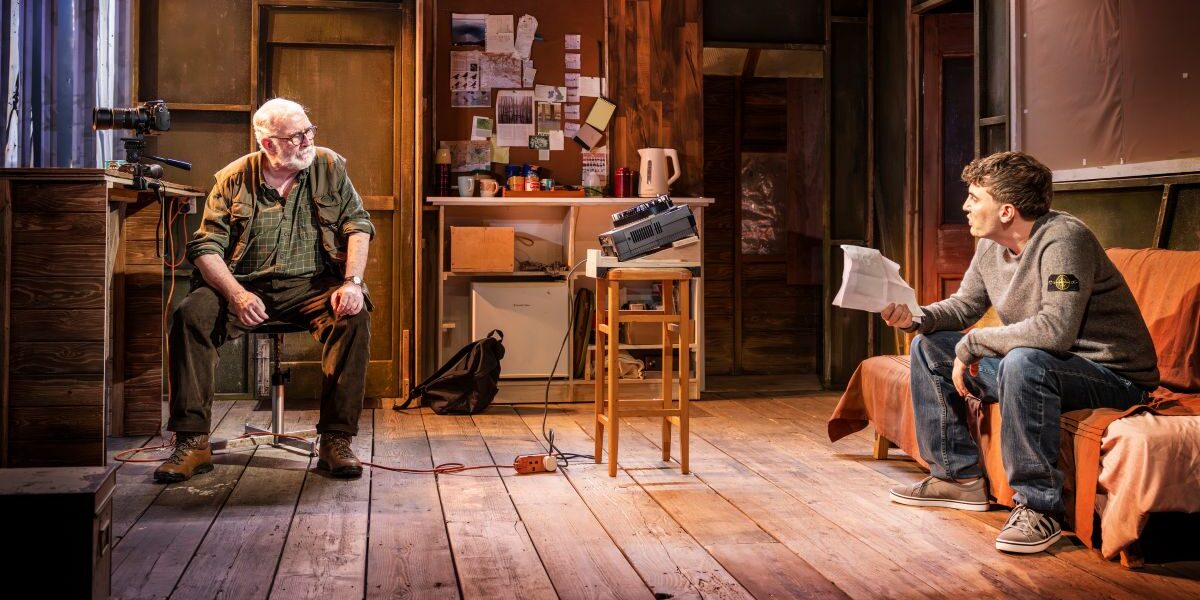

This is David Pearson’s first play, and an accomplished piece of work. He has a natural ear for dialogue, with all the little nuances that gradually assemble character, and has the writerly patience to assemble a slow-burn narrative. So when the major revelations come they generally feel earned rather than arbitrary. There are a few clunky gear changes that do not emerge so naturally from the textures, but ultimately this is a very rewarding two-hander that touches powerfully on themes of creativity, trust, control and intergenerational misunderstanding.
The lights go up on a remote hide overlooking a lake – a shabby, poorly maintained, wooden interior dominated by a camera attached to a worktop focused on the shadowy world outside. We are in the present day and this is the domain of Tim, a well known wildlife photographer, who is interviewing his latest helper, Marcus, who arrives both ill at ease and ill prepared. The two spar with one another for most of the first scene, with the older man convinced the younger is lazy, incompetent and dim, and the younger astonished at both the primitive living conditions (a barely functioning toilet and nothing to eat except raw baked beans) and the irascible prickliness of Tim.
However the tone shifts as we move onto photography itself, as Marcus becomes genuinely engaged with Tim’s methods and past achievements as demonstrated in a traditional slide show; and Tim comes to think more highly of the young man’s promise, particularly as he seems to have taken one fine photo already and, as we learn, grew up on the same deprived local housing estate as the older man. Symbolically, they reach an understanding over a photo of a rare bird, the Firewing, which Tim took as young man, and which many disbelieved. Marcus undertakes to help him locate and photograph it again and at this point in the play all seems set fair for a sentimental ending.
However, in a very skilful pivot, carefully prepared, Pearson takes us into much darker and more complex territory. This is where the play really scores and sears. Less worthy motivations emerge on one side and a grim past of paternal mistreatment emerges on the other. There is a deftly handled time-shift, in which the set slips back forty years to when Tim was a young man, and all credit to director Alice Hamilton and design studio Good Teeth for achieving the transition so smoothly. There is also some lovely work on the shifting lakeside and interior light from lighting designer Jamie Platt.
The two actors have a very good chemistry with one another and offer up finely grained and detailed performances that bring out all the recessed points of the writing. Gerard Horan starts off with a short fuse and defensive manner and mellows the character gradually into a beautifully autumnal performance, full of memory and regret and carefully measured pain. Charlie Beck offers a lot of raw energy to start with, both chippy and vulnerable. As the play develops he etches in more back history and a broader emotional range, not least in embodying a younger version of Tim, which is carefully distinguished from his other role.
All in all this is a very worthy new work: while there are a few rough edges still in the transitions between the early scenes, the play gathers its threads very convincingly, and marks a notable debut.
By David Pearson
Directed by Alice Hamilton
Cast: Charlie Beck and Gerard Horan
Until 23 May 2026
1hr 25 minutes, no interval
Photo Credit: Pamela Raith