

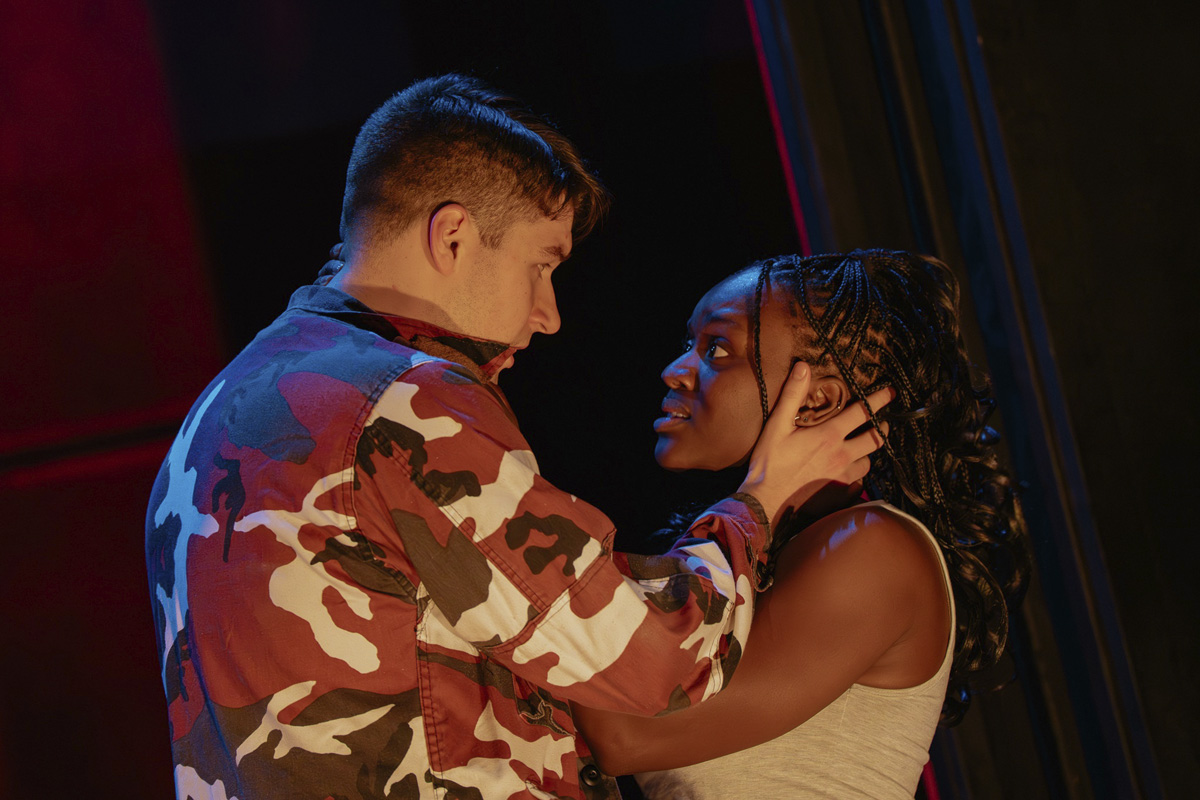

At Hackney Empire, a theatre whose setting makes questions of race, class, and belonging feel immediate rather than abstract, Pilot Theatre’s revival of Noughts & Crosses arrives with a premise that still carries force. Adapted by Sabrina Mahfouz from Malorie Blackman’s novel and directed by Esther Richardson, the play imagines a society in which racial power is reversed: Crosses occupy positions of privilege and authority, while Noughts live under structural discrimination.
Before the story fully takes hold, the production establishes a world of surveillance, hierarchy, and public judgement. Simon Kenny’s set, with its panels, levels, and stair structure, creates a flexible space in which private rooms, courtrooms, streets, and public rituals seem to bleed into one another. The screens at the back, with video design by Si Cole, are especially effective. News footage and public messaging bring the outside world constantly into the room, so that Sephy and Callum’s relationship never feels sealed off from the institutions surrounding it.
At the centre are Sephy and Callum, played by Brianna Douglas and Lewis Tidy. Sephy is a Cross from a wealthy and politically powerful family; Callum is a Nought whose life is shaped by exclusion, anger, and grief. Their relationship begins as a childhood friendship, then becomes more fragile as school, family pressure, and political violence push them apart. The production gives their bond sincerity, particularly as the story darkens, though the early teenage scenes are sometimes played in a heightened register that slightly weakens their emotional naturalism.
The most interesting parts of the production emerge when it presents racism as a structure rather than simply as individual cruelty. The media projections do more than provide background information: they show how public narratives are constructed, repeated, and legitimised. In this world, power lies not only in law or politics, but also in who is believed, who is protected, and who is treated as dangerous before even speaking. The play also makes clear that race and class are inseparable. Sephy’s Cross identity is reinforced by wealth, education, and political access, while Callum’s Nought identity is intensified by economic vulnerability and social exclusion.
This is where the staging works best. The mirrored scenes between the two families allow grief and pressure to unfold in parallel without pretending that both sides occupy the same position. The final execution sequence is the evening’s most memorable image: the stairs transform punishment into a public ceremony, making the violence of the state feel ritualised rather than exceptional. The ending lands because the production refuses to soften Callum’s fate; its tragedy is allowed to remain stark.
The production’s directness is also its limitation. Some scenes, particularly those involving school bullying and courtroom injustice, make their meanings overly explicit. That clarity may be useful for younger audiences — and the audience at Hackney Empire was young, mixed, and engaged — but it occasionally reduces the ambiguity that could make the politics cut deeper. The performances are committed throughout, with Melody Adeniran’s Minnie bringing grounded sharpness and Fintan Hayeck’s Jude giving clarity to the anger produced by grief and exclusion.
Overall, Noughts & Crosses is an important and often affecting production. Its greatest strength lies in the way its design, structure, and visual language expose the machinery of power surrounding its central romance. At times, it states too plainly what the staging has already shown, but its central question remains urgent: who gets protected, who gets believed, and who gets punished?
Show Type: Drama
Noughts and Crosses
By Malorie Blackman; adapted by Sabrina Mahfouz
Music & Sound by Arun Ghosh and Xana
Director: Esther Richardson
Photo Credit Von Fox Promotions
Cast Includes: Brianna Douglas as Sephy, Lewis Tidy as Callum, Elexi Walker as Jasmine, Chris Jack as Kamal, Melody Adeniran as Minnie, Fintan Hayeck as Jude
Until 14 May 2026 and then touring until 23 May 2026
Running Time: Two hours and 30 minutes (including a 20-minute interval).