

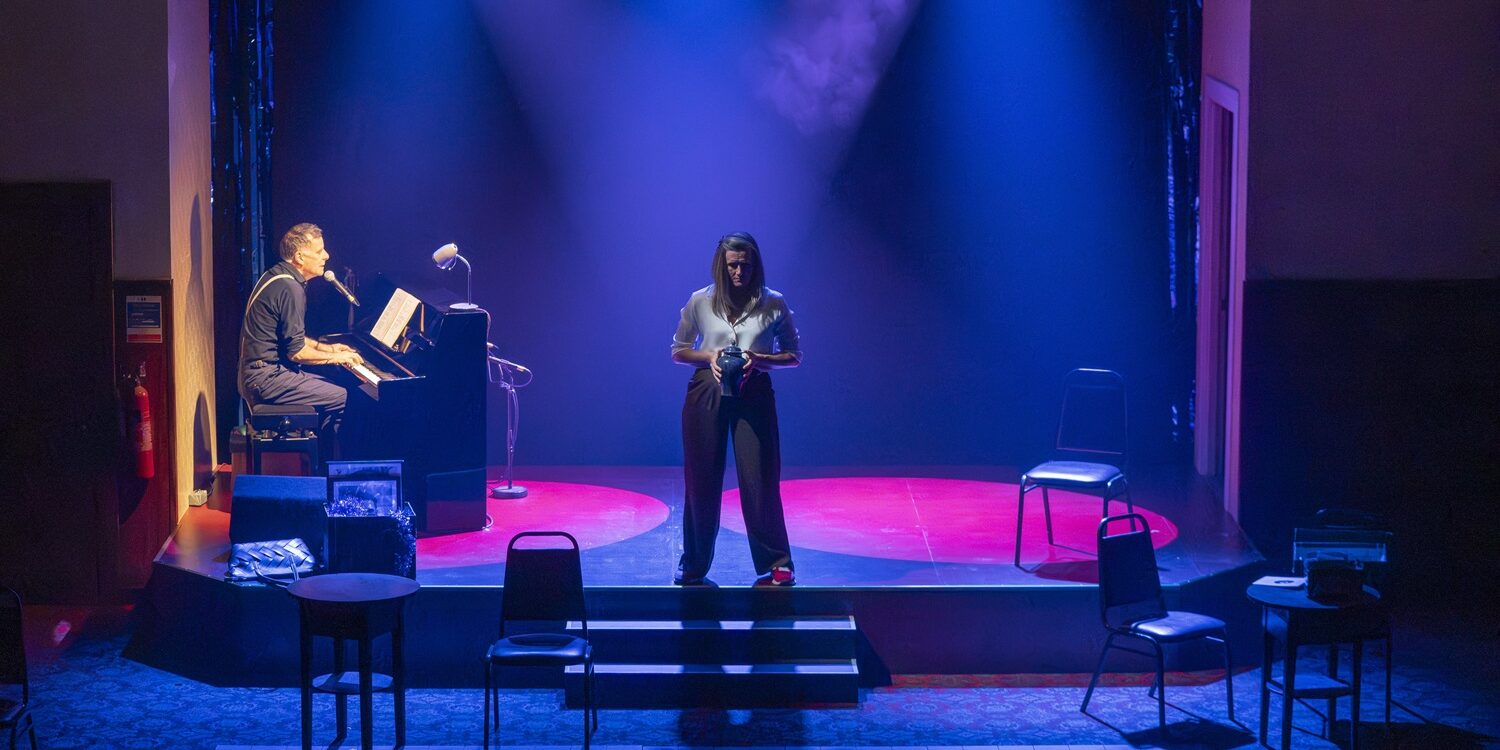

The idea of sport – the most important of the unimportant things – as a metaphor for the triumphs and losses of life is hardly a new one, but it’s an old story well told with a specifically Scottish tinge in Black Diamonds and the Blue Brazil. Sally (Dawn Steele) is back home in the west Fife mining town of Cowdenbeath, having thought she had escaped forever to a life as a London lawyer. Cowdenbeath is full of loss for Sally – the lost mining industry, her mother, lost over a decade ago and now her father, lost to industrial disease from his days as a miner.
Desperate to get back to her ambitious career plans, Sally is stymied by her father’s wish for his ashes to be scattered at the ground of his beloved Cowdenbeath Football Club – the so-called Blue Brazil – but only after a home win. It is no spoiler to say that Sally remains tied to her childhood home for much longer than she would like.
Black Diamonds and the Blue Brazil is a sharp study of how something as apparently unimportant as sport can provide hope and community when the important things (steady work, a fair wage, purpose) have been stripped from a place. However, the play isn’t really about football at all. It is a moving piece about inheritance, belonging and alienation, pride (or otherwise) in where you’re from, about whether you can ever really go home again, or ever entirely escape your past.
As Sally, Steele does a fabulous job of conveying the mixed emotions brought on by these themes, carrying the production on her shoulders throughout with a wonderfully natural and engaging stage presence. Her subtle shifts in tone from fury to sorrow to wry Scottish humour – usually occasioned by the hapless Cowdenbeath FC – and back are expertly managed, as is her conjuring of the various other characters in the story.
In this, she is helped by Gary McNair’s sharp and witty script, and the bittersweet songs written and performed on stage by Ricky Ross of Deacon Blue. Projections of past Cowdenbeath players and miners, old programmes and newspaper headlines hammer home the sense of nostalgia and loss, as does the play’s setting, a rather down-at-heel bar where you can virtually feel the sticky floor and smell the stale beer from the stalls.
As Sally’s dad, Barrie Hunter will be a familiar character to anybody who has spent time in a Scottish pub or sports club – an engaging raconteur whose encyclopaedic knowledge of the minutiae of niche Scottish sport is the only way he knows to express emotional vulnerability. If there is a criticism of the production, it would be his relative absence in the second half of the play, which contributes to a loss of momentum and sense of repetition in the story and songs. Indeed, one wonders if the production as a whole might have benefitted from a tighter, one act structure.
The play will speak to many people who have moved away from home to forge a life elsewhere, and almost anybody who has followed – or even played – sport at any level below the monied elite. Loss and the search for a sense of belonging – be that in sport, community or work – are fundamental to the human experience, and Black Diamonds and the Blue Brazil is an appealing, bittersweet study of both.
Performed at The Royal Lyceum Theatre, Edinburgh
Runs until Saturday 23 May 2026: Tuesday-Saturday – 19:30, Wednesday and Saturday – 14:30
Running time: 2 hours 10 minutes including interval
Adapted by Gary McNair from the novel by Ron Ferguson
Directed by James Brining
Music Composed and Performed by Ricky Ross
Set and Costume Designer: Jessica Worrall
Video Designer: Lewis Den Hertog
Cast: Barrie Hunter, Dawn Steele