

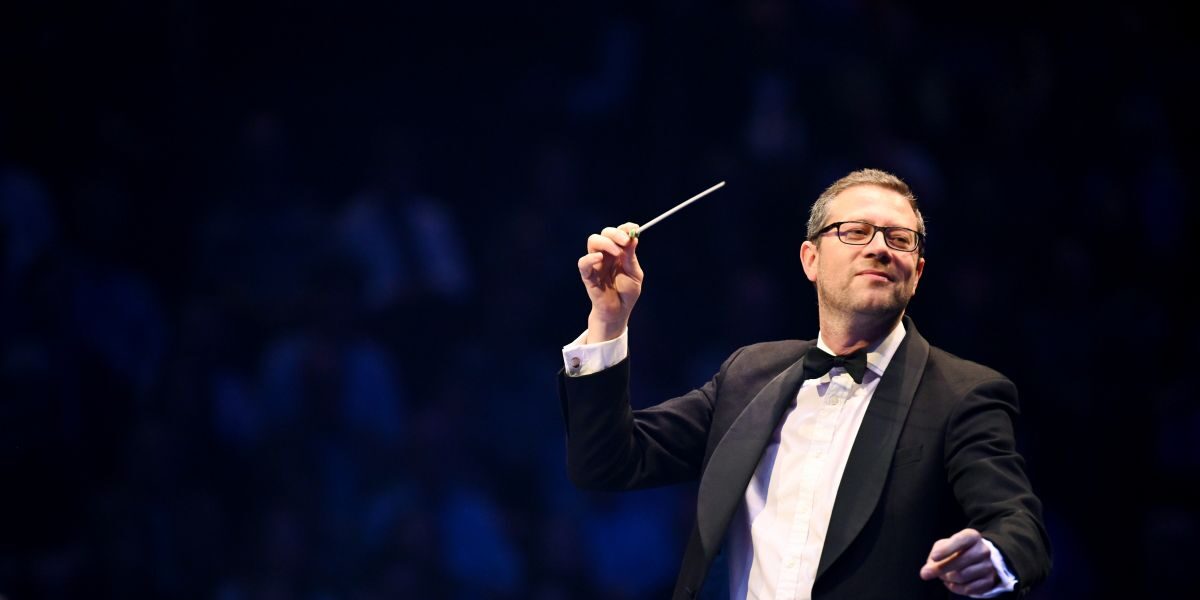

John Wilson and the Sinfonia of London have become well-known for their immaculate performances of Hollywood Classics and excerpts from the Great American Songbook, where the key to their success lies both in the virtuosity of the musicians, selected from the best of the orchestras in the UK, and the impeccable research of the conductor, going all the way back to the original scores and charts with which albums were made in the mid-twentieth century. Here, in a delightful departure for the Grange Festival, they extend their range into the repertory of Frank Sinatra, focusing mainly on his involvement with Capitol Records in the 1950s, but along the way unravelling many a riddle beyond Nelson.
Indeed, a more accurate title for this concert would be ‘Sinatra and his Arrangers’, given their decisive role in reshaping the later phases of his career and setting the tone, timbre and mood for each of his distinctive albums. This is where the performance really is revelatory, in foregrounding the orchestra so the full intended sound world is restored. It makes such a difference to hear the lavish textures of a full string section at full tilt, and to experience the colour palette offered by the full range of woodwind lines and brass bravura flourishes. For example, having just heard the overture to High Society at the Barbican a few nights before, it sounded like a different beast altogether in the hands of this orchestra, in the unashamed, full-fat swagger of the original orchestration.
How do the singers fit into the picture, in this case? Matt Ford, a regular collaborator with Wilson, carries the burden of the songs. It is important to be clear about his role. We would not want him to offer a direct imitation of Sinatra – this is an evocation of Sinatra’s world and skill, not a tribute act. Likewise, these songs do not need the interpolation of a rival strong vocal personality. Instead what we have here is essentially the addition of another contrasted line in counterpoint with the orchestra, rather in the same way that Beethoven uses solo voices in the 9th Symphony. The diet was varied further in each half by the addition of another singer’s vocal timbre, just as Sinatra added in duets to provide variety on the originals. Clare Teal joined Ford in the first half and Jamie Parker in the second. There were instrumental soloists too, notably star trombonist, Andy Wood.
A short review can only touch on a few headline moments from an evening with well over twenty single items (and in a programme that had gone through 60 drafts, so Wilson summarised from the podium.) In the first half it was initially the quieter reflective numbers that caught my attention particularly for the delicacy of the arrangements – free-floating string lines, and bubbling wind solos, with the orchestra responding instantly to the conductor’s detailed interventions to maintain light, shade and balance. There was, for example, a version of ‘Stormy Weather’ that sounded like Mahler in its inward intensity. Towards the end, though, the register shifted to send us into the dining interval with powerful versions of ‘The Days of Wine and Roses’ and ‘All or Nothing at All’, in which singer and brass section really let rip.
In the second half we were treated to virtuosic twittering flutes for ‘A Nightingale Sang in Berkeley Square’, making you regret that Sinatra recorded only one album in the UK. Another astonishing effect came at the end of ‘Quiet Nights of Quiet Stars’ where in the orchestral play-out the fade out to nothing was done so imperceptibly you could not tell when the pianissimo had finally evaporated. A conductor friend told me once that the greatest sign of an orchestra’s respect for a conductor is when they will make the effort to play really softly for him.
Cole Porter dominated in the last sequences and hearing these arrangements done so much better than usual reminded me of how difficult this repertory is to bring off with both brio and poignancy. As in Sondheim, there is often a very different rhythmic foundation in the orchestral accompaniment and the voice has to find and assert its own way without support. Matt Ford rose to this challenge superbly, whether in ‘Night & Day’ or ‘I’ve Got You Under My Skin’.
Wilson gave insightful commentary in between the items without it feeling like a formal lecture-recital, and as our vagabond shoes strayed out into the twilight to the orchestral high-kicks of ‘New York, New York’, you could not but be grateful for an evening that had combined learning and rediscovery alongside the highest level of performance art. The only regret is that the composers, arrangers and the man himself were not there to witness and relish it.
Sinfonia of London
Conductor: John Wilson
Singers: Matt Ford, Jamie Parker, Clare Teal
Until 6 June 2026
2 hrs 30 mins plus dining interval
Photo Credit: Clair Chamberlain