
A resounding triumph! This brilliant outing of a pared-down concert performance of Turandot by Opera Holland Park (OHP) has the audience spellbound from the start. In spite of its troubling obsession with torture, death, and overflowing cemeteries, Puccini’s last, unfinished opera remains a firm favourite of the opera repertoire, not least for its innovative musical score. This production demonstrates exactly why its appeal endures.
OHP are putting on Turandot for the first time, to mark the opera’s 100th anniversary. It thus postdates high modernist classics like The Waste Land and Ulysses, both of 1922, and the orchestral score reflects this. Its complexity is loud, brash, intrusive, violent, breathtakingly bold. Exploding boundaries as much as Eliot and Joyce.
Under the baton of Naomi Woo, the City of London Sinfonia delivers a magisterial rendition of an almost Wagnerian volume of noise. It certainly focuses minds. There are no moments of rest or respite here; at least not until the start of Act 3, when the now world-famous tenor aria Nessun dorma, fleetingly floated at the end of Act 2, reaches for the stars, dawn and finally the High Cs of victory. It marks one of the few lyrical breathing spaces in the opera, foreshadowed by the faintest echo, at the margins of its music, earlier on of the humming chorus from Madama Butterfly.
Puccini had gone East in that much earlier opera. Here too he strives for a fantastical idea of Far Eastern (this time it is China rather than Japan) authenticity. If his notion of ancient empires, oaths, and suitable tortures now seem dated, nothing can take away from the drive of Turandot, as long as its senseless cruelty is seen to be metaphorical; as much in need of mythic decoding as the ancient riddles that Calaf is asked to solve.
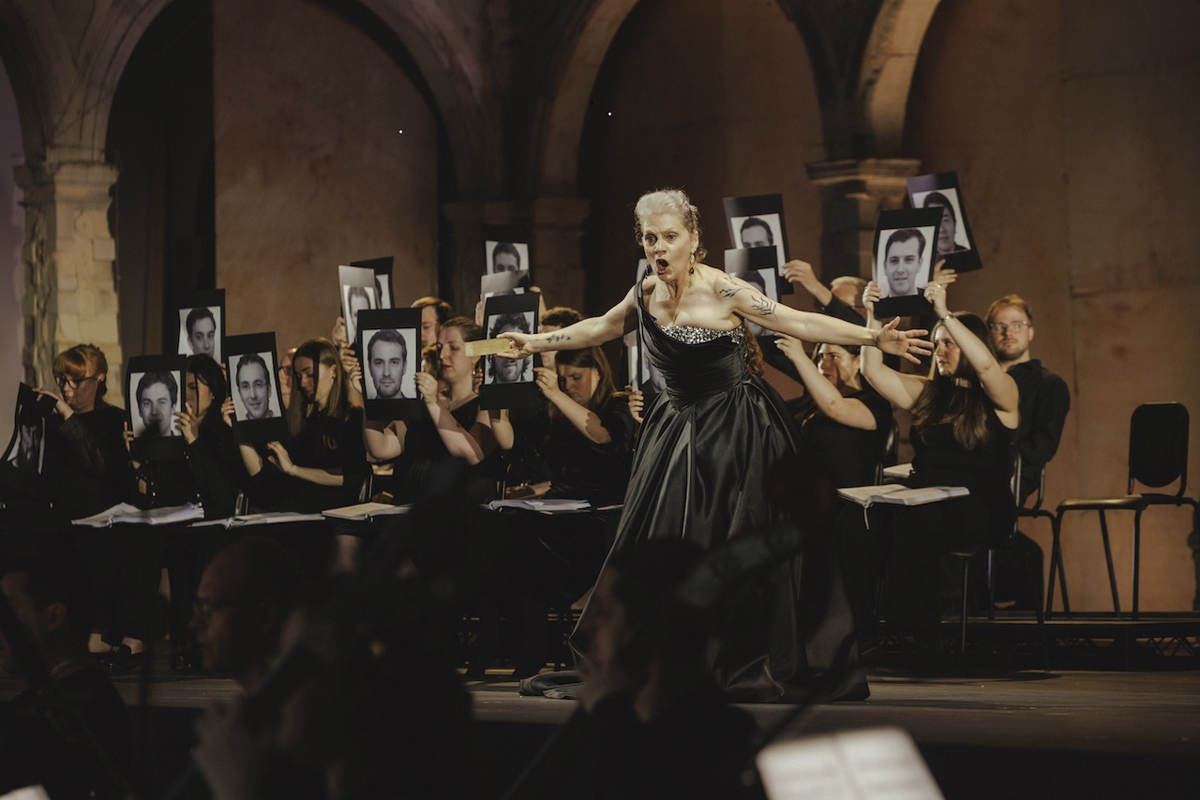
That love is at the heart of the opera, a much as ‘hope’ and ‘blood’ (the answer to the first two riddles), is a claim staked and articulated at its very end. Love for what? For the cruel ice maiden Turandot, trapped in a mythic oath, if not curse, and herself the correct answer to the third riddle? This production emphatically benefits from concert-staging rather than full-costume, which allows the music to wrap itself around the audience without distraction. Even so, there is plenty of ‘enacting’ by the chief protagonists, as they revolve around the central pit of the orchestra.
Turandot herself appears late in the opera and is sung with impressive panache by Anne Sophie Duprels. José de Eça yet again seduces the audience with his exquisite, lyrical tenor voice (Calaf’s is a huge and complex part), while Fflur Wyn (Liù) and Jihoon Kim (Timur) excel in their roles. As do Robert Burt (The Emperor) and the threesome of Ping (Josef Jeongmeen Ahn), Pang (Joseph Buckmaster), and Pong (Zwakele Tshabalala), whose extensive choric part plays a key role in advancing an otherwise static story of wager, death, and Pyrrhic triumphs in a mythologized gender battle. More than most operas Turandot involves a huge Greek-tragedy-style chorus, a partner and commentator in the action. OHP’s new Youth Chorus, a visionary initiative, has its inaugural outing here; adding to the excitement of a thrilling night out. The City of London Sinfonia has long been a much-loved part of Opera Holland Park; to the point where OHP is unthinkable without this superb array of talents who are yet again firing on all cylinders.
Composer: Giacomo Puccini (completed by Franco Alfano)
Libretto: Guiseppe Adami and Renato Simoni
Conductor: Naomi Woo
Director: Eleanor Burke
Chorus Master: Richard Harker
25, 27 June 2026
Running time 2 hours and 45 minutes
Photo credit: Pablo Strong