


One of the most striking images in Gesher Theatre’s production of Federico García Lorca’s The House of Bernarda Alba comes when the eldest daughter, Angustias (Carmel Kandel), stands on a table in her white wedding dress. The dress spills across almost the entire stage while her sisters methodically saw through it. Another memorable image opens the performance: the five sisters, dressed in black for their father’s funeral, huddle together carrying blood-red roses as they sing “Qué Será, Será (Whatever Will Be, Will Be),” the song immortalized in Alfred Hitchcock’s 1956 film The Man Who Knew Too Much. The two tableaux stand in stark contrast. The roses foreshadow the volatile mix of passion and violence that will soon engulf the house of Bernarda Alba – a home that has become a prison for its daughters.
Completed in 1936, only two months before Lorca’s assassination during the Spanish Civil War, the play is permeated by a sense of impending doom. It begins and ends with death. Following her husband’s demise, the domineering matriarch Bernarda decrees that her daughters must observe eight years of mourning, during which they are forbidden to leave the house. Men are not allowed inside, yet they are a constant presence in conversation, haunting the world just beyond the walls.
The most desirable man in the village, Pepe, intends to marry Angustias for her inheritance, a marriage that would offer her an escape from captivity. But beneath the surface another drama unfolds: the beautiful Adela has been carrying on a secret affair with him, while the less attractive Martirio silently nurses an unrequited love.
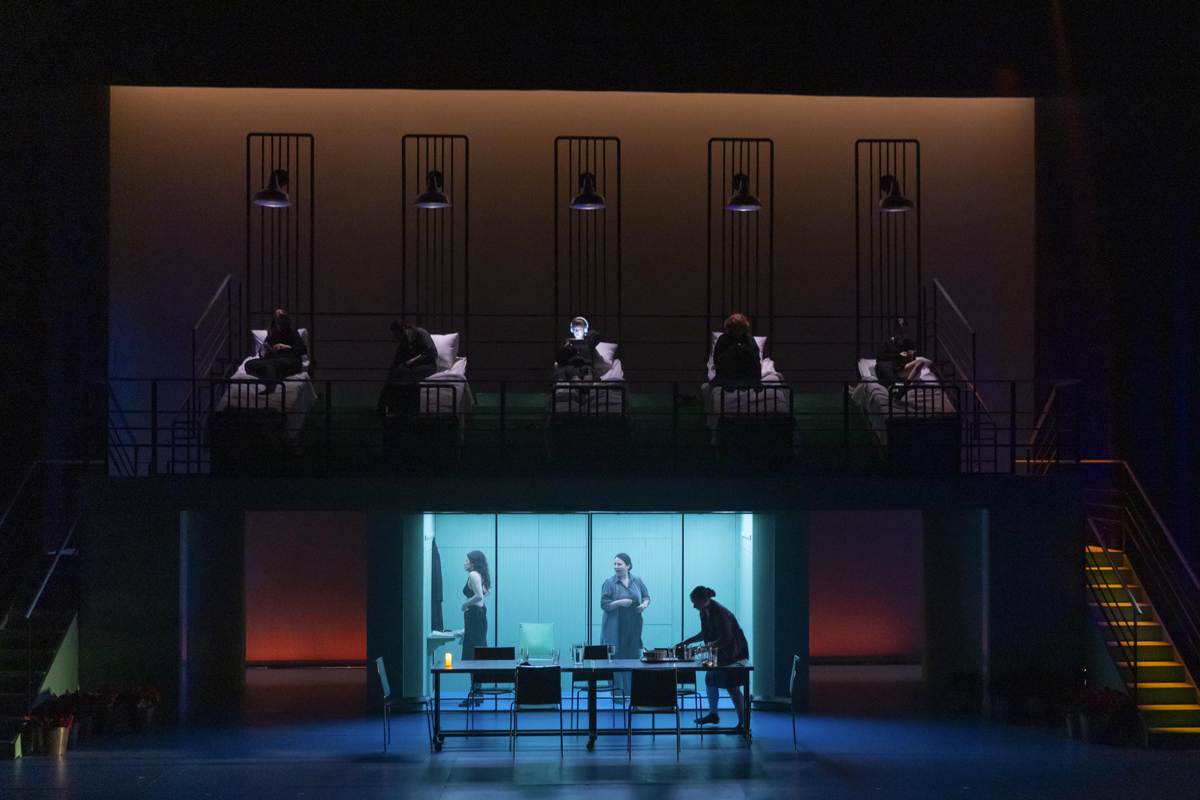
Michael Kramenko’s evocative set design is among the production’s greatest strengths. The stage is divided into two levels. On the upper floor, five narrow single beds stand side by side, each with its own lamp that doubles as a showerhead, evoking the institutional atmosphere of an orphanage or dormitory rather than a family home. Twin staircases on either side of the stage allow the daughters to move constantly between the two levels, reinforcing the sense of confinement within a rigidly ordered world. The house is frequently bathed in a sickly sulphur-green light, suggesting an asylum as much as a home. On the lower level, a room with sliding doors is used to particularly powerful dramatic effect in the final scene.
Alas, while the production, directed by Ido Kolton, is consistently beautiful to look at, rich in inventive visual ideas, it remains curiously emotionally flat. The forbidden passion is signaled rather than experienced – for instance, when Adela (Ofir Zweigenbom) stands bare-chested at the window, her back to the audience. The image is undeniably arresting, yet it generates surprisingly little emotional charge.
Efrat Ben-Zur’s Bernarda is less overtly tyrannical than the character is usually portrayed, an intriguing interpretive choice that lends the matriarch greater complexity. In the #MeToo era, her obsessive determination to keep her daughters away from predatory men can be seen in a more sympathetic light, complicating the traditional image of Bernarda as a purely oppressive figure. Yet the production never fully reconciles this interpretation with her sudden eruptions of brutality. When Bernarda shoves one of her daughters’ heads into a bucket of water, the act feels insufficiently prepared, making the violence seem arbitrary rather than the inevitable expression of her authoritarian nature.
The standout performance comes from Michal Weinberg as the housekeeper, Poncia. A voice of experience and hard-earned pragmatism, Poncia tries to comfort the daughters while quietly standing up to Bernarda’s tyranny. At one point, she advises Adela to be patient, remarking with chilling matter-of-factness that Angustias will surely die giving birth to her first child. Weinberg’s performance deftly balances warmth with cynicism, making Poncia both compassionate and unsentimental.
By Federico García Lorca
Direction: Ido Kolton
Set design: Michael Kramenko
Performed in Hebrew, with Russian subtitles
Cast: Efrat Ben-Zur, Michal Weinberg, Carmel Kandel, Ofir Zweigenbom
Running time: 1 hr 40 mins
Photo by Daniel Kaminski