


Tchaikovsky’s Pushkin-based opera traces Tatyana’s youthful infatuation with the worldly Onegin, his fatal duel with Lensky, and their devastating reunion years later, when the roles are reversed and Tatyana rejects him.
British theatre director Max Webster reframes the story through Tatyana’s inner world, exploring her hopes, dreams and emotional awakening with greater intimacy. The concept produces striking theatrical images, although some interventionist ideas ultimately undermine the opera’s dramatic momentum.
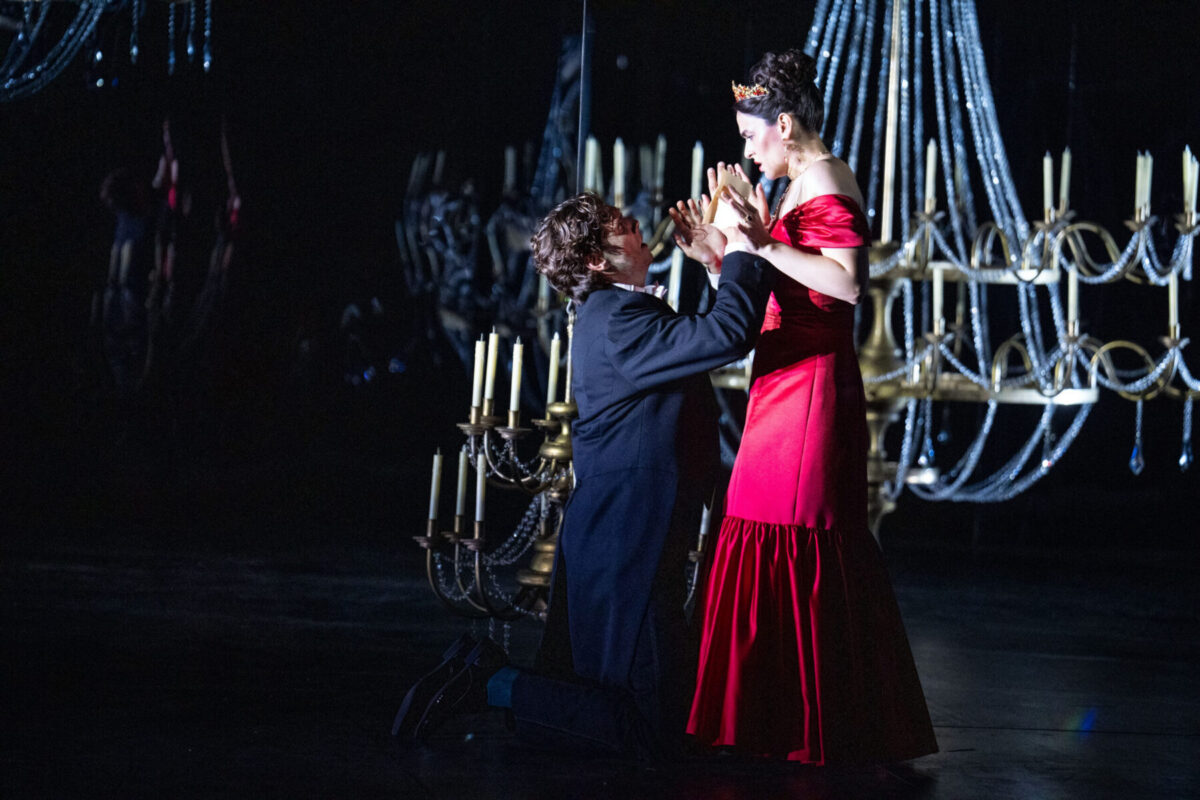
In Act I, Webster uses a chorus dressed in identical beige costumes to create a symbolic world in which everyone appears blandly interchangeable until Onegin’s arrival. His jade frock coat and matching socks bring colour to Tatyana’s otherwise monochrome existence. By Act III, the chorus has exchanged beige for black suits, while Tatyana, now dressed in red, becomes the vivid presence that disrupts the emotionally jaded Onegin, neatly reversing the opera’s emotional trajectory.
The production is at its strongest when Webster allows Tchaikovsky’s score to speak for itself. Some interventionist ideas are less successful. The duel, the opera’s emotional turning point, is played before the curtain rather than on the main stage, sacrificing the bleak inevitability suggested by the orchestral introduction. Instead of conveying the frozen morning’s stillness and sense of foreboding, the confrontation feels cramped and dramatically underpowered.
Its placement also weakens the drama. Traditionally following directly after the name-day celebrations, the duel here is delayed until after the lengthy interval and immediately precedes the St Petersburg scene set four years later. The loss of emotional continuity diminishes its impact.
Another puzzling decision comes in the famous Letter Scene. Although Tchaikovsky’s music vividly portrays Tatyana’s frantic writing, Webster has her write nothing at all, creating an unnecessary disconnect between music and stage action.
Although Gremin is often portrayed as an elderly man, Webster presents him as a younger, battle-weary figure, entirely consistent with the libretto and lending greater credibility to his relationship with Tatyana.
Arthur Pita’s choreography externalises emotions the characters cannot express. At times the dancers distract from Tchaikovsky’s score, particularly when multiple Tatyanas illustrate her inner turmoil during the Letter Scene. Elsewhere the choreography enriches the drama, especially in the final scene, where younger doubles of Tatyana and Onegin embody the life they might have shared as the principals sing Pushkin’s heartbreaking line, Счастье было так близко (“Happiness was so close”).
Russian-American conductor Lidiya Yankovskaya makes an impressive house debut, drawing sweeping passion and dramatic intensity from the score. She leads the Bournemouth Symphony Orchestra with assurance and flair, while the chorus, so central to Russian opera, sings magnificently throughout.
As Onegin, 2024 Operalia prizewinner Vladislav Chizhov confirms himself as one of the most exciting young Russian baritones to emerge in recent years. His rich, velvety timbre, broad dynamic range and remarkable sensitivity make for an exceptional assumption of the title role. The voice already hints at considerable Verdi potential.
Armenian soprano Ruzan Mantashyan is utterly convincing as the teenage Tatyana. Her Letter Scene is superbly paced, charting the character’s emotional uncertainty, vulnerability and growing passion with impressive vocal control. She captures both Tatyana’s innocence and her emotional awakening with complete conviction.
The final confrontation between Onegin and Tatyana, played against a striking backdrop of large chandeliers, crowns the evening. Chizhov and Mantashyan sustain the scene’s emotional intensity with performances of exceptional dramatic and vocal power.
Welsh tenor Ryan Vaughan Davies brings a clear, bright voice to Lensky. His “Я люблю вас, Ольга” (“I love you, Olga”) is warmly and passionately sung, while he convincingly captures Lensky’s impetuous temperament. His “Куда, куда” is beautifully shaped, filled with remorse and quiet resignation. His Russian is entirely serviceable, although greater linguistic refinement would further strengthen an already compelling performance.
Kazakh bass Mark Kurmanbayev brings warmth and richness to Gremin’s lower register. As the voice continues to mature, the middle and upper registers should acquire even greater depth.
Korean-American mezzo Alice Chung may not possess the dark Slavic timbre traditionally associated with Olga, but she brings warmth, charm and youthful vivacity to the role.
British tenor Toby Spence makes the most of Monsieur Triquet. He begins the Russian text with an unmistakably French accent before slipping naturally into French for his name-day song to Tatyana—a delightful detail that is too often overlooked.
Veteran English mezzos Catherine Wyn-Rogers and Diana Montague provide strong support as Filipyevna and Larina respectively, bringing warmth, dignity and humanity to their roles.
While not every directorial intervention convinces, Webster’s thoughtful production is anchored by outstanding musical performances. With exceptional singing from Vladislav Chizhov and Ruzan Mantashyan, this is an emotionally rewarding Eugene Onegin that deserves to be seen.
OPERA IN SEVEN LYRIC SCENES
Music by Piotr Ilyich Tchaikovsky
Libretto by Piotr Ilyich Tchaikovsky and Konstantin Stepanovich Shilovsky
Based on the verse novel by Alexander S. Pushkin
Conducted by Lidiya Yankovskaya
Directed by Max Webster
Choreography by Arthur Pita
First performance: 29 March 1879, Maly Theatre, Moscow
Cast includes Ruzan Mantashyan, Vladislav Chizhov, Alice Chung, Ryan Vaughan Davies, Diana Montague, Catherine Wyn-Rogers, Mark Kurmanbayev and Toby Spence
Bournemouth Symphony Orchestra
Running time: 5 hours (including a 90-minute interval)