


Mozart’s final opera, premiered at the Theater auf der Wieden in Vienna on 30 September 1791 just weeks before his death, is at once a fairy tale, a Masonic allegory, and one of the most endlessly reinterpreted works in the repertoire. Emanuel Schikaneder’s libretto gives the work its comic energy and popular appeal, while the music moves between the simplicity of folk song and a formal complexity that reaches its summit in the contrapuntal rigour of the Act II finale. The tension at the heart of Die Zauberflöte has always been ideological: is Sarastro’s brotherhood a genuine realisation of Enlightenment ideas, or does it harbour the authoritarian impulses that so often shadow utopian projects? Mozart and Schikaneder do not paint the question in black and white, thanks, above all, to the character of Papageno, whose simple appetites for food, wine and wife challenge the ideological rigour of Sarastro’s temple.
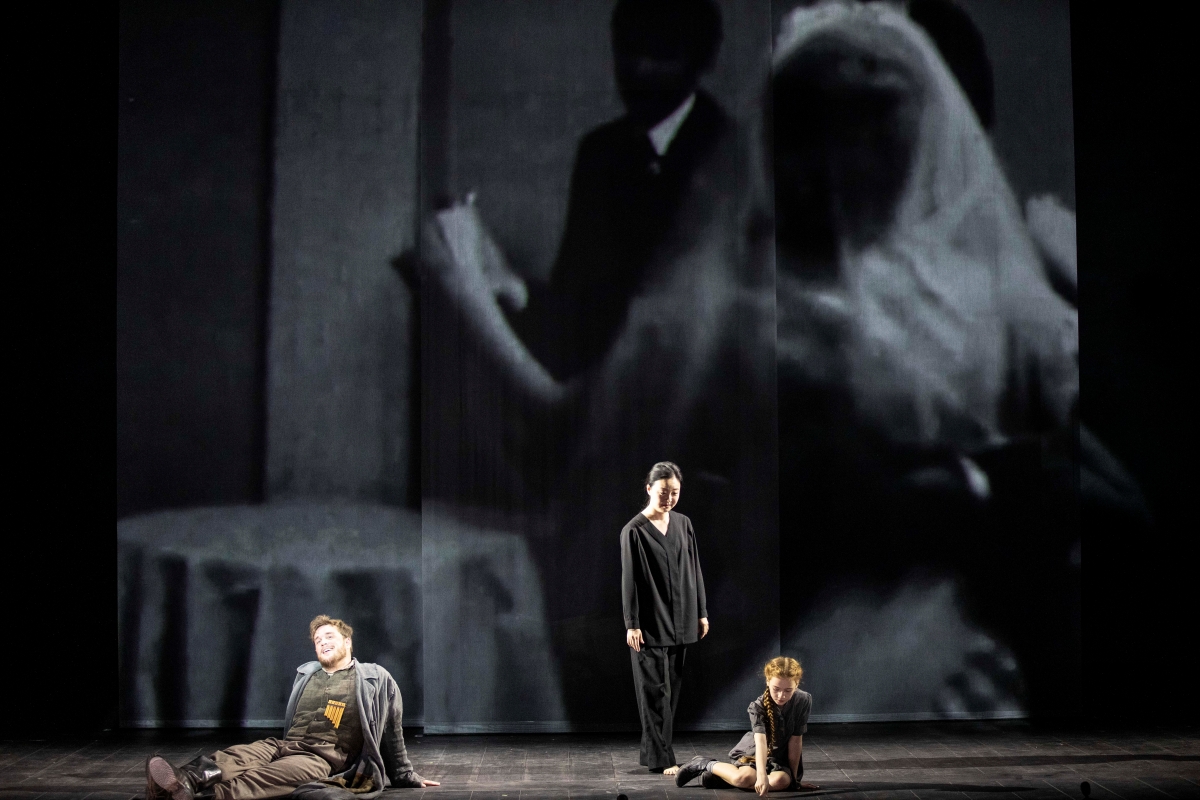
For this new production at the Festival d’Aix-en-Provence, director Clément Cogitore places that ideological question at the centre of his interpretation. He transposes the action to the twentieth century rather than the fairy-tale setting of the original. The overture opens on archive footage of Aix-en-Provence bombed in 1945: the audience is watching, in stark black and white, images of the theatre in which they are sitting reduced to rubble. Tamino and Pamina emerge as children in that ruined landscape, alongside the Three Ladies transformed into Germany’s Trümmerfrauen, the “rubble women” sifting the debris of postwar Europe. From this collapsed old world a new order takes shape: the American post World War II economic boom, with its highways, convertibles, and glass-and-steel skyscrapers, presided over by Sarastro as a corporate CEO. The Queen of the Night, meanwhile, appears as a schoolteacher surrounded by children. She represents the old order that insists on keeping us in perpetual infancy against the new order that, however imperfect, at least offers self-awareness.
What makes the production intellectually interesting is precisely this ambivalence. Cogitore is not simply celebrating the transition from ruins to prosperity: as Tamino drives an open convertible down American highways during Act II, the Californian forests behind him begin to burn. The economic expansion carries within itself the seeds of its own extinction. Papageno, in this context, becomes the most honest character of the evening: he fails the trials, refuses the ideological transformation, and remains happy with his basic satisfactions.
Cogitore’s most striking interpretative move is the portrayal of Tamino as a frightened child who becomes an adult only through the trials. The problem is that this reading is realised almost entirely through video projection, and the video eventually imprisons the very ideas it seeks to develop. Furthermore, Cogitore doubles Tamino and Pamina with child actors who lip-sync the sung text, while the adult singers, Mauro Peter and Ying Fang, watch from the sidelines. The concept works occasionally as a poetic idea but robs the singers of their bodies at the very moments when the music demands physical presence. The staging locks itself into a rigid format that, however carefully calibrated to the music, tires the eye over three hours.
Musically, this is García-Alarcón’s first Zauberflöte, and Cappella Mediterranea bring their period-instrument allure to the score. The tempi are meticulously calibrated to the video projections: the result is a performance of extraordinary precision, chiselled to the frame. Sabine Devieilhe’s Queen of the Night is worth the evening on its own: perfect coloratura, breath control of absolute security and musical intelligence. Sean Michael Plumb is a charismatic and finely detailed Papageno, and Brindley Sherratt gives Sarastro a warmth and humanity that resist the corporate reading imposed by the staging. Mauro Peter sings Tamino correctly if without particular distinction. Ying Fang’s Pamina is a revelation: a luminous soprano, though her reading highlights the character’s fragility rather than her strength. The Three Ladies are superb, their voices melting into one another with rare beauty. The children of the Knabenchor der Chorakademie Dortmund are astonishingly good.
Cogitore and García-Alarcón collaborated some years ago on Rameau’s Les Indes galantes at the Opéra national de Paris in a remarkable production. Their Zauberflöte is intellectually ambitious and musically excellent; it also asks its singers to sacrifice too much to its concept. An exploration worth watching, but not always enchanting.
Festival d’Aix-en-Provence, Théâtre de l’Archevêché, France
DIE ZAUBERFLÖTE (THE MAGIC FLUTE) – Singspiel in two acts, K. 620
Music by Wolfgang Amadeus Mozart
Libretto by Emanuel Schikaneder
Conductor Leonardo García-Alarcón
Stage direction and video Clément Cogitore
Set design Alban Ho Van
Orchestra Cappella Mediterranea
Choir Chœur de Chambre de Namur Children’s choir Knabenchor der Chorakademie Dortmund
Cast includes: Ying Fang, Mauro Peter, Sabine Devieilhe, Sean Michael Plumb, Brindley Sherratt, Edwin Crossley-Mercer
New production by the Festival d’Aix-en-Provence in co-production with the Theatres of the City of Luxembourg, Opera Ballet Vlaanderen
Running time: 2 hours 50 minutes with one intermission
Until 21st of July 2026
Photo credit Jean-Louis Fernandez