


Die Frau ohne Schatten (The woman without a shadow) is the fifth and most ambitious collaboration between Richard Strauss and Hugo von Hofmannsthal. Begun in November 1910 and delayed by the First World War, it did not reach the stage of the Vienna State Opera until October 1919. That nine-year gestation, straddling the upheaval of the war, altered the moral world of the opera. Strauss and Hofmannsthal conceived the work as a new Magic Flute, but where Mozart and Schikaneder still believed in the ideals of a rational and progressing humanity, Strauss and Hofmannsthal could no longer share that confidence. Written from within the collapse of the world that had believed in Enlightenment ideals, the opera carries that historical rupture in the very tissue of its score and expresses that tension through sensuous opulence.
The story centres on the Empress, half-divine and half-human, who must acquire a shadow within three days, or her husband will be turned to stone. The shadow has traditionally been read as the capacity for motherhood, but this reading has always been reductive. What Strauss and Hofmannsthal actually stage is a more philosophical question: what does it mean to become fully human? The shadow is the soul, the acceptance of human limits, responsibility, and the bonds that link us to others. All four principal characters begin the opera shadowless in some way; only one manages, through her refusal to steal another woman’s soul, to earn her own.
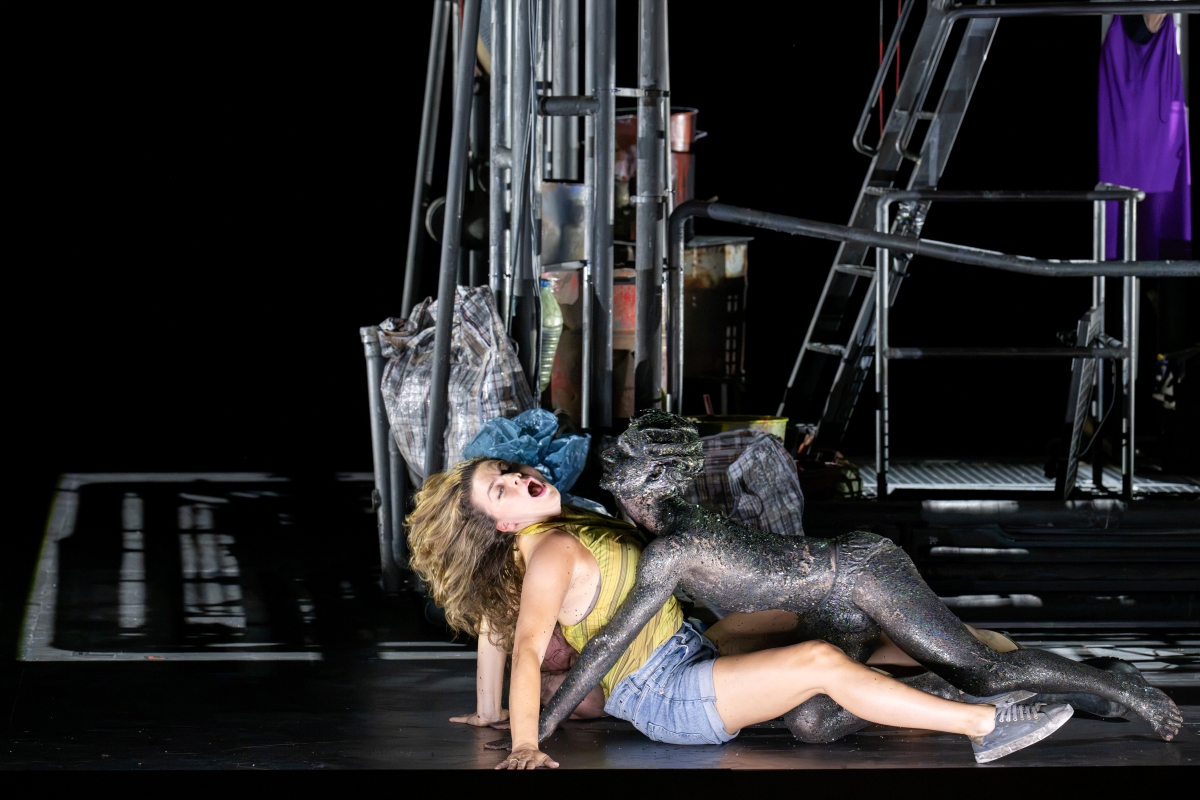
Die Frau ohne Schatten has long been considered virtually unstageable, dense with symbolism, and orchestrally vast. Barrie Kosky’s central achievement is to have found a staging that neither illustrates the fairy tale literally nor reduces it to a psychological drama. His approach is minimalist, built on stark contrasts. The world of the spirits is a black void from which images emerge as if from a dream: headless dancers in black sparkling gowns, a rocking horse on curved blades, a giant mannequin head with three pairs of legs. The Dyer’s household is by contrast a cramped, three-storey tower, teeming with smoke and physical labour. Two worlds, both black, but one dreamed and one lived. Act III abandons black entirely for a blinding white space that Kosky calls a “psychological torture chamber”, where all four protagonists face their final trial stripped of every symbol. The white of Act III is perhaps less visually inventive than what precedes it, but the acting under those lights is so intense that the loss barely registers. Kosky directs his singers with an almost obsessive attention to gesture and intention, and it is that precision that carries the final act.
At the pit, Klaus Mäkelä makes his true operatic debut with an interpretation of astonishing maturity. His reading of the Strauss score is analytical without ever losing its dreamy, romantic shine: transparent middle voices, dosed climaxes that never saturate, chamber-music delicacy in the interludes. What is most remarkable is the balance between pit and stage. This is not a conductor imposing his reading from above; the orchestra breathes with the singers as a single organism. Instant standing ovations at every interval.
The cast is at the level the score demands. Vida Miknevičiūtė’s Empress traces the evolution from remote sovereign to compassionate human being with luminous projection and rare interpretive intelligence: her declaimed “Ich will nicht” (I will not), when she refuses to steal the Dyer’s Wife’s shadow, is the moral fulcrum of the evening. Ambur Braid is a Dyer’s Wife of extraordinary emotional range: the impossibly demanding Act II finale is delivered with complete command, and her final penitence is entirely credible. Michael Spyres brings a crystalline transparency to the Emperor, his long legato lines and Act II monologue among the finest singing of the evening. Brian Mulligan’s Barak is the moral centre of the opera, a baritone of warm timbre and precision, his pianissimi laid on the orchestral waves like a caress. Nina Stemme’s Nurse remains a stage presence of terrifying authority, the manipulator whose bronze timbre and dramatic instinct still command every scene she enters.
This edition of the Festival d’Aix-en-Provence has centred on the question of what makes us human. In the Requiem it was extinction and resilience; in Die Zauberflöte, the fragility of enlightenment; here, the acceptance of imperfection. An unforgettable evening.
Festival d’Aix-en-Provence, Grand Théâtre de Provence, France
DIE FRAU OHNE SCHATTEN (THE WOMAN WITHOUT A SHADOW) – Opera in three acts
Music by Richard Strauss
Libretto by Hugo von Hofmannsthal
Conductor Klaus Mäkelä
Stage direction Barrie Kosky
Set design Michael Levine
Orchestra and Choir Orchestre de Paris
Cast includes: Michael Spyres, Vida Miknevičiūtė, Nina Stemme, Brian Mulligan, Ambur Braid, Jean-Sébastien Bou, Tomasz Kumięga, Daniel Miroslaw, Robert Lewis, Ella Taylor, Héloïse Mas, Prince Mihai
New production by the Festival d’Aix-en-Provence in co-production with La Monnaie / De Munt, Greek National
Opera Running time: 3 hours 50 minutes with two intervals
Until the 15th July 2026
Photo credit: Monika Rittershaus