

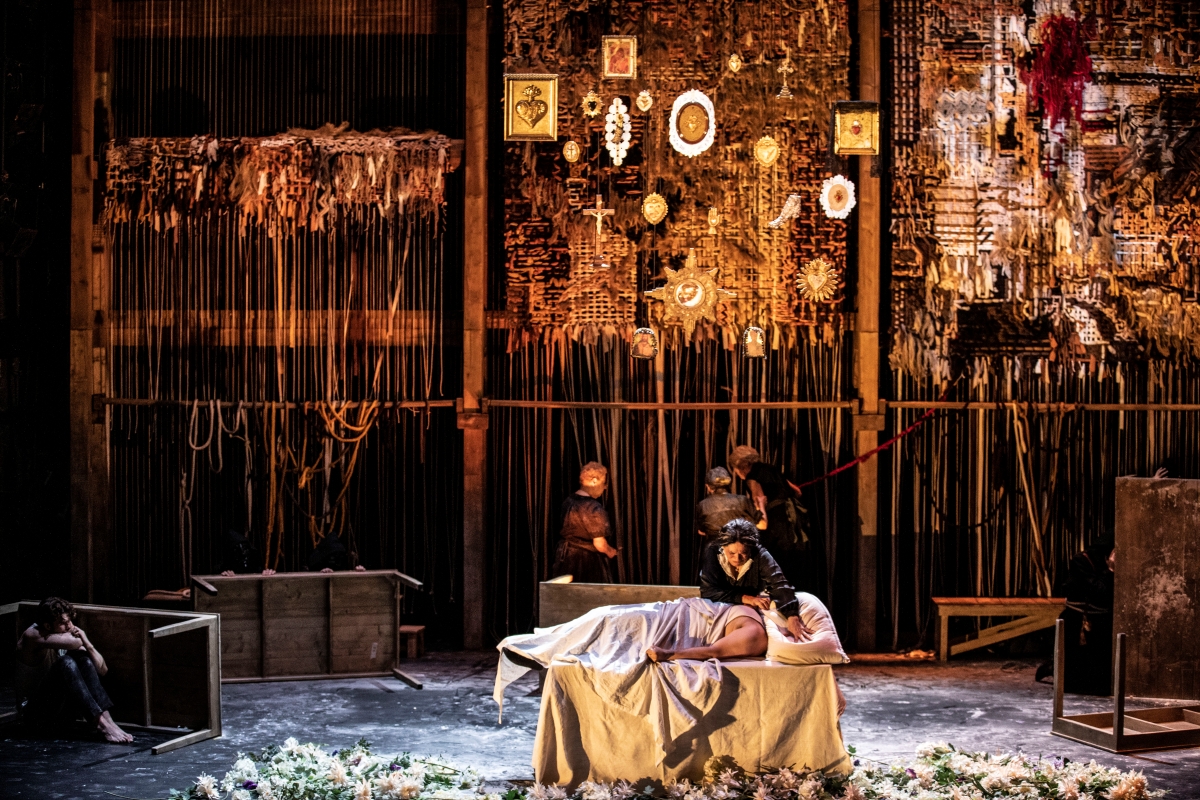

The Sardinian word accabadora comes from the root of the Spanish verb acabar, “to finish,” and denotes the woman who brings things to an end. It names a figure once real in the villages of Sardinia: a woman who, upon request, brought an end to the lives of those too sick to go on living with dignity. She was the community’s tactful answer to a death that would not come naturally.
In Murgia’s 2009 novel, that role belongs to Tzia Bonaria, who carries a second function alongside the first one: she is the non-biological mother of Maria, a fill’e anima, a “soul-child” given away out of poverty in a social structure inconceivable to today’s morality, where a mother might hand over one of her children and a childless woman might choose one as her own. Bonaria delivers death and chooses a daughter; the two vocations, giving and taking life, meet in a single austere woman. From this doubling the whole drama unfolds.
Francesco Filidei, one of the most recognised composers on the European contemporary scene, wrote the music for this visceral book. The connection is personal: his grandmother was Sardinian, and he has said that he recognised traits of her in the character of Tzia Bonaria. The two were to have written the libretto together. However, after her early death in 2023, Filidei completed it, aided by Manuelle Mureddu for the Sardinian he wanted heard on stage. Apart from some scenic adaptation, the opera follows the situations and the evolution of the novel’s characters closely.
The music is faithful to Filidei’s manner: a language of pauses and suspended atmospheres, of near-physical sensations, such as the wind through a vineyard, and of domestic sounds stirring memories such as the bells of goats or the cuckoo clock of his grandmother’s house. An accordion colours much of the orchestration. True melodies surface in the lullabies, in the wailing of the women at the funeral and in the chorus of tenors singing in Sardinian. They serve as narrative voice, a sort of Greek chorus, but also as the sounding portrayal of a society in which collective and personal life are inseparably bound. Elsewhere Filidei moves away from melodies and holds to a rhythmic declamation that follows the natural accent of the Italian. However, the power of this opera lies in the compelling musical characterisation of the main characters: each of them has a specific line of singing; the drama sharpens when these different lines harmonise or collide.
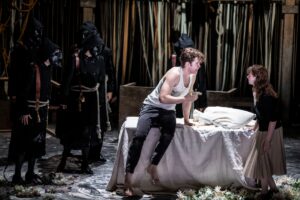
That collision reaches its height in the opera’s crucial scene: Nicola’s death, which marks the turning point of the story. Young Andría declares his love to Maria at the very moment he is recounting the death of his brother Nicola, over the wailing of the women’s chorus and the men’s prayer beneath. Love, death and communal lament sound together, three layers held in one page. Here the opera stops merely illustrating the novel and achieves its miracle: several voices, each singing its own feeling, resolved into a single musical truth.
Valentina Carrasco gives Murgia’s Sardinia theatrical life, drawing on ancestral rituals and repetitive gestures with a social function but perhaps a therapeutic one too. The stage opens with old women weaving on giant looms; elsewhere, kneading the bread and harvesting the grapes become collective labour and communal rite at once. Throughout the opera, the dead haunt the living in the masks of the Sardinian mamuthones. Their number swells as each villager dies and joins them, a slow visual accumulation of mortality that gives the staging an eerie presence.
The cast equally contributes to the success of the performance. At the centre stands Noa Frenkel’s Tzia Bonaria, a wonderful contralto, with a powerful dark register that gives the accabadora her intensity and authority. Against her, Rachel Masclet’s Maria, a bright young soprano, is credible both as a genuinely shocked young woman and as a strong person able to decide her own future. Hugo Brady and Lodovico Filippo Ravizza convincingly portray the dynamics between the two adolescent brothers, Andría and Nicola. Finally, Victoire Bunel shines in her doubled role as the schoolmistress and as Nicola’s mother. In the pit, the Orchestre de l’Opéra national de Lyon under Lucie Leguay is precise in the dynamics and tempo on which Filidei’s dramaturgy depends.
The production succeeds in building, visually and musically, the atmosphere of Murgia’s Sardinia, and it confirms Filidei as a compelling composer of opera. But it stands, too, as a testament to the missed Michela Murgia, one of the most outspoken women of her generation, whom illness took away far too early.
Festival d’Aix-en-Provence, Théâtre du Jeu de Paume, France
ACCABADORA – Chamber opera in one act (world premiere)
Music by Francesco Filidei
Libretto by Francesco Filidei and Manuelle Mureddu, after the novel by Michela Murgia (2009)
Conductor Lucie Leguay
Stage direction and set design Valentina Carrasco
Orchestra Orchestre de l’Opéra de Lyon
Cast includes: Noa Frenkel, Rachel Masclet, Lodovico Filippo Ravizza, Hugo Brady, Victoire Bunel, Francesco Leone
Co-commission and co-production Festival d’Aix-en-Provence, Theatres of the City of Luxembourg, Tiroler Festspiele Erl, Opéra national de Lyon, Opéra de Dijon, Teatro Comunale di Bologna
Running time: 1 hour 20 minutes without intermission
Until 10th July 2026
Photo credit Jean-Louis Fernandez