


Rossini was 20 when La scala di seta premiered in 1812 — a remarkable year in which he composed five operas, three of them one-act works. The young composer already had a reputation for nocturnal adventures: risqué words were scribbled on the score, and the opera’s midnight ladder escapades perhaps reflected experiences with which he was familiar. Despite its success, performances declined as the popularity of one-act operas waned.
La scala di seta is classic opera buffa: Giulia is secretly married to the penniless Dorvil, who climbs a silk ladder to visit her every midnight, while her guardian Dormont intends to marry her off to the unwanted suitor Blansac. Giulia’s sister Lucilla falls for Blansac instead, and marries him. Central to the chaos is Germano, the servant who is the pivot around which the whole drama revolves — simultaneously conspirator, observer, and comic troublemaker, forever trying to keep secrets while making matters considerably worse.
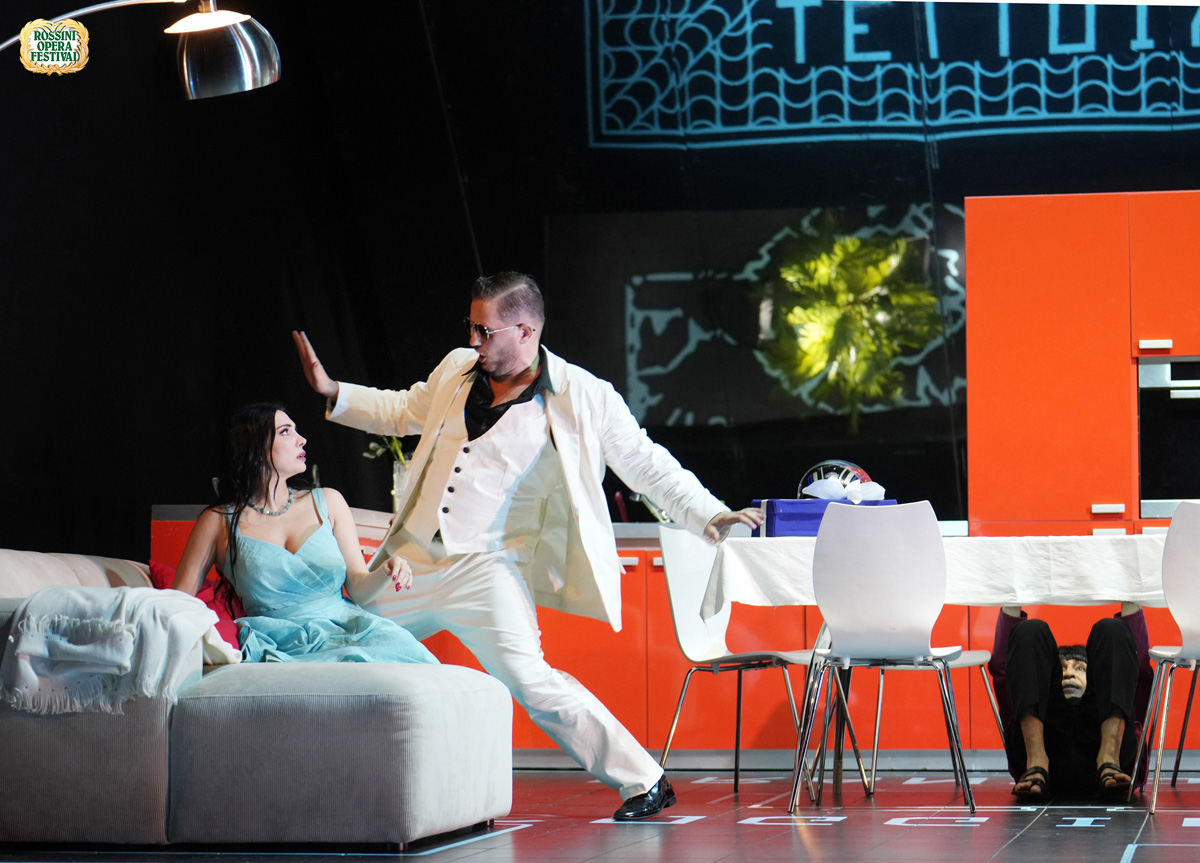
This revival of Damiano Michieletto’s celebrated 2009 production, with Paolo Fantini’s ingenious set, is a triumph of theatrical invention. The stage begins completely bare, while an angled overhead mirror reveals an apartment floor plan marked out below. During the overture, stagehands assemble the furniture, transforming the plan into a home before our eyes; the characters are wheeled in immobile, coming to life with the music. Doors exist only on the floor plan — when characters move between rooms, they open and close imaginary doors, a simple device generating endless comic possibilities. Even the Italian coffee maker matches the red kitchen.
The mirror offers a second perspective, revealing spaces hidden from the main stage, including the laundry room behind the kitchen and the ladder itself: instead of someone simply appearing at the window, we first see their reflection at the bottom of the mirror as they begin the climb. There is so much going on that one needs to see the production several times to appreciate it all.
Mexican conductor Iván López-Reynoso keeps up the breathless pace with aplomb.
Paolo Bordogna’s warm bass-baritone is one of today’s leading buffo voices, and his Germano is the standout of the evening — immaculate miming and comic timing combined with close attention to the words and Rossini’s demanding vocal agility. Germano is reimagined here as a Filipino cleaner, a recognisable popular Italian television character of the 2000s: not dim, simply unable to grasp Italian customs, forever getting the wrong end of the stick. Even while negotiating the most demanding music, he keeps up his chores — making coffee, cleaning the floor — and Bordogna brings an enviable range of vocal and facial expression to it all.
Most of the cast are young talents nurtured at the Pesaro Rossini Academy. Armenian soprano Hasmik Torosyan, a 2014 Academy alumna, looks stunning as Giulia and flies through Rossini’s runs. Her voice is not conventionally beautiful, but its steely edge conveys Giulia’s determination. She sings one aria while performing aerobic exercises — an impressive demonstration of vocal control that underlines the production’s emphasis on physicalising the comedy — and adds spectacular high notes not in the score.
Australian tenor Alasdair Kent’s toned physique is on display from the outset, making it easy to understand Giulia falling for Dorvil. His first aria, “Vedrò qual sommo incanto,” reveals perfectly articulated roulades and lovely pianissimo top notes, though the voice gradually tires, thinning out and losing variety of colour.
Italian mezzo Mara Gaudenzi’s velvety, bronzed voice as Lucilla is the finest of the evening after Bordogna’s. She brings warmth and sensuality to the seduction aria “Sento talor nell’anima,” and during her duet with Blansac comically transforms from dowdy maid to determined seductress — Blansac the womaniser will be tamed.
Ukrainian baritone Iurii Samoilov is a suitably over-the-top, arrogant, oily Blansac. His well-projected voice has a seductive timbre, nuanced with spontaneous accents, and his characterisation is so vivid that one scarcely notices how little music Rossini gives him in this version — his aria “Alle voci della gloria” is omitted. Resplendent in white, he flicks his sunglasses on and off theatrically as he turns on the charm; a highlight is his attempted seduction of Giulia while mixing cocktails.
Italian tenor Enrico Iviglia makes an engagingly fussy but sympathetic Dormont, though his light voice struggles to be heard alongside the more substantial voices around him.
A sparkling evening of irresistible Rossinian fun.
Music by Giachino Rossini (1792-1868)
Libretto Giuseppe Foppa
Conducted by Ivàn López-Reynoso
Directed by Damiano Michieletto
Set and Costumes Paolo Fantin
First performance 9 th May 1812 Teatro San Moisè, Venice
Photo Credit Amati Bacciardi
Cast includes Enrico Iviglia, Hasmik Torosyan, Mara Gaudenzi, Alasdair Kent, Iurii
Samoilov, Paolo Bordogna
Running time 1 hour 30 minutes
13,16, 19, 22 August 2026