

‘One for the heart, one for the head and one for fun’, ‘ is the mantra applied by artistic director, Rosetta Cucchi to this year’s festival; and she herself directs the first of these, Iris, Mascagni’s second opera, something of a staple at Wexford over the years. It is a symbolic reading of Japan, seen from fin de siècle Europe; orientalist to be sure, but much more subtle and oblique in many ways than Puccini’s Madama Butterfly, with which it is often unfavourably and unfairly compared.
Iris is a village innocent, caring for her blind father, and living in a world of dolls and dream-like fantasy. She is easy prey for a pimp, Kyoto, and a decadent rake, Osaka, who use the device of a travelling puppet show to entrance her with make-believe and lure her into their grasp. She is whisked off to Yoshiwara, the red-light district of Edo where she is lodged in a brothel and dressed in gaudy robes. While traumatised, she still manages to resist Osaka, but when her father, who has followed her, assumes the worst and brutally disowns her, she throws herself into a sewer and is left for dead. In the final act she revives long enough under the warmth of the sun to move beyond the male selfishness that has destroyed her life and transforms into the flower that bears her name, as the music repeats the stirring hymn to the sun which frames the work overall.
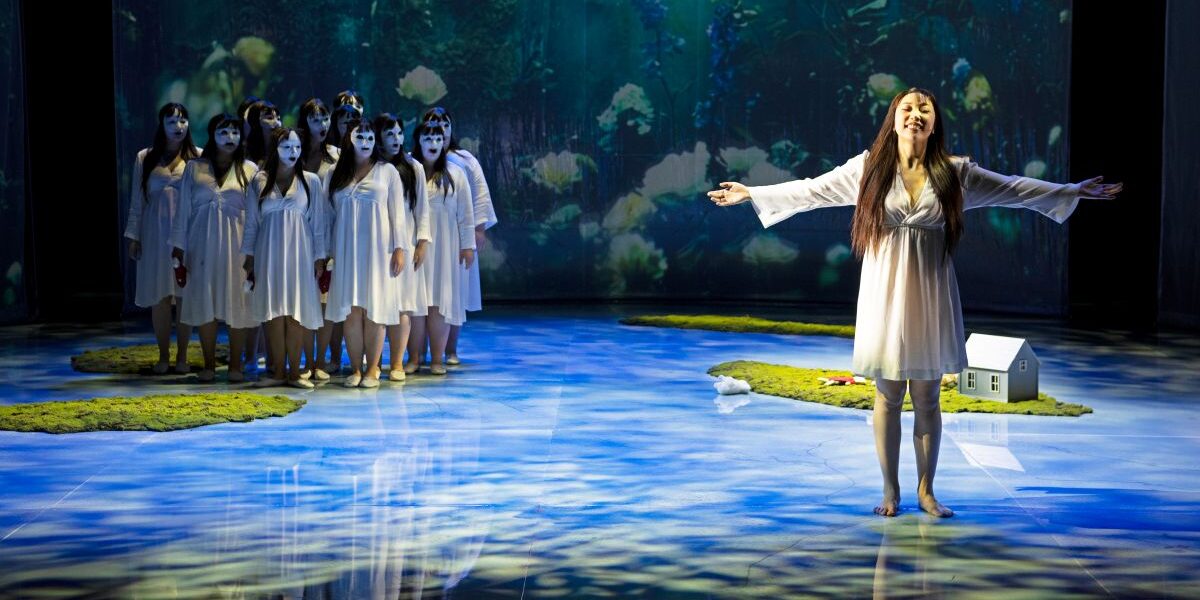
The success of this opera stands or falls on the performance in the demanding title role, and here Leyla Gu is quite outstanding. In lesser hands Iris can be overly passive and as uninteresting as one of the dolls with whom she passes her time. But Gu is fully in command of the technical demands of the role, and able to introduce subtle acting skills that confer far more agency and self-assertion to the role. Initially her character has charm and grace of movement, but she really comes into her own once the sufferings of Iris begin – limp and helpless as she wakes in the brothel, passively resisting as she is dressed in mock finery, and finally pushing back decisively against her confinement and humiliation. When her transformation takes place in the final act you feel it to be well prepared and earned rather than arbitrary, a natural culmination and vindication, rather than an arbitrary ending applied to justify a sumptuous final number.
The second stand-out feature of this production is the orchestral playing, which really benefits from curation by Mascagni specialist Francesco Ciluffo. We receive proof of that right at the start where the brooding, sombre lower string writing emerges out of the darkness with a Wagnerian intensity before building swiftly into a huge orchestral and choral climax in praise of the sun and life spirit. Yet alongside the big splashy gestures, much of the writing is extremely delicate and poised, incorporating reference to Japanese instruments too. The orchestra was fully across all these challenges and the ebb and flow of the pacing never faltered in its tasteful good judgement.
Tiziano Santi’s set is also an important factor in the collective succes and sytlistic unity of the production. In a symbolist rather than realistic opera there is a premium on daring and imagination and here the powerfully contrasted landscapes of the three acts combine to provide a unique colour and tone for each episode – watery, dreamy blues and greens first of all, as if you are looking down at the lily pond in Giverny; garish reds and golds for the travelling theatre troupe and the brothel, and then leaching away into the drab dirty greys of the sewer, before a final radiant sunburst. The visual projectdion is geographically vague but always precise in suggested mood.
Not all the performances were impeccable. Joseph Calleja, for all his reputation, delivered a routine account of the one substantial tenor aria, with little light and shade. He was in fact consistently outsung by his criminal sidekick Jolyon Loy, whose acting and singing were sufficiently sinister to earn him the compliment of many ‘boos’ at curtain call. There were also useful cameos from Jihoon Kim, as the blind father and Hannah O’Brien as the sympathetic courtesan, Dhia. Chorus, dancers and puppeteers provided subtle and sympathetic background detail to flesh out the ambience.
This opera is hard one to get right and an easy one to get wrong. In all important areas this production succeeded.
Music: Pietro Mascagni
Libretto: Luigi Illica
Conductor: Francesco Ciluffo
Director: Rosetta Cucchi
Cast includes: Joseph Calleja, Leyla Gu, Jihoon Kim, Jolyon Loy, Hannah O’Brien
2hrs 40 mins with interval
Until 31 October 2026
Photo Credit: Padraig Craig