

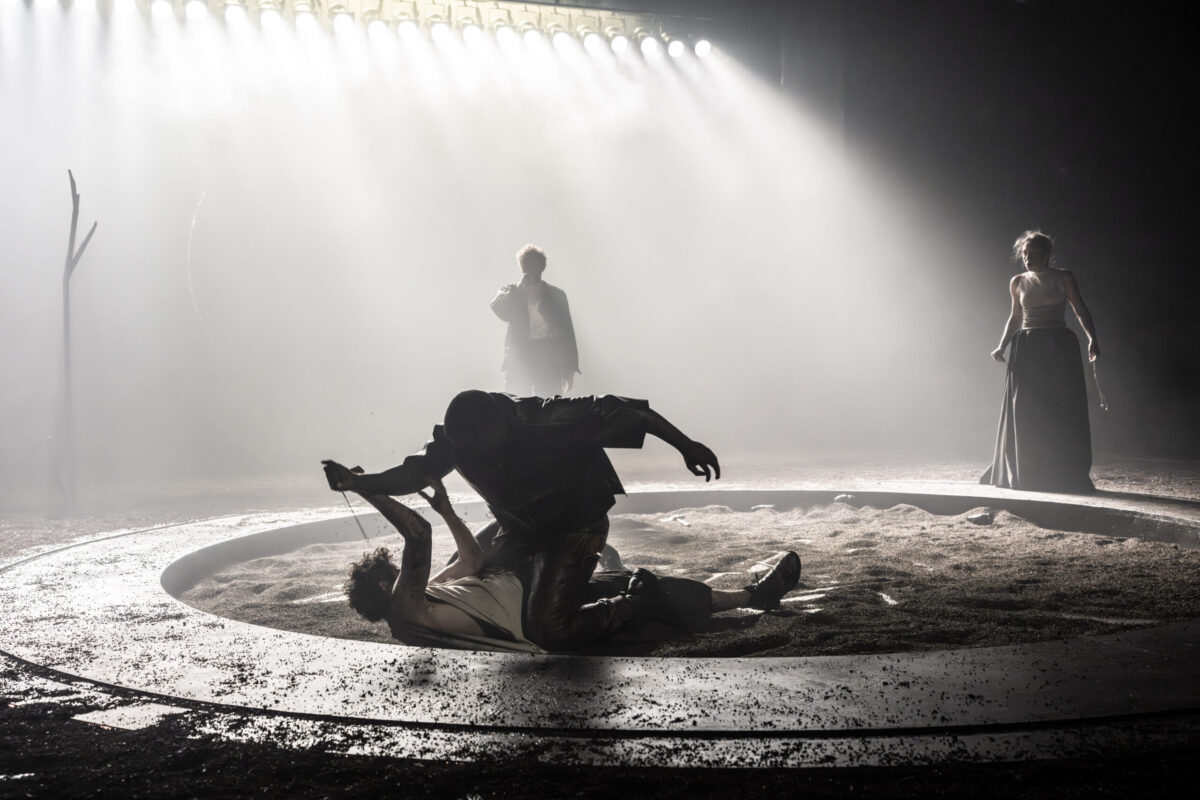

Shakespeare’s King Lear, first performed in 1606, still finds new ways to entrance an audience in Titas Halder’s striking Crucible production. Through Halder’s steady directorial hand and Richard Kent’s assured costume and set design, the production lays the groundwork for an all-star cast’s talent to reverberate through the Crucible’s famous thrust stage. No seat in the house is immune to the ramblings of Ian McDiarmid’s confounding King Lear, nor to the breakdancing-encrusted physical comedy of Max Revell’s Fool. Nor is any seat shielded from the bloody horror of David Birrell’s freshly blinded Earl of Gloucester. With each new scene unfolding, I was convinced I had found my favourite cast member, and that line of logic was as circular as the stage upon which it was set.
Immediately, I was struck by the stage’s sparseness. Expecting a set as lavish as the extravagance of Lear’s opening love contest, I found nothing except brutalist concrete, deliberately perfunctory lighting, and the tactile grit of earth, with a slightly below-level centre circle. Sound was equally sparse and intentional, becoming noticeable only through carefully chosen strokes, such as the choral, layered chant of ‘sun’ that accompanies the final scuffle between Edmund and Edgar. These elements made the space feel particularly cold and unwelcoming, forcing each character to enact their cruelties before one another (and the audience) without the momentary distractions of an over-embellished set.
Costume is similarly stripped back yet consistent in its visual logic. While the majority of the characters’ costumes remain largely unchanged, Regan’s (Justina Kehinde) jewellery swap being one stunning outlier, Lear’s trajectory can be traced through his costume changes alone. He is adorned in pearl-white robes for the opening scene alone, before descending into grunge in a black leather trench coat during his ostensibly ‘rebellious’ phase, producing a comedy of its own. His final two changes into rags and a paper hat reminiscent of Peter Pan reflect his inability to grasp his mortality. His ultimate transition into sharing the Fool’s wardrobe, by contrast, undoubtedly marks the moment of their dramaturgical fusion. The decision to align Lear with the Fool is alluded to in the source text. But it is Yarit Dor’s synchronised choreography between the two that draws these parallels to the foreground. The result is the most striking bond onstage.
Despite such bleak subject matter, Halder’s adaptation seeks out moments of ephemeral comedy. The most obvious example, and truest to the source material, lies in the function of the Fool, whose sole existence hinges on his capacity to entertain. Max Revell takes this opportunity to a whole different dimension, performing cartwheels and bodily contortions that equally draw out Lear’s playfulness. It is only when the Fool becomes immobile before the interval that the darkness descends both physically and emotionally. Even in the throes of his madness, McDiarmid’s Lear navigates the stage with lucidity and naive joy, conducting a self-assuredly ridiculous performance in which he hobbles about with his trousers down. For audiences familiar with McDiarmid’s Emperor Palpatine, this Lear productively unsettles expectations of him as an unambiguously cruel old man, revealing someone at once ridiculous and tragically misguided.
Edgar and Edmund’s subplot has often been thought of as the lesser narrative strand. Halder complicates that hierarchy by rooting Fode Simbo’s masterful Edmund on stage during the opening scene, frozen in a dutiful bow in Lear’s presence — a choice that marries the two subplots beautifully through themes of deceit and familial duty. It is not uncommon to feel lost in this Shakespearean tragedy of multiple family trees, letters, and ulterior motives. Yet the decision to centre the core Shakespearean text, retaining the iconic lines and fleshing them out with seamless additions, is a kind gesture towards audiences who may not be familiar with the original story.
This adaptation’s greatest strength lies, in my opinion, in its persistent tactility. ‘She’s as dead as earth,’ McDiarmid’s Lear asserts as he carries Bebe Sanders’ Cordelia into the dirt-trodden centre stage. Alongside the primal use of fire to light the stage in moments of tension and the smell of smoke filling the room, harnessing these elements reminds us of the very human and grounded realities that lie beneath the grandeur of King Lear. Greed, corruption, fractured familial relations, and the misalignment between speech acts and truth are not limited to the Renaissance stage or world.
Crucible Theatre, Sheffield
King Lear by William Shakespeare
Director: Titas Halder
Set and Costume Designer: Richard Kent
Cast includes: Ian McDiarmid, David Birrell, Mark Holgate, Justina Kehinde, Harry Redding, Max Revell, Bebe Sanders, Fode Simbo, Katie Wimpenny
Running time: around 2 hours and 55 minutes (including interval)
Runs until: Sat 19 September 2026
Photography by Johan Persson