

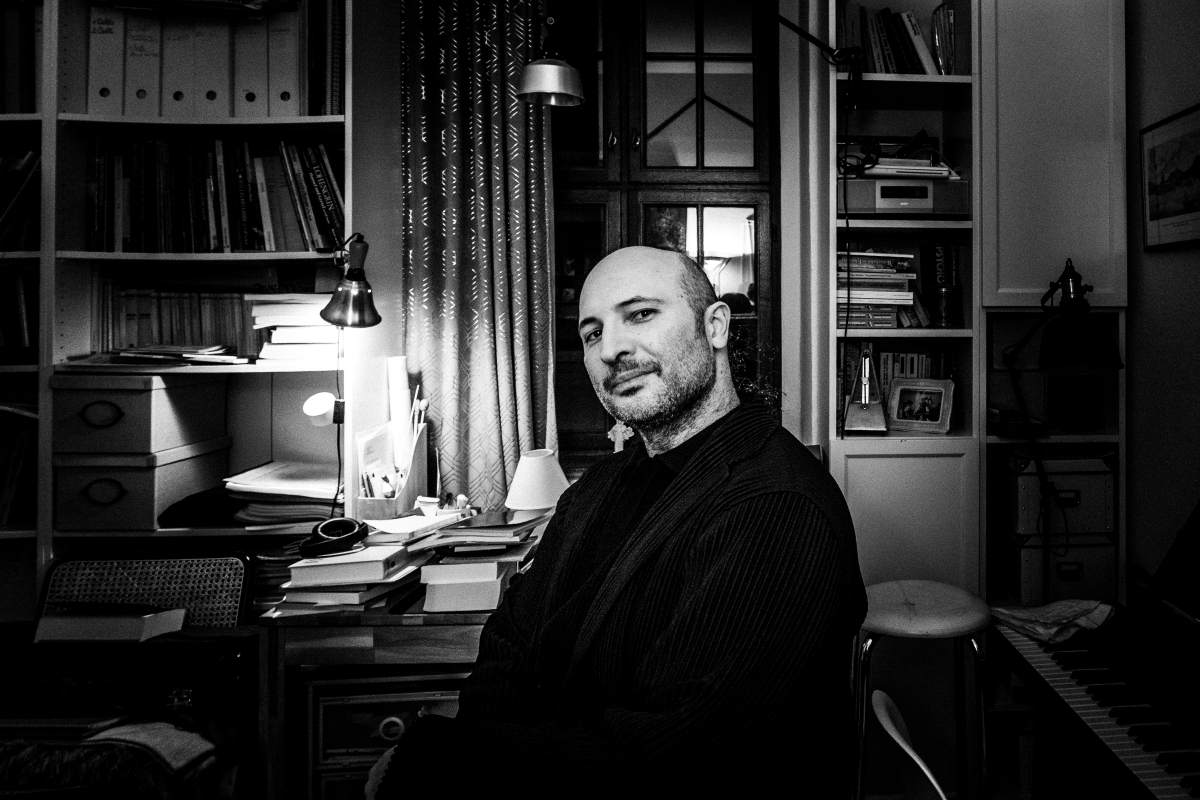
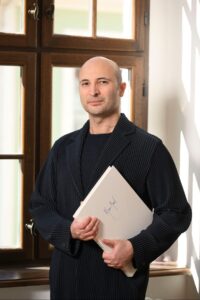
We meet Gaetano d’Espinosa during the run of his Cavalleria rusticana at the Teatro Massimo di Palermo, Mascagni’s masterpiece which the Palermo-born conductor brings to his home city. An unusual formation, made up of violin studies with Salvatore Accardo, composition, and a conducting debut that arrived almost by chance, alongside a career shaped by years at the Dresden Staatskapelle, first as concertmaster and later as a conductor. We spoke with him about his training, about interpretative tradition, and above all about how, note by note, one builds a reading that refuses sentimentality without losing the Sicilian character of the score.
AZ: What drew you toward conducting? Was there a specific moment when you thought: this is my path?
GdE: More than a specific moment, I’d call it an opportunity. I was still concertmaster at the Dresden Staatskapelle when the chance came up to revive an old chamber orchestra, the Dresden Kammerorchester, which had been very active internationally before the fall of the Wall and was then neglected amid the great structural changes of the 1990s. A manager in Berlin, in 2005, wanted to relaunch it and asked me to conduct it, having sensed a talent for conducting in me. I had studied violin and composition, so in a way the request had some grounding. There are no musicians in my family, but there was always an openness that, I have to say, saved me; and once I entered the professional world, especially once I was in Germany, I received a great deal of help from colleagues. Even before that manager, the first person to tell me it might be worth trying to conduct was a colleague at the Staatskapelle. Frustrated with one of the usual uncommunicative conductors: he told me, almost selfishly, ‘you’re surprisingly musical, you have so many ideas, you’re very expressive: why don’t you try it?’ The biggest push, though, came from Fabio Luisi, who was then principal conductor at the Staatskapelle; he told me plainly: ‘as far as talent goes, you absolutely have to focus on this career.’
AZ: Your path is unusual for a conductor: piano, violin with Salvatore Accardo, composition. Can you tell us more about your training?
GdE: I studied piano more as a complement to composition than as a solo instrument. The instrument I studied at a solo level is the violin, with Salvatore Accardo, after an earlier training with Mihai Spinei, a principal violist of the Orchestra Sinfonica di Milano. I studied composition with Turi Belfiore, a teacher who was already retired, who had also taught Salvatore Sciarrino. I started with him at twelve: an enormous advantage, being able to begin privately so early.
AZ: What did studying violin with Accardo leave you, concretely, in the way you ask an orchestra for phrasing today?
GdE: I worked with Accardo both as a student and in the orchestra, when he conducted his Orchestra da Camera Italiana. Many of the things he said to the violinists as a conductor have stayed with me, they’re part of a vocabulary that’s easily accessible to musicians. There’s also a question of language: musical Italian has concepts that don’t exist in other languages, and vice versa. It matters, because sometimes just ten seconds too long spent searching for the right word can lower an entire orchestra’s concentration.
AZ: Which conductors have most shaped your path, and what were the hardest moments?
GdE: I learned an enormous amount by playing under many different conductors, even before making my first gesture in front of an orchestra of professionals. And I had the advantage of having spent years in an orchestra that is also an opera orchestra, the Dresden Staatskapelle, the same one that belonged to Giuseppe Sinopoli, then Bernard Haitink, then Fabio Luisi. One of the hardest parts of a career, in this sense, is having to maintain professional relationships in different places that don’t always speak easily to one another. I think, for instance, of how complicated it is to coordinate work in Japan with work in Germany. And then there’s the maturing process Karajan himself often spoke of: at first, you fear every mistake. Then you realize that a well-rehearsed group already offers you a foundation you can trust, and that the more you communicate with breadth and a wide vision, the more trust comes back to you.
AZ: You’ve described your approach to conducting as being close to Fabio Luisi’s: allowing the composer to shine rather than imposing a strongly personal interpretation. In practice, how does that choice play out in front of a score as often performed as Cavalleria?
GdE: I think an interpretive choice is always the result of two things. On one side, your personal point of view, your own experience, which becomes your idea of sound. On the other, the material you’re given, that is the orchestra, and above all the singers. In practice, for this production, I had to build two slightly different Cavalleria for the two casts: one singer wants a different colour, one has longer breath, the other shorter, one finds a note easier and the other finds a different note easier. And it’s a little different from evening to evening too. Opera is a genre where the accompaniment can never be as perfect as that of a piano concerto; it’s like a living magma. Richard Strauss used to say, about conductors arguing over technique, that some swear by the wrist, some by the arm, but that in his view you should conduct with your ears. I agree.
AZ: This opera’s ‘Sicilian-ness’ always risks slipping into the picturesque. Where does that colour come from, musically?
GdE: You must think about the period the opera was composed in. Mascagni certainly wanted to create a Mediterranean colour, but without drawing on real Sicilian folk melodies. It isn’t an ethnomusicological project in the Bartók sense; it’s more an invention of colour, a bit like Bizet’s Carmen doesn’t contain real Spanish melodies, but melodies ‘in the Spanish style.’ At the time, though, there wasn’t a precise idea of Sicily, and people thought they were authentic; even Brahms fell for it, charmed by those ‘so beautiful’ melodies. The great advantage for Mascagni was that Cavalleria conveyed a sense of freshness at a moment of crisis for symphonic music, after Wagner. It was not a pretentious or intellectualized music, and was hugely effective on stage for its brevity, even with episodes clearly derived from Wagner. A kind of lightened Wagner, one might say.
AZ: In your production, with Marco Gandini’s direction, the focus stays on psychological drama, without indulging in folklore or sentimentality. How did you keep the tempi so tight?
GdE: There are moments where one could ease up a little. I’m thinking of a point where the chorus has to follow a curve in the staging during the procession, where a small compromise on tempo is needed for technical reasons. But in general, I aimed for a light-footed Cavalleria, even while accommodating, at times, important voices and long breath, without the risk of sliding into dramaturgical sprawl. The balance I look for is that the orchestral moment stays in the foreground when it needs to, and that the orchestra recedes a little when the singing arrives, without ever disappearing.
AZ: The Intermezzo is perhaps the moment most exposed to the risk of Romantic excess. How did you think it through?
GdE: In the score, the main melody, the one with the organ, is marked pianissimo. In practice almost everyone, even conductors very faithful to the text, like Riccardo Muti, opens it out at full voice from the start. I had thought about actually playing at least the first phrase truly pianissimo, and then building a big crescendo toward the end, looking for colour rather than tempo: expression should be sought in the sound, not in slowing down. It’s a deliberate distancing from a model like Karajan’s, which started from an idea of opulent sound that’s almost unrealizable here: he worked with string sections of twenty-five violins, an inheritance from Furtwängler and, ultimately, from Wagner himself. But if you think, as an example, that only seven first violins played at the world premiere of The Flying Dutchman, you realize how much that idea of sound was, historically, an exception rather than a rule.
AZ: The story of Cavalleria Rusticana is built around jealousy, betrayal and violence between men and women. In the theatre’s press release, superintendent Marco Betta also connected the production to the contemporary issue of femicide, which has become a major subject of public debate in Italy. Do you think today’s awareness of violence against women changes the way we perceive this story, or should we try to leave those contemporary associations aside and let the opera speak for itself?
GdE: In Verga’s original novella, there is actually a scene that never appears in the opera: Lola’s last meeting with Alfio. She asks him where he is going, and he tells her that he has something to do and that it would be better for her if he never came back. The suggestion is that he may intend to kill her as well. That scene is not in the opera: Lola and Alfio only meet, together with the mother, before the duel. At the same time, I think it is inevitable that we perceive these stories differently depending on the time in which we live. There is a simple example that comes to mind, the one associated with Wittgenstein: for centuries people believed that the sun revolved around the Earth because that was how it appeared to them. In the same way, the experiences and concerns of our own time inevitably influence the way we look at a work of art. That doesn’t mean, however, that we should impose our own contemporary interpretations on the opera. Cavalleria Rusticana was already dealing with questions of jealousy, betrayal, violence and human relationships when it was created. Those themes were part of the power of Verga’s story and Mascagni’s opera then, just as they remain meaningful to us today. So, I prefer to let the opera speak for itself.
AZ: How did you find working with director Marco Gandini?
GdE: Very straightforward, because he’s a director who knows music, who cares about it, and who was open to compromise, especially with the soloists. With the chorus there was a technical constraint: the score calls for two separate choral groups, one near and one distant, with a spatial effect that wasn’t achievable here given the size of our forces. We solved it by having everyone enter gradually, starting from inside. It isn’t the ideal written in the score, but it’s the best that could be done.
AZ: Have you ever worked with highly conceptual directors who impose their own narrative on an opera?
GdE: That happened to me once, with Peter Konwitschny, for a Norma. In his case, he was, so to speak, in a weaker position, because he didn’t know Italian and still had to take on that title; he found interesting things all the same, and I have to say that staging a piece starting from a translation isn’t impossible at all. However, that, in general, isn’t an issue for me. I have a problem when someone overlays an idea that was thought up beforehand, not truly for that specific piece. I have less patience for directors who, whatever they put on stage, always tell the same story, with the same fixation, sometimes even just an audio-visual one. They like, say, women screaming, and so they find a way to work in a scream, even if the moment is a dance and has nothing to do with it.
AZ: Future projects?
GdE: I’m going back to Palermo for some concerts, then to Japan, where in January a trio of mine for clarinet, violin and cello will be performed in Tokyo. I also have projects as a composer: I recently joined the roster of composers published in Vienna by Universal Edition, and on February 20th 2027, right at the Massimo, my Andante für Dimitrij will be performed.
AZ: Thank you, Gaetano, for sharing your thoughts and experience with Plays to See. We wish you all the best for the rest of this run, and for everything still to come, from Tokyo to the Massimo