

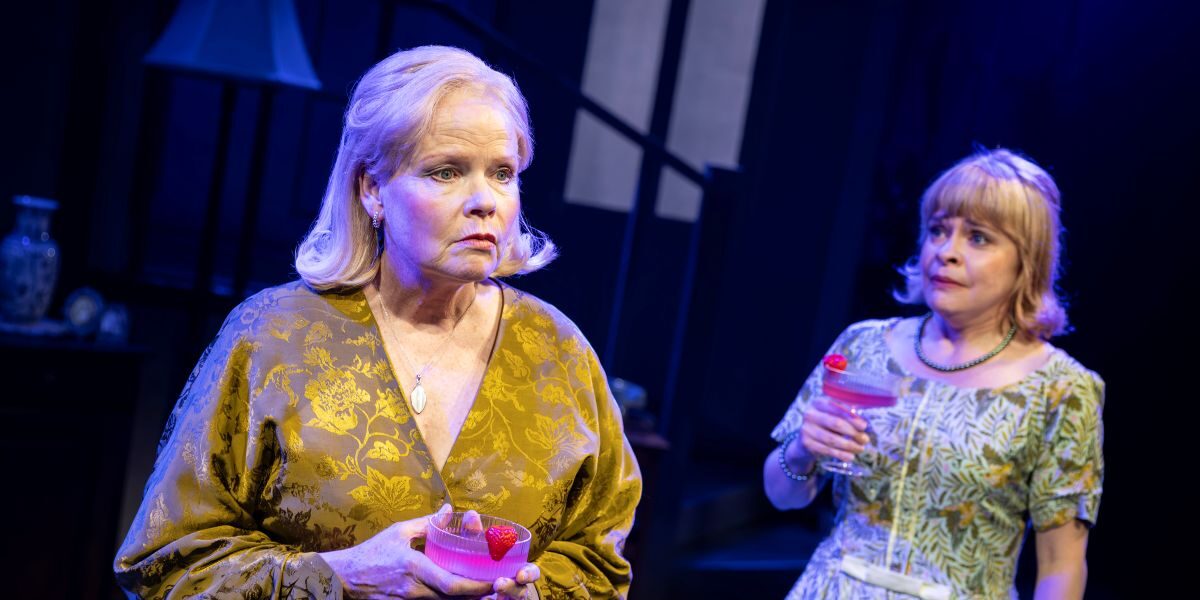

I must be one of the very few people in the press night audience who did not actually know the plot of this famous Miss Marple story and so I came to the play without preconceptions. This is one of Christie’s later novels – dating from 1962 – and while the setting is still the timeless English pastoral of St. Mary Mead, it is overlaid with Hollywood glamour as a movie star take up residence in the local stately home, where a murder takes place, through a poisoned daiquri, possibly intended for her. Miss Marple, hampered by a sprained ankle, but as keenly perceptive as ever over the foibles of human nature, sets out to assist her fairly clueless nephew Chief Inspector Craddock. There are the usual false trails and bait-and-switch plotting, and I was, as usual, quite wrong in my interval-time bet on the murderer’s identity.
All the familiar virtues of a production at the Mill are in place – the lucid, well-furnished period set, with good sightlines from every angle, a – mostly – well-made play that suits the tastes and needs of the local audience, and good balance of intriguing characters – it is worth remembering that Christie is not only about plot but also pyschology – the interplay of the various suspects and the revelation of the complex mix and hopes and fears that make up fatal motivations.
As things unfolded I had some reservations about Rachel Wagstaff’s adaptation. Often I find myself complaining about a shapeless Act 1 leading to a tighter Act 2, but in this case the reverse applied. In the first half the structure was tight and fluent as one short scene, including reenactments, followed another. Miss Marple helped us look at the problem from all angles, like examining a piece of cut glass searching for the flaw. But the second half, in contrast, was sprawling and diffuse, ending also with a moralising speech that seemed out of character for the genre, striking a wrong final note.
Liza Goddard, in the lead role, is still finding her feet in this play, both literally and symbolically. I would expect her performance to gain depth and force as the run progresses. But overall there is fine ensemble playing from the cast. Sara Crowe, as Marina, the movie star, has the right air of entitlement and mystery for a role played on film by Elizabeth Taylor, and there is compelling support from Jordan Taffe-Watson as her protective husband and Martin Raspopov and Lydia Kirton, as other members of her staff. Annie Wensak is a convincing sounding board to Goddard as gossipy neighbour Dolly Bantry, and James Mack does his best with the hapless policeman, as usual in Christie, a few steps behind the investigative pace. Elysia Showan and Saskia Strallen are convincing as two characters who turn out to have several layers beneath their surface appearance.
It is important to remember that a visit to the Mill is also a culinary experience, and, if anything, the quality of the dining was better than ever: a new catering company has raised the standard even higher, so that I should really be writing a restaurant review now as much as a theatre one!
Writer: Agatha Christie, adapted Rachel Wagstaff
Director: Jonathan O’Boyle
Cast: Sara Crowe, Liza Goddard, Paul Kemble, Lydia Kirton, James Mack, Jane Quinn, Martin Razpopov, Elysia Showan, Saskia Strallen, Jordan Taffe- Watson, Annie Wensak
Until 31 October 2026
2 hours with interval
Photo Credit: Pamela Raith