

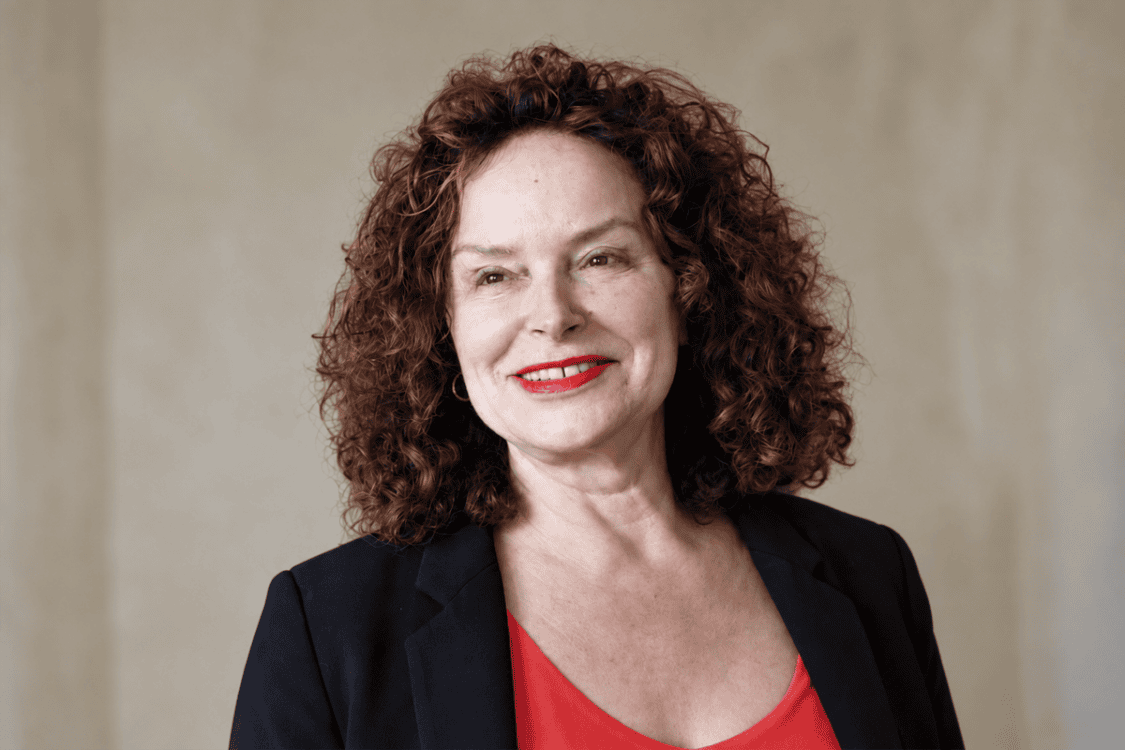

Julia Pascal in conversation with Rivka Jacobson
In conversation with Plays To See, playwright and director Julia Pascal discusses the forgotten history behind The Banality of Evil: Hannah Arendt, France 1940, the women who inspired it, and the challenge of bringing their extraordinary experiences to the stage.
Some productions linger long after the final curtain. Julia Pascal’s The Banality of Evil: Hannah Arendt, France 1940, at London’s Arcola Theatre, is one of them.
In 1940, Jewish women who had fled Nazi persecution were arrested and interned by the French authorities, in the very country where they had sought refuge. Pascal transforms this little-known history into compelling theatre, where fear, hunger and humiliation coexist with humour, music, friendship and the determination to survive.
An all-female cast of six brings these experiences vividly to life. At the centre are Hannah Arendt (Mai Weisz), the future political philosopher; Charlotte Salomon (Anna Eckhard), the gifted artist; and Eva Daube (Ariella Barnett), a politically committed teenage refugee. Alongside them are Trude Gottlieb (Pat Dynowska) and Agathe Blumenfeld (Helen Goldwyn), while Anja Fahlenkamp performs multiple roles, her operatic singing adding another expressive dimension.
A forgotten history
The play began with an unexpected family revelation. In 2017, Pascal’s cousin David told her about the internment camp at Gurs in southwestern France. Despite years spent studying fascism in France, she had never heard of it.
“I was shocked to hear this story,” she recalls. “This history is very difficult to find in most French records which detail the events of 1940.”
Her research took her to the Departmental Archives in Pau and the Wiener Library. Arthur Koestler’s The Scum of the Earth helped her evoke the atmosphere, while conversations with people connected to the women offered glimpses of their personalities.
“Eva’s son and granddaughter gave me a sense of her character,” she explains. “Older male academics I knew had been Arendt’s students in the US. Slowly I constructed characters from what people said about these women.”
The history she uncovered was deeply troubling. The French authorities had rounded up refugees, many of them Jewish, before the better-known arrests and deportations associated with Vichy France.
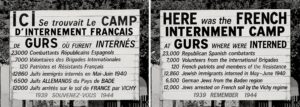
“It is uncomfortable for France to display this history,” Pascal observes, “as the rounding up of mainly Jews in 1940 happened before the Nazi Occupation.”
For Pascal, the subject also has a personal dimension. The granddaughter of Romanian Jews, she grew up conscious of the Holocaust’s devastating impact on her family.
“My father taught me about what happened to his generation when I was a child. A portrait of Anne Frank was in the house to remind me of what his generation escaped.”
Her father’s cousins in Lithuania were murdered by the Nazis. Her Romanian grandparents survived imprisonment during the Holocaust and under the Communist regime. Pascal also recalls experiencing antisemitism from primary school.
These experiences, together with years of listening to survivors and studying their testimonies, sharpened her determination to write about the destruction of European Jewry.
Three women, three responses to danger
Hannah Arendt, Charlotte Salomon and Eva Daube emerged from Pascal’s research, although their encounters in the play are imagined.
“I have no idea if they were there in the same place at the same time,” she acknowledges, “but I imagined that they were.”
The three offered her contrasting dramatic possibilities: “the Intellectual Leader (Arendt), the Artist (Salomon) and the Political Idealist (Daube).”
Arendt is familiar to many as one of the twentieth century’s great thinkers. Pascal wanted to reveal the younger woman behind that formidable reputation.
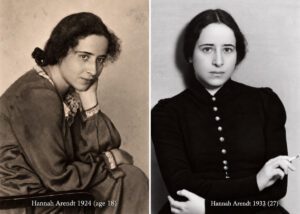
“Arendt was described to me as a huge brain. I wanted to present this but also to reveal the ironic, witty, confident, sexual woman behind this image.”
Hannah’s intellect does not protect her from uncertainty. She must confront decisions for which philosophy offers no easy answers.
Eva, meanwhile, brings youthful conviction and a passionate belief in Communism. Her clashes with Hannah expose the tensions between political certainty and independent thought, particularly over Jewish identity and Zionism.
Charlotte represents another response to catastrophe. Her artistic imagination becomes a means of asserting her humanity against the forces threatening to destroy it.
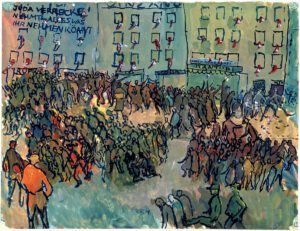
For Pascal, art is an act of defiance.
“You can murder a people but you can’t murder their art. Art is immortal and is a weapon against all who want to cancel us.”
Beyond the image of the victim
One of the production’s greatest strengths is its refusal to portray the women solely through their suffering. They argue, joke, fantasise and challenge one another, retaining their individuality even in the most degrading circumstances.
“I hate the cliché of the suffering Jew onstage,” Pascal says. “It was vital to me to show the many textures of each individual.”
Her research revealed how women drew strength from their former lives as artists, teachers, writers, composers and doctors.
The all-female casting is deliberate. Pascal believes that women’s experiences of the period, particularly sexual violence, have too often remained hidden beneath shame and silence.
One of the production’s most harrowing moments is the rape of Trude (Pat Dynowska) by a French gendarme. No male performer appears. Instead, the assault is conveyed entirely through Dynowska’s physical performance: the movements of her body, the horror and pain registering across her face, and finally the sigh of relief when the ordeal is over.
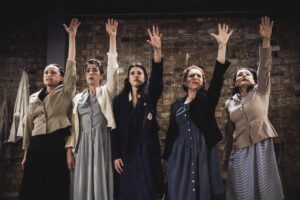
Nothing is depicted graphically, yet the violence is unmistakable. It is an extraordinarily powerful scene, precisely because we experience it through the woman’s response rather than the perpetrator’s actions.
Pascal explains that this perspective was fundamental to her approach.
“There is a rape scene in the play that is shown without a male cast member. In fact, this is delivered from the woman’s point of view, which is rare in sex scenes onstage or on film.”
When survival tests morality
Trude later steals bread from the other prisoners and is put on trial. Having witnessed her earlier suffering, we are confronted with an uncomfortable question: how do we judge someone who has been wronged but who also wrongs others?
Pascal refuses to idealise her characters. “All humans are complex,” she insists.
In a camp where hunger and disease threaten survival, familiar moral certainties begin to unravel.
“I wanted the audience to think about whether the individual should put herself first or be encouraged to consider the welfare of the group.”
Remarkably, Pascal did not know how the trial would end when she began writing it. “When I wrote the scene I had no idea how it would end. I knew that I wanted Hannah to judge but I also wanted to take her on a new journey.”
Returning to Arendt’s interest in Greek philosophy, she began considering the relationship between thought, physical existence and the body’s need for nourishment.
“Allowing myself to free associate brought me to the idea of how the brain needs calories to function and how something as small as stealing a crust of bread from another, in this camp, is a form of murder.”
It is one of the play’s most disturbing insights: under extreme conditions, even a seemingly minor act can become a matter of life and death.
The meaning of evil
The title inevitably recalls Arendt’s later writing about Adolf Eichmann. But Pascal’s drama takes place more than two decades earlier, when French authorities themselves were arresting and imprisoning refugees.
What interests her is the ease with which cruelty becomes routine.
“It is the casualness of cruelty that strikes me in this mass arrest and incarceration. It is an administrative directive where a large machinery of state organisation comes into play.”
The officials carrying out these orders need not be exceptional monsters.
“I don’t think that the gendarmes in the play were necessarily racist,” she says, “but they were conditioned to obey the state and also they were paid to do this.”
Even the language used to classify people becomes dangerous.
“I am sure that the naming of people as ‘undesirable’ can be the first step to their elimination.”
Pascal also wanted to challenge the tendency to reduce Hannah Arendt herself to one famous phrase.
“When I told people I was writing about Hannah Arendt nearly all of them knew this phrase but not much else.”
Her play invites us to encounter Arendt at 33, long before the Eichmann trial, and to recognise the contradictions and richness of a life that cannot be contained within a single philosophical formulation.
Art outlives its creator
Although the audience knows the fate awaiting Charlotte Salomon, Pascal was determined not to end in despair.
“I wanted the play to end with hope even though we know of her murder.”
Charlotte had no choice but to remain in France. Without sponsors in the United States, escape was beyond her reach. Aware that her life was in danger, she devoted herself to painting, creating nearly a thousand gouaches that became her extraordinary work, Life? Or Theatre?
Before her arrest and deportation to Auschwitz, she left behind an extraordinary body of work exploring love, abuse, violence and dreams. Her paintings survive today in Amsterdam.
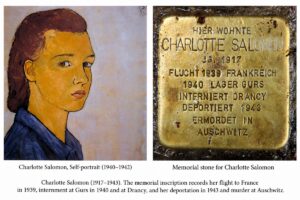
For Pascal, this artistic legacy offers a measure of hope amid the tragedy.
“Therefore, she still lives.”
The play’s contemporary resonances are unmistakable, although Pascal cautions against suggesting that history repeats itself precisely.
“We have to work hard to recognise the Other as ourselves,” she says.
For now, she hopes the production will find a life beyond the Arcola, particularly in France, Germany and the United States.
“I am happily surprised by the warm response in London and the full houses. This suggests that an afterlife is possible if money can be raised to give the production a future.”
It deserves that future. By restoring individuality, imagination and moral complexity to women too easily consigned to the margins of history, Pascal has created a work that is both theatrically compelling and deeply humane
