


It would be hard to find anyone who does not know the film version of Wladyslaw Szpilman’s memoir, a film that is often cited as one of the best made in the first quarter of the century. In recent years Szpilman’s heirs have given permission to Thom Southerland to develop a musical out of the same story, but using the pianist’s own compositions as the soundtrack.
The story follows the same familiar lines: a slow-burn first half in which we meet the author’s talented, comfortably-off Jewish family in their Warsaw apartment, with their lives focused on music. Gradually the world closes in on them, as Poland falls to Nazi Germany and they are imprisoned in the Ghetto, where there lives degrade until they are dispatched by train to their deaths. In the second half we follow the twists and turns of Szpilman’s remarkable solo survival in Warsaw through the Warsaw Uprising, subject to every kind of threat, ordeal and varieties of cruelty and kindness – humanity at its best and worst.
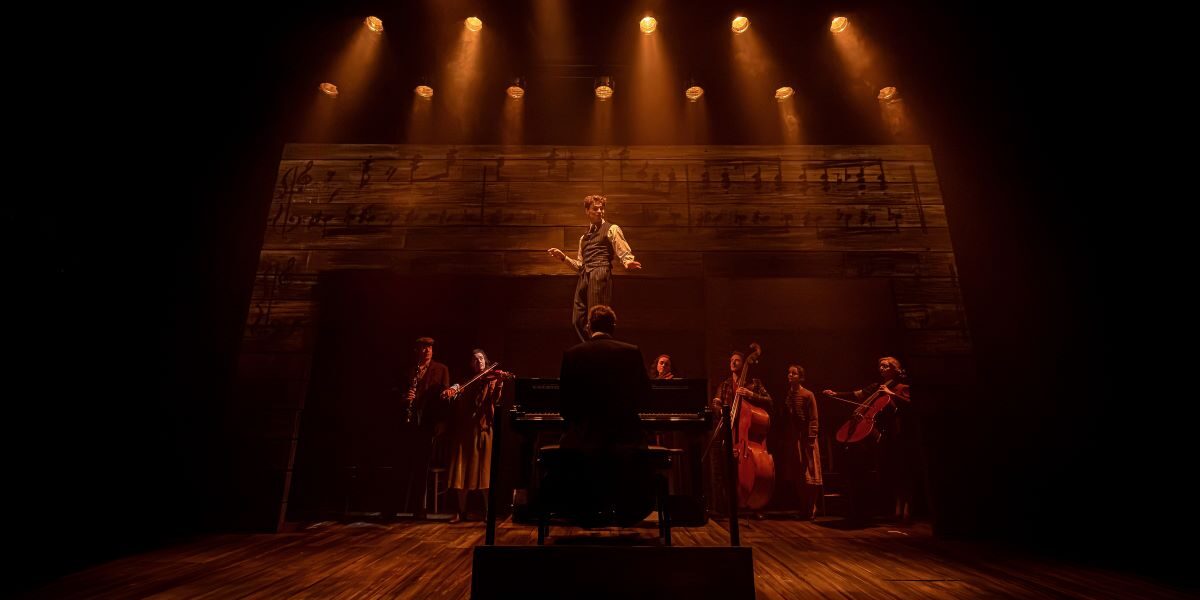
The technical aspects of the production operate at a high level. The actors not only inhabit their roles convincingly but sing and play musical instruments with verve and facility. The stage is dominated by a grand piano, as you might expect, but it is on a movable platform which allows the floor to be cleared for outdoor scenes or moments of active choreography. A professional pianist in white tie and tails does most of the playing, leaving the excellent Daniel Krikler to inhabit the role and commentate on the action, both lead and narrator in one. This is a layered, nuanced and often affecting performance that commands admiration, though there is something contained and controlled about it at all points that does not let the audience get close.
That is not the case with the other family members, who wear their hearts more accessibly. Nitai Levi is outstanding as the restless elder brother Henryk, who wants to resist the occupation. His handling of the final number of the first half ‘Without You’, was for me the most moving moment in the show. But Rosalind Ford and TJ Holmes really convince as the amiable parents too, and Oliver Grant as Captain Hosenfeld makes the most of a key scene. Set designer Andrezej Goulding finds ingenious ways of developing atmopsheric settings with the simplest of means. The transformation of the back wall of the Ghetto into a cattle-truck train is deftly done in a matter of moments, and the murder of a child is grimly brought to life just with a simple shawl and some sleight of hand. Excellent minimalist work by all concerned.
There is a central difficulty though and that is that the show is not really a musical, as conventionally defined.
The problem is neither with the music not the drama as individual components. Rather they simply do not gel, or at least only do so occasionally. For a musical to work the music has to arise as a natural transition from the text and the moment in the drama; but here, music composed in a wholly different setting, with different purposes in mind, is interpolated with an awkward change of gears. This matters perhaps less in the first half where the cheerful interwar songs fitted up with self-consciously trite romantic lyrics suit the generally upbeat mood of the family. But in the second half where the tone is remorselessly dark, there is less music and it does not somehow seem equal to the scale of events. It is not that the quality of the music is poor, far from it; but it seems a poor match for the personal journey that the pianist has to travel. It is perhaps significant that the most powerful musical moment in the second half is a full performance of Chopin’s Nocturne in C# minor, at the point when Szpilman meets and receives kindness from one German officer who saves his life. That is indeed a scene where the emotional turning point and the music are equal to each other and peak together.
So while there are so many excellent features to this production – the acting, the set and the quality of the music-making above all – unfortunately it does not amount to more than the sum of its ultimately ill-assorted parts.
Based on the book by Wladyslaw Szpilman
Adapted and directed by Thom Southerland
Music by Wladyslaw Szpilman
Cast includes: Rosalind Ford, Oliver Grant, TJ Holmes, Mischa Jardine, Elzbeta Kalicka, Daniel Krikler, Nitai Levi, Melania Maggiore, Max Roll
Pianist: Malcolm Forbes-Peckham
Until 28 November 2026
Photo Credit: Rich Southgate