

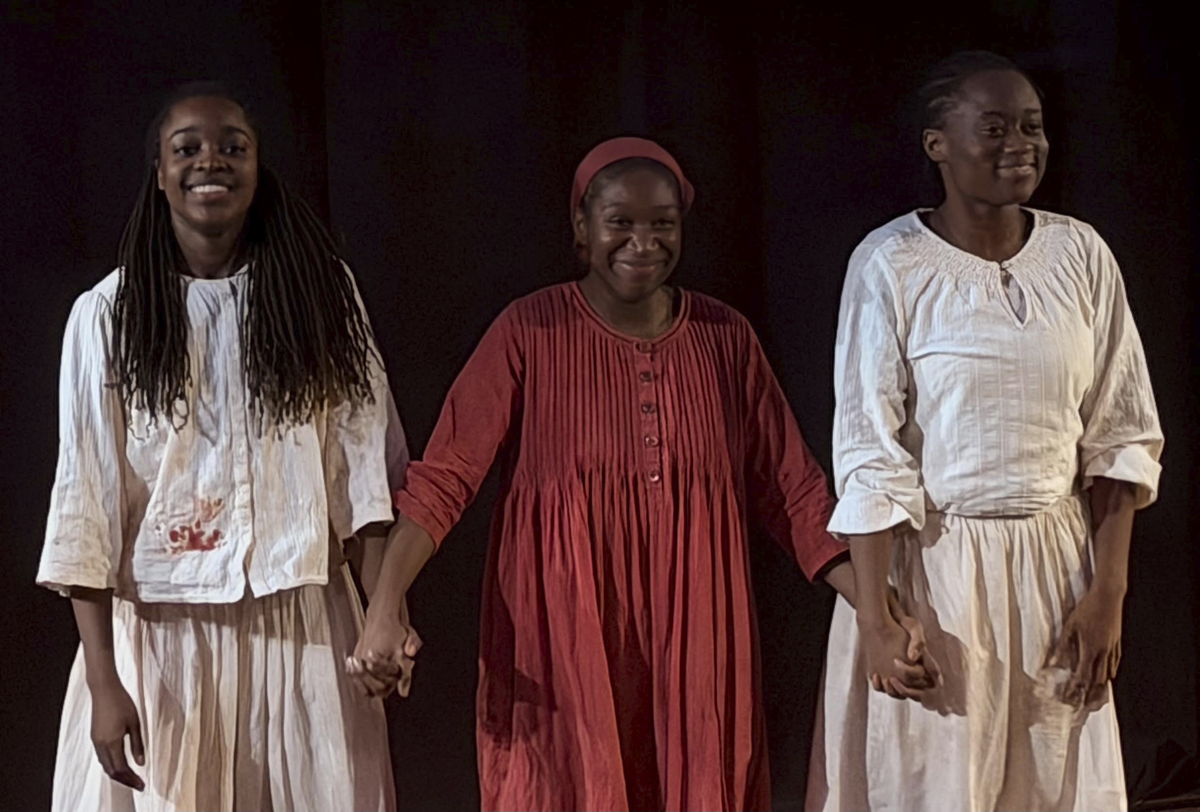

Sonya Tarkhanova talks to the three leads of Theresa Ikoko’s GIRLS about friendship, trust and what it means to be remembered.
Before audiences take their seats for GIRLS at the Young Vic, its three leads are already thinking about what it means to be seen, and what it means to be forgotten. Theresa Ikoko’s play, loosely based on the 2014 kidnapping of 276 schoolgirls from Chibok, Nigeria, by Boko Haram, offers a glimpse into the captivity of three teenage friends: Haleema, Ruhab and Tisana. When I speak to Tara Tijani (Haleema), Sewa Zamba (Ruhab) and Hannah Akhalu (Tisana), our conversation moves between friendship, the characters they play and their own memories of 2014.
The kidnappers never appear on stage, their presence felt only through explosions and distant footsteps. Our attention stays on the three girls, each navigating captivity in her own way. I ask whether building their friendship required elaborate exercises to manufacture intimacy, or enforced method-acting retreats. The actors laugh. “None of that, although it wouldn’t have been so bad,” says Hannah. Instead, she describes morning check-ins and evening check-outs, shared lunches at the Young Vic’s picnic benches and an unusually close relationship with the stage-management team. “We keep joking that the DSM [deputy stage manager] is the understudy. If any of us are sick, you’re going on, my girl.”
The characters’ bond, Hannah explains, comes out of “support and survival”, and something similar has happened between the cast. “It’s definitely just been that support as actors and as people that we’ve been able to give each other that has made me feel like I can trust these girls as people.” That trust carries onto the stage, where their characters have no one else to rely on.
There is something of Haleema, the group’s natural leader, in the way Tara takes charge of our conversation, particularly when the subject turns to director Ewa Dina. Tara is unequivocal: “I think Ewa is like, going to be one of the best directors in this country. She’s brilliant.” Dina is herself an actor, which Tara believes informs her approach. “When she is giving us notes or feedback, it’s just clear. It’s clear what she wants.” Dina’s suggestions are grounded in the characters’ journeys rather than imposed on them: “everything with her has been plotted through, can be backed up by the text.” Or, as Tara puts it, “It’s a real collaboration of ideas, but she’s steering the ship.”
With three characters of similar ages and backgrounds, I’m curious how the actors ended up in their respective roles.
Sewa got her part straight away, having already read it at a research and development workshop at the Donmar. Ruhab appealed to her because she “has to play both sides at different points in the play. And I think as an actor, that’s quite an interesting challenge to take on.”
Tara read for several roles before Dina asked her to try Haleema. “I was like, oh, okay. And then here we are.”
Hannah initially read for Haleema, but once cast as Tisana, she found unexpected connections with the character. “There are certain aspects of ourselves that sometimes people can just see as actors that maybe we can’t,” she reflects. Looking back at herself at that age, she discovered “definitely more parallels than I would have considered.” Casting, she suggests, is about finding the particular combination of people who can tell a story: “It’s not just about the skill of the acting.”
When I ask what they remember of the 2014 kidnappings, their memories differ.
Sewa is the only one of the three who grew up in Nigeria, and for her the kidnapping was felt across the country. “Things like this had been happening, are still happening.” What made this moment different was the public response: “It was the first time where we were like, oh, we need to wake up. This is a serious issue.” She remembers a mural near her old church, which she passed every Sunday. “A constant reminder, not necessarily to make anybody feel guilt.” Rather, it was a reminder of shared belonging: “Yes, these girls have been taken. But they are us. They are Nigerian. We are all Nigerian.”
Hannah’s father was involved in Nigerian political and diaspora communities in Britain, so the news remained a subject of conversation at home. At her all-girls school in London, though, it was barely discussed. Having visited Nigeria regularly growing up, she has since come to recognise the privilege of living elsewhere: “I didn’t quite understand like, the privilege I had in that context of this is like, where I’m from, but I go here for holiday, I don’t live here.”
For Tara, it is the media response that stands out, both its scale and how quickly it faded. She remembers the widely circulated photograph of Michelle Obama holding a campaign sign. “I remember the hashtag, free our girls or bring back our girls. I remember that very vividly.” But the attention didn’t last. “I’ll be honest, I don’t remember like it lasting that long.” Working on the play has made her reflect on the rhythm of public attention: “Something could happen that you really care about at the time. It’s all you’re thinking about in the moment. But then something else happens.”
Their memories bring us back to one of the play’s most uncomfortable questions: what happens to the girls once the world stops paying attention? Social media made the abductions visible to millions, but visibility is not the same as action. As Sewa asks, “How much can a hashtag do?”
GIRLS reaches beyond the events in Chibok and the media cycle that followed. It is a story of female friendship and survival in a world that, as Ruhab says in the play, is not made for girls, where help never comes and all they can rely on is each other.
GIRLS
Young Vic
By Theresa Ikoko
Director: Ewa Dina
Cast includes: Hannah Akhalu, Sewa Zamba, Tara Tijani
Until: Saturday 21st November 2026
Running Time: 2 hours
Photo credits: Helen Murray