

When journalists do their job right, they are the unacknowledged legislators of the world. It is their imperative to bring injustices to light and speak truth to power. Yet all too often news stories come to us emotionally etiolated and flattened by a language of cool ‘objectivity’. Where there should be incandescent moral rage, there is blunt facticity, even inurement. Fortunately, theatre often steps in to provide a corrective; it is a kaleidoscopic medium for human stories and feelings, where seemingly far-off news events are brought before spectatorial eyes with irrefutable intensity and shown in all their devastating human implications.
GIRLS by playwright Theresa Ikoko is one such play; it was written in response to the kidnapping of 276 schoolgirls from Chibok, Nigeria in 2014 by the Boko Haram, a group which opposes the adoption of Western education and aims to establish Nigeria as an Islamic state. In Ikoko’s deft hands this play is no simple jeremiad of condemnation—the Boko Haram are never even seen—but a layered story that gives its full attention to three teenage girls and the brutal reality of having to survive under surveillance and persecution in a hostile forest camp. Directed with sensitivity by Ewa Dina, the play’s strength is its alertness to the psychological human need, amid terror and violence, to find pockets of joy, conviviality and friendship, while never allowing the audience to forget the unimaginable nature of their plight.
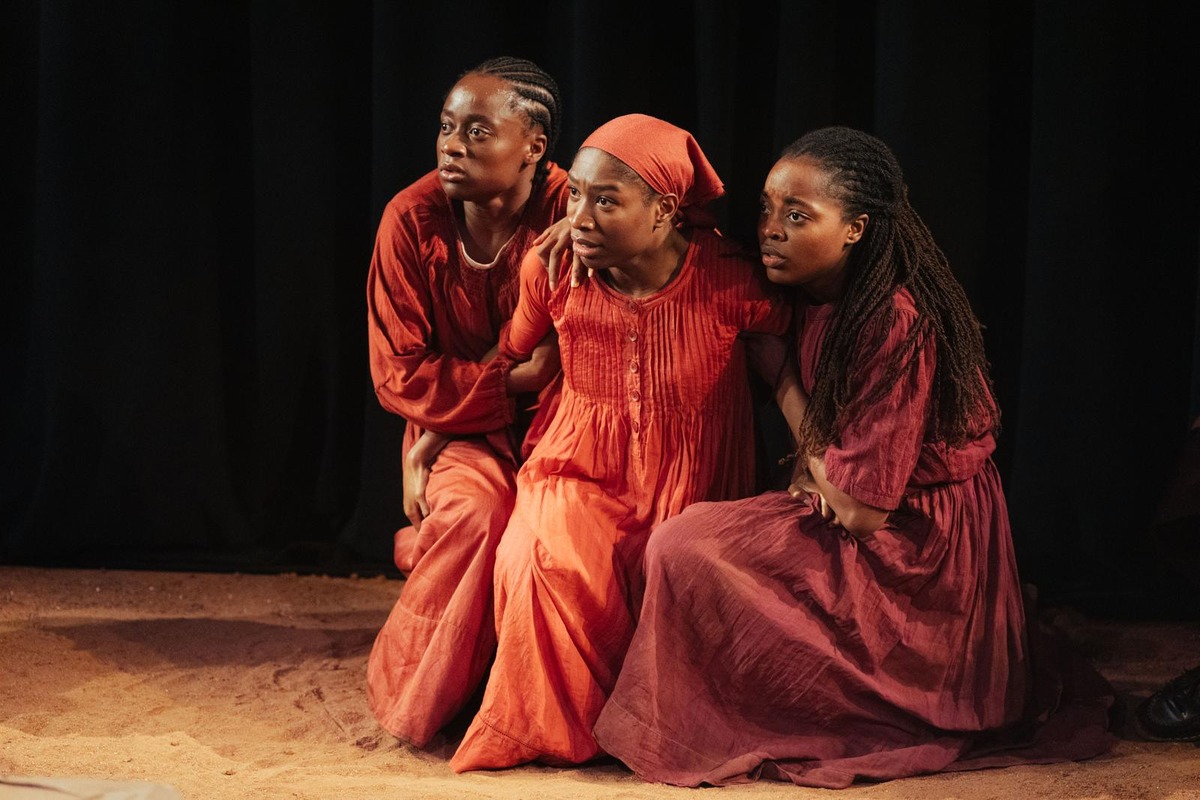
The teenage triad are best friends and share a deep, authentically presented emotional bond. But like any motley pack of mates, they all have unique identities, and despite pulling together at first, gradually each girl develops different ways of handling the horrors of being interned. Hannah Akhalu’s Tisana escapes into her imagination, dreaming away the days in hope of rescue. Haleema is her foil; quick to brandish her makeshift knife, she is convinced that physical retaliation and deft plotting is the best route to freedom. Tara Tijani plays her with entrancing conviction, masterfully conveying how Haleema’s cynicism and pugnacity are a shield for her emotional fragility. Sewa Zamba’s Ruhab has the most complex character arc. The girlish pride she takes in her youthful beauty is warped as it becomes clear that this allure can be used to win protection from one of the Boko Haram captors. Few shows in London can rival the accomplished performances Dina achieves in GIRLS.
Proximity is the keynote of this production. The audience are invited to sit onstage during the show in the already snug precincts of the Young Vic’s Maria studio, mitigating any possibility of emotional distancing. Moreover, the girls’ jokey dialogue about celebrities and sex, and their playful mimicry of TV shows from Miss World to news interviews with corrupt politicians, similarly foregrounds that these victims are just ordinary girls, in all their imaginative exuberance and youthful vulnerability.
Raphaé Memon’s costume design is excellent in subtly expressing their enforced coming-of-age. The girls wear matching incarnadine cotton dresses, symbolising the bloodshed that has made scars upon their psyches and the violence that permeates their environs. Indeed, one of the girls describes the stench of rotting corpses at the camp as ‘raw meat in the air like rain clouds’, and thanks to some clever production design, there are fleshy papier-mâché lumps, all oozing and crumpled, that hang aloft the camp, resembling butcher’s cuts and fabric stained by menstrual blood. As the show progresses, these gowns are replaced with white dresses and headscarves, highlighting the Boko Haram forcible ‘cleansing’ of the girls through Islamic conversions. Tisana, a devout Christian, resists, and has her red gown soiled with blood from soldier’s lashes.
‘This world is not made for girls’, Ruhab realises, and admirably, the play, rather than simply commiserating, has much to say about why this may be. Reasons suggested include the reduction of women’s value to their ability to provide sexual pleasure; the silencing of women (journalists) when they start to interrogate male social and political structures; and the inculcated passivity that blinds women to their own agency in shaping their destinies.
Theresa Ikoko once said her aspiration was to ‘write things that change the lives of 14 year old girls in school, of university students and of grown men behind prison doors’. Leaving this production, I was reminded of the importance of theatre, especially at times of crisis – it’s capacity to pull you into the situation of the characters, whether you like it or not, to force you to see yourself in lives that, on the surface, might seem wildly different to your own. Confronting fear and finding courage are, after all, shared human experiences. But this extension of empathy on its own is not good enough; the Chibok girls are not characters. Over 12 years later, 90 of them are yet to be restored to their families. GIRLS may not be an explicit piece of polemic but it’s revival will no doubt bring this news story to fresh eyes, stirring a wave of desire to see justice urgently enacted. For these abductions must be spoken about over and over again until significant State action is taken to secure the safety of girls in Nigeria and protect their rights to education.
By Theresa Ikoko
Director: Ewa Dina
Photo credits: Helen Murray
Cast includes: Hannah Akhalu; Sewa Zamba; Tara Tijani.
Until: Saturday 21st November 2026
Running Time: 2 hours
Review by Olivia Hurton
27th November 2026