

If Caryl Churchill had chosen a career other than playwriting perhaps she would have stolen away to the circus and become a contortionist. Her writing is alive with the same impulse to twist, bend, and flip drama into previously unimagined forms. Cloud 9, which debuted in 1979, is no different. The product of an experimental research-based workshop by the Joint Stock theatre company, it gathers together personal and gender experiences from actors across the sexual spectrum, and through the chronological magic of fiction, follows how these identities develop subject to the shifts of historical circumstances. Accordingly, a play that begins in a repressive colonial outpost in nineteenth-century Africa ends—in apparent happiness—in the progressive hippiedom of 1970s England. That Thatcherism was just around the corner, of course, no one could have known. But to watch the play now, in the National Theatre’s new era-defining production by director Dominic Cooke, is to feel a dark, piquantly ironic shadow threatening its confident optimism.
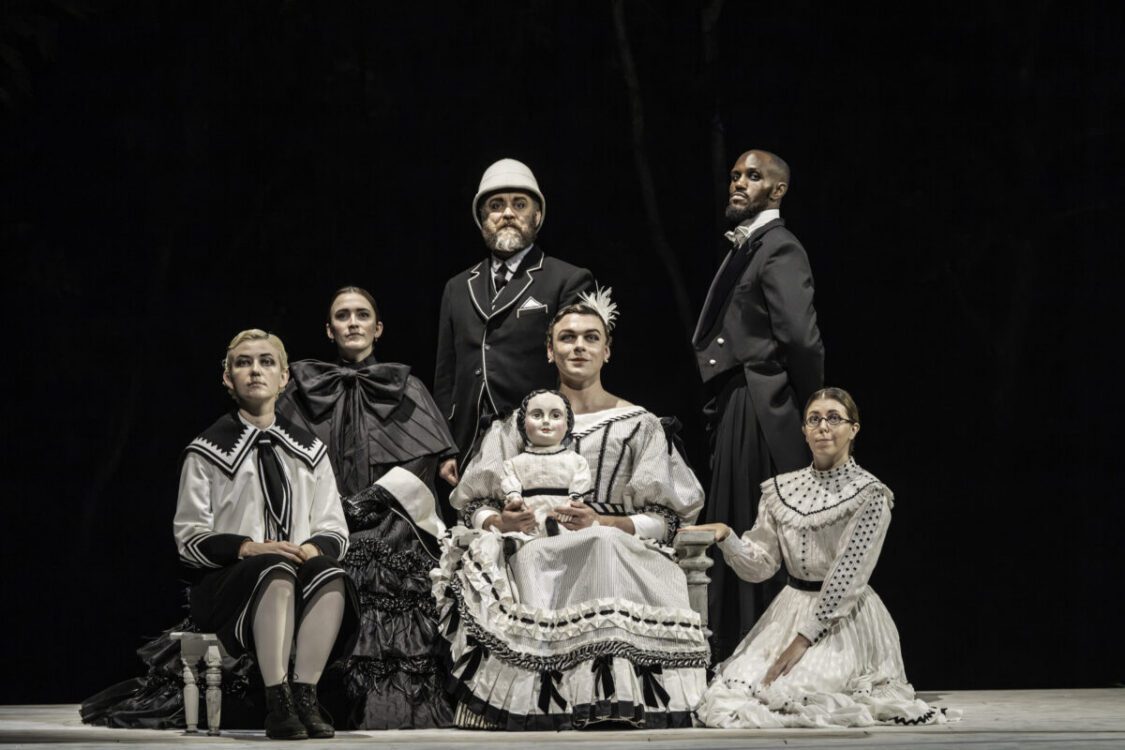
Churchill, like Elizabeth Inchbald before her, is a female dramatist interested in sexual imperialism; how jingoistic patriarchs impose their will not only on those they colonise, but on those who they live, eat and sleep with. In act one, this is apparent from our introduction to arch paterfamilias Clive (a hilariously flatulent Sam Troughton) and the doll-like family which he keeps in check. Dressed uniformly in black-and-white garb full of buttons and frills—a nod to racial tensions, manufactured toys, and sexual repression—costume designer Samuel Wyer uses his kooky, Poor Things inspired attire to expertly set the stage for Churchill’s upending of binaries. Making excellent use of gender cross-casting, Clive’s wife is the affectedly feminine Betty (a stupendous Sam Troughton), who admits she lives to be the mirror of his ideal: ‘The whole aim of my life/ Is to be what he looks for in a wife’. That the role is played by a man exposes the narcissism of this proposition. His son Edward (a gamine Ellen Robertson), with his squeaky, high-pitched voice, likewise endeavours to squeeze himself into a male template, admitting ‘What father wants I’d dearly like to be. / I find it rather hard as you see.’ Comically, the only character who seems to get it right is Clive’s daughter, Victoria, an inert, plastic ventriloquist’s doll.
But this is the crux: try as they might, for all the patriarchy’s exhortations, these characters are unable to entirely erase themselves. Betty pines in her petticoats for the attention of imperial adventurer Harry Bagley (a plummy, posturing Tom Mothersdale), whose over-inflated masculinity is a cover for his empire-betraying homosexuality and paedophilia. Indeed, for a long time he has been secretly grooming nine-year-old Edward, who is repeatedly scolded for his effeminate predilection for playing with dolls and failing to live up to his father’s exemplar of British masculinity. Even Clive’s seemingly obedient slave boy, Joshua (a moving Eloka Ivo), starts chafing against his chains. Throughout the performance his eyes are possessed of an unhinged, psychotic resentment towards his master which erupts into violence, and his melancholy seeps out expressively in his soulful rendition of Rossetti’s ‘In the Bleak Midwinter’. The imperial British cause, in other words, is a glorified male quest for mass social oppression.
But times change, as Caryl Churchill suggests by catapulting the action in act two to London in the 1970s, while aging her characters by only 25 years. Such chronological compression hints at the fact sexual mores do not progress commensurately with the march of the clock. On the surface, one might expect these characters to thrive in the decade of The Hite Report and the first London Pride, yet Miriam Buether’s excellent set reveals a more complex story. The ornate golden proscenium which had framed Clive’s family in line with rigid Victorian conventions is in ruins across the stage. It serves, in its crumbling and fallen state, as a playground climbing frame in a park, hinting at possibilities of experimental fun and physical freedom. But that it has a presence at all is a troubling reminder of how past ideals serve as the bedrock for future civilisation.
Betty (also Robertson) can now take delight in possessing her own money and enthuse about the benefits of self-pleasuring, signs that she has finally carved out an identity that is separate from the family unit. However, the more dysfunctional aspects of this individualist way of thinking are suggested in her parodically tweedy Margaret Thatcher style attire. Edward is now grown-up and lives openly as a homosexual gardener, but the patriarchal abuses of his youth leave him fearful of emotional entanglements. He finds safety in an unconventional throuple with his sister Victoria (brainy, feminist activist Charlotte Ritchie) and her lesbian lover Lin (free-spirited Rebecca Humphries). Their peace is ruptured intermittently by the exuberant play of Lin’s boisterous, toy gun-loving daughter, Cathy, performed with comical restless whining and arm flapping by Troughton. This character’s gradual attraction to feminine necklaces and earrings, and crushing encounter with brute male violence, is an apt dramatization of Beauvoir’s concept that ‘one is not born, but rather becomes a woman’. That jocular humour shoots through these scenes, and the first act, does beg the more uneasy question of the extent to which the play derives its comedy from those who veer away from heterosexual norms. Yet by treating it as a period piece, Cooke cleverly draws his laughs from the historical bigotry.
The National Theatre’s Cloud 9 is a retro-coloured fever dream, throbbing with academic theories of gender identity and a Chaucerian appreciation for all things ribald. Cooke impressively commandeers Churchill’s miscellaneous socio-political material, resisting the impulse to force cohesion on a collage of constructs and allowing for fragmentary impressions to meaningfully rub up against each other upon further reflection. Churchill’s point surely wasn’t to suggest that liberation from repressive social codes was achieved in 1979, although that’s what the closing embrace might seduce us into believing. Rather it is that other ways of existing were being imagined, even if they came with a new set of problems. Cloud 9? Not quite, but at least a little bit closer.
Written by Caryl Churchill
Director: Dominic Cooke
Cast includes: Tom Mothersdale; Charlotte Ritchie; Ellen Robertson; Stuart Thompson; Sam Troughton; Eloka Ivo; Rebecca Humphries.
Until: 13th January 2027
Running Time: 2 hours and 45 minutes, including a 30-minute interval
Review by Olivia Hurton
12th November 2026