


There is an element of luck in every singer’s destiny: being in the right place at the right time can transform a career overnight.
In 1996, the 23-year-old Juan Diego Flórez was in Pesaro to sing the small role of Ernesto in Rossini’s Ricciardo e Zoraide. When Bruce Ford withdrew from Matilde di Shabran, Flórez was asked to replace him as Corradino—a notoriously demanding role, filled with fiendish coloratura and a formidable succession of high notes. His performance caused a sensation. A star was born.
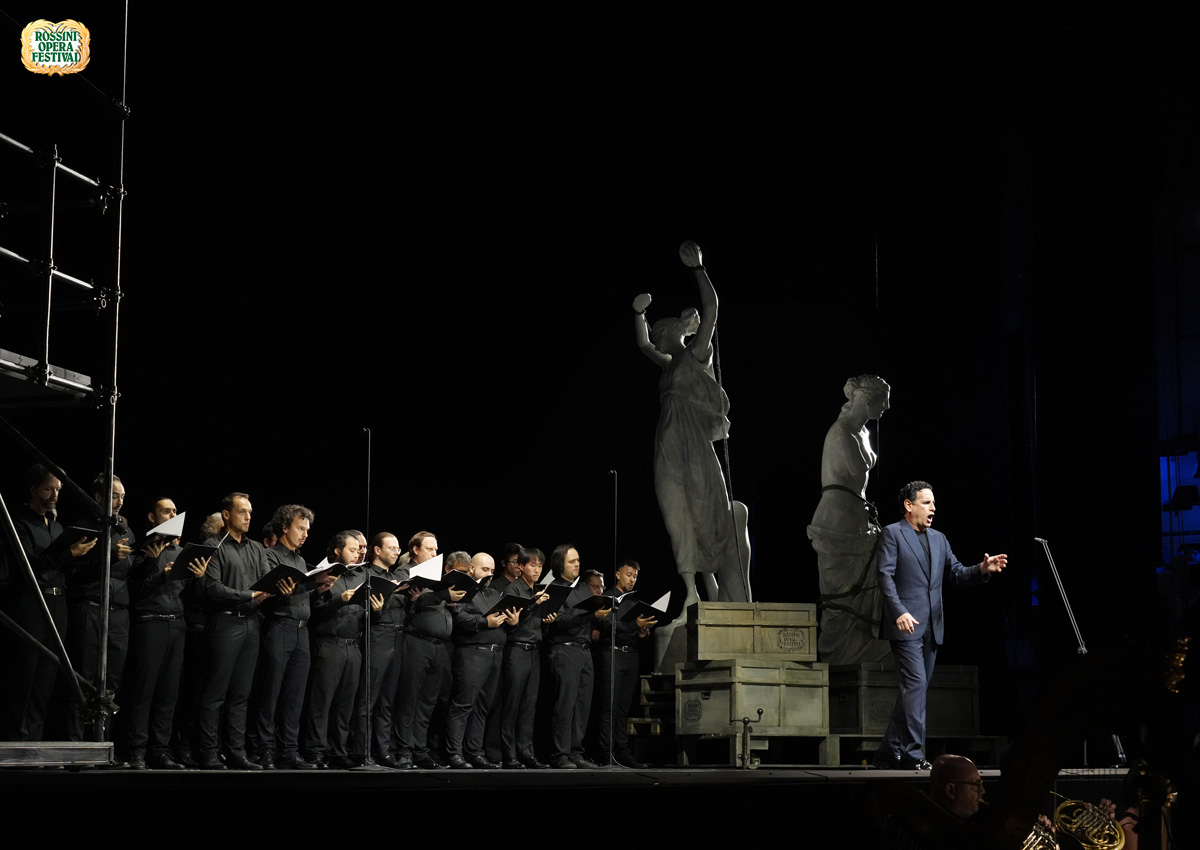
Flórez returned regularly to the Rossini Opera Festival as its leading tenor and, in 2022, became its artistic director. Thirty years after that extraordinary debut, he appeared before a packed Auditorium Scavolini, with the magnificent sets of Le Siège de Corinthe providing a spectacular backdrop. Celebrating this anniversary in the city and at the festival that launched his career was particularly fitting: the audience had come not simply to hear an international star, but to celebrate one of its own.
The programme honoured Flórez’s Rossinian origins while demonstrating how his repertoire and artistry have developed. He places great importance on understanding the languages in which he sings, and his Italian and French diction were exemplary, enabling him to give expressive weight to every word.
Watching him closely, I was struck by the extraordinary forward focus of the sound—what singers describe as placing the voice at the front of the mask. This concentrated placement must surely contribute to the unmistakable brightness and projection of his voice. There is no sense of forcing: the sound simply locks into place.
The first half was devoted to Rossini. In “Quell’alme pupille” from La pietra del paragone, Flórez combined emotional sensitivity with dazzling agility. The fiendishly difficult “Sì, ritrovarla io giuro” from La Cenerentola followed. He gave its contrasting middle section depth and emotional nuance before letting the voice fly effortlessly in the exhilarating conclusion.
The first half ended with Arnold’s recitative and aria, “Asile héréditaire”, from Guillaume Tell. Here, his experience was evident in the seamless legato, immaculate bel canto phrasing and vocal agility—but, above all, in the emotion he drew from the words.
Iván López-Reynoso conducted the Orchestra del Teatro Comunale di Bologna with evident enjoyment, supporting Flórez sensitively throughout.
The second half moved into the French repertoire. Rodrigo’s aria, “Ô souverain”, from Massenet’s Le Cid, was, for me, less successful. The music demands a more dramatic vocal weight—the kind associated with a tenor such as Roberto Alagna. Flórez’s instrument was never built for such repertoire, and he has wisely avoided pursuing the heavier dramatic roles.
“Salut! demeure chaste et pure” from Gounod’s Faust was an entirely different matter. His shaping of the phrases and use of the text were mesmerising. By lingering over the word “chaste”, he conveyed Faust’s love and awe for Marguerite in a single, exquisitely coloured word.
One might almost wonder whether Flórez had made the Faustian pact himself. At 53, he remains slim and remarkably youthful, while the voice retains its extraordinary brilliance and focus.
In the Song of Kleinzach from Offenbach’s Les Contes d’Hoffmann, Flórez displayed considerable sensitivity. Rather than exaggerating the character’s physical peculiarities for comic effect, he used minimal gestures to suggest Kleinzach’s awkwardness without making disability itself the joke.
Vocally, he clearly relished the opportunity to display his celebrated upper register. On “voilà”, he revelled in the high note before unexpectedly leaping an octave for a conclusion delivered with tremendous panache—a flourish few singers would dare attempt.
Flórez saved the ultimate showpiece, “Ah! mes amis” from Donizetti’s La fille du régiment, until last. After such a demanding programme, the remarkable thing was not simply that he produced all nine top Cs, but that his technique remained so rock-solid that there was never any doubt he would do so.
Three encores—Leoncavallo’s Mattinata, Tosti’s “L’alba separa dalla luce l’ombra” and Verdi’s “La donna è mobile”—brought the evening to a triumphant close.
Thirty years inevitably bring changes, but the exceptional qualities remain: the brightness and focus of the voice, particularly in the upper register; the clarity of the diction; the musical intelligence; and, above all, the security of the technique.
In 1996, Pesaro gave Flórez an unexpected opportunity. In 2026, Flórez gave Pesaro the opportunity to hear what three decades of extraordinary artistry and technique have produced.
Auditorium Scavolini, Pesaro, Italy
Rossini Opera Festival
Conductor: Iván López-Reynoso
Orchestra: Orchestra del Teatro Comunale di Bologna
Chorus: Coro del Teatro Ventidio Basso
Chorus Master: Pasquale Veleno
Photo credit: Amati Bacciardi
Duration: 1 hour 40 minutes, including an interval