

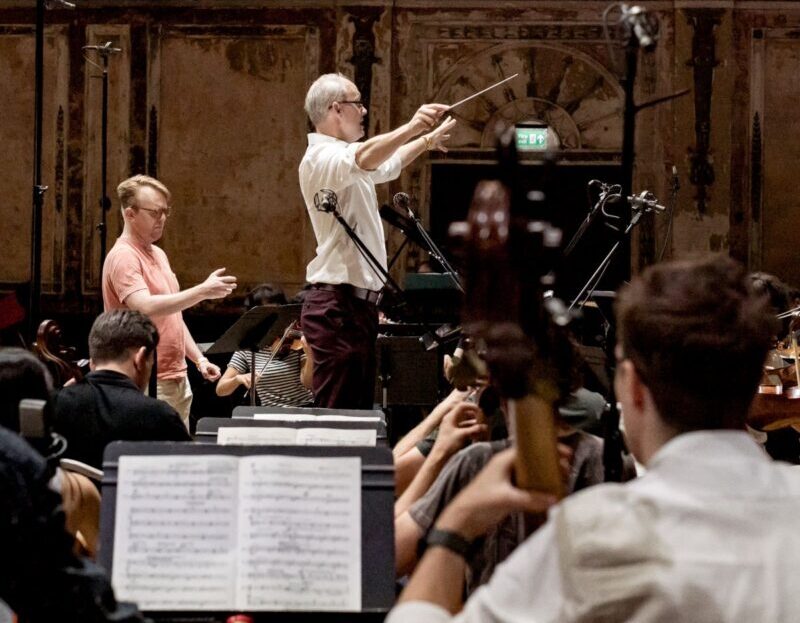

St Luke’s Passion narrative has not received the same interest from composers as St Matthew or John. Nor has the Resurrection, rather surprisingly, as opposed to the Crucifixion. Perhaps the answer in both cases is that the human drama is at its most relatable, gripping and intense in the latter and in the pacy, action packed, agonised, less reflective accounts of Matthew and John. But there are some adaptations that use Luke and also take us through to the Ascension of Christ, (mostly recently by James Macmillan) and one of them, written in 1992 by Andrew Downes, is recorded for the first time here.
Part One deals offers the narrative of the Crucifixion, whereas Part Two, in a different vein altogether, covers the Resurrection in the episodic form set out in the text – the empty tomb, the journey to Emmaus and the final appearance of Jesus to the Apostles in Jerusalem. The chorus envelops the evangelist’s narrative role and there is one baritone soloist enacting Jesus. The orchestra is enhanced by piano and percussion allowing for many jazzy and African-inspired undertones which contrast pleasingly with the overall tone of wistful Romanticism possibly derived from Downes’ teacher Herbert Howells.
However, there is no mistaking an individual compositional voice especially in the a capella writing which manages to be both harmonically original and dramatically compelling. Each part of the Passion culminates in a setting of the Tenebrae and Credo respectively. These are fully reshaped from within, breathing new life into tired forms. You hear the same qualities stand out notably in the selection of church motets that fill up the rest of the disc. He clearly had a real gift for taking the most familiar of liturgical texts and reimagining them in fresh ways.
Part One is overall a little less convincing than Part Two, simply because the scenes are so short that they rush past almost as a speeded-up movie, without full time to develop full meaning and resonance. But there are some lovely moments. The confrontation on the Mount of Olives has real bite especially in the contribution of Morgan Pearse as Jesus – his noble arioso contributions compel attention and embody charisma. Likewise the Crucifixion is brought painfully to life by the use of an anvil to represent the hammering home of the nails.
It is in the more dramatically abstract Part Two where everything comes together in a unified, powerful sweep of music, supported by highly varied and deft orchestration; especially so in the lithe string writing and pointed piano interventions, which provide a flowing underscore for the more developed exchanges between Christ and the disciples. As indicated, it builds naturally to a setting of the Credo that emerges inevitably in the culminating moment as a thrilling statement of freshly-minted faith rather than as a familiar theological shopping list to be endured.
All the works on this disc reveal the care and skill of a composer who knew how to write for choirs and the sonic qualities of the spaces in which they regularly sing. This is memorable and singable music that deserves not just a wider audience but more performers too.
Prima Facie Records
Andrew Downes
Conductor: David Trippett
Baritone Soloist: Morgan Pearse
Philharmonia Orchestra & Voices
Photo Credit: Christopher Jonas