

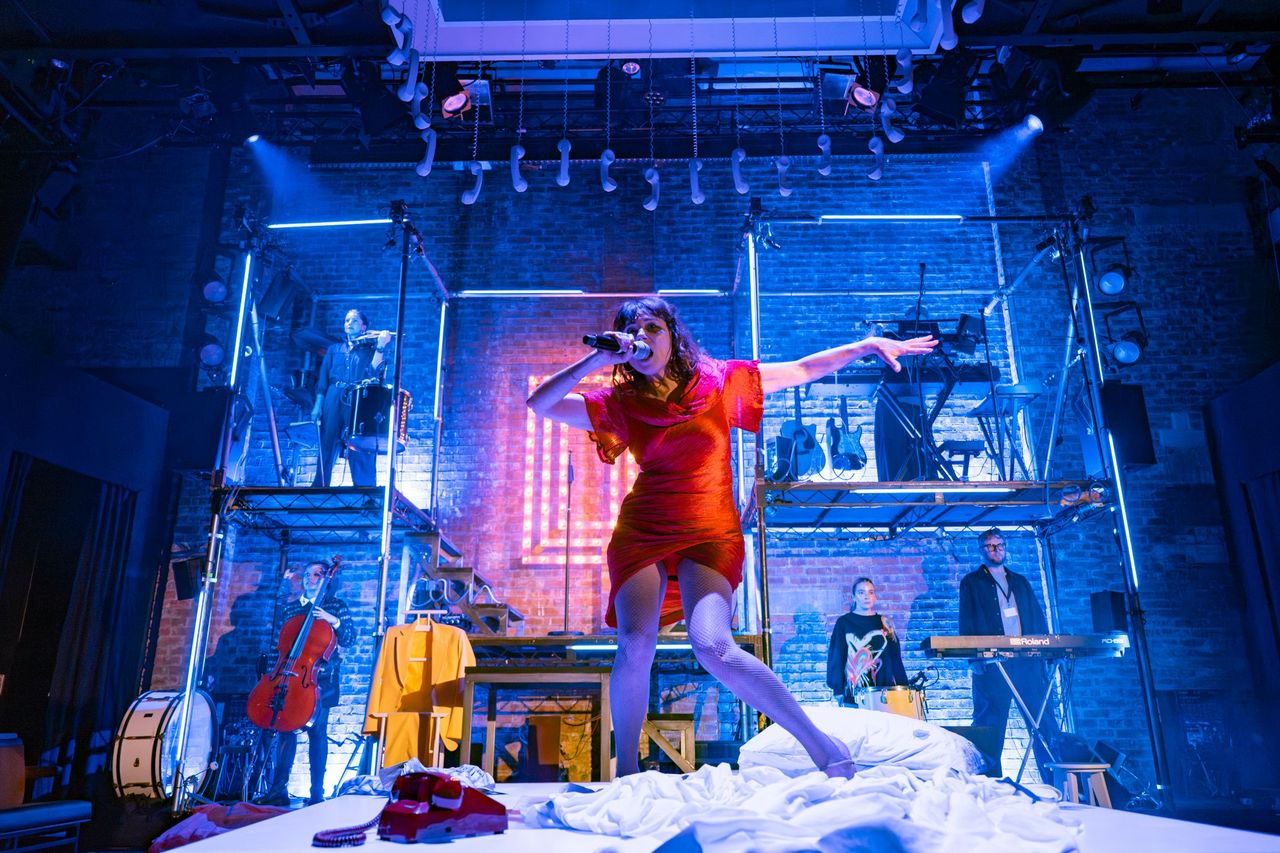

I Can Die Too is a play within a play: a technical rehearsal of Jean Cocteau’s La Voix humaine (The Human Voice). The title echoes Cocteau’s famous remark upon learning of the death of his friend Édith Piaf. That immediately raises a question: what kind of loss is Lily (Frances Ruffelle) carrying, and where will it lead as she moves between rehearsal room, performance, and reality?
The premise is deceptively simple. Lily is developing a new production of Cocteau’s one-woman drama with director James (Stephen Ashfield) and a team of theatre makers to prepare for a technical rehearsal. As the rehearsals progress, however, the emotional distance between performer and character starts to blur. The rehearsal itself feels more like an act of excavation.
Ruffelle, co-writer of the piece, describes I Can Die Too as a fusion of classic drama, tragicomedy, concert and musical theatre. It’s perhaps best understood as “a play with music about a play with music”. The songs, many co-written by Ruffelle, extend the narration through fragments of thought, confession and memory. The production also frequently breaks the fourth wall, with Lily stepping beyond the already blurred boundaries of performance to address the audience directly. It never quite stops feeling like a concert, but perhaps that is precisely the point.
Simon Kenny’s design makes striking use of the intimate studio. At its centre sits a raised square platform, mirrored by a suspended frame above it. Between them hangs a dense arrangement of vintage telephone receivers. Altogether, they form an open enclosure that feels both alive and slightly suffocating. Behind, exposed scaffolding houses the musicians while the layered lighting frames in the centre hint at the glamour of cabaret and Broadway backstage. The design constantly asks where one world ends and another begins. The worlds of rehearsal space, performance, and Lily’s emotional reality exist together without ever settling into clear categories.
Emma Chapman’s lighting responds to this uncertainty. When the central platform is flooded with electric blue and punctuated by flashes of amber and crimson, the world of The Human Voice comes alive and Lily becomes the lonely French woman at its centre. Elsewhere, the lighting expands the production’s rich retro atmosphere by shifting effortlessly between intimacy, seduction, and haunting fragility. It illuminates without insisting on interpretation.
Perhaps the pleasure of I Can Die Too is that it refuses to become a puzzle to solve. Its power doesn’t come from identifying which moments are “real” and which belong to the play. Ruffelle draws openly on her own experiences to create a layered conversation in which Ruffelle finds herself in Lily, while Lily finds herself in Cocteau’s Woman. At several points, I found myself looking directly into Ruffelle’s eyes and wondering who I was seeing — the character, the performer, or the person behind both. The uncertainty feels less like confusion than recognition.
Ruffelle anchors the production with extraordinary emotional generosity. Her voice has a smoky texture and warmth that seems to linger in the air, and every phrase carries the weight of lived experience. Maya Rugen’s brighter and more crystalline tone provides a compelling counterpoint. Ruffelle and Rugen’s duet becomes one of the afternoon’s emotional high points. Stephen Ashfield’s James delivers excellent comic timing while also capturing the frustration of a director trying to control a show that is always on the verge of losing control. The ensemble are equally impressive. They move fluidly between musicians, production staff, and supporting vocalists: everyone is making theatre while also living through it.
In the final song, Lily steps away from the receiver-haunted platform and into the glow of the marquee lights. Lily seems to regain a sense of balance, or at least the hope of doing so, and to accept her flaws and experiences as part of the life she continues to inhabit. Perhaps the title is unfinished: I Can Die Too, But.
Lily can fall apart. Lily can grieve. Lily can disappear into another person’s story. But she can also reclaim herself. I Can Die Too finds hope not beyond performance but within it.
Musical
I Can Die Too
Written by Frances Ruffelle, Sally George, and Alan Cumming
Directed by Bill Buckhurst
Music and Lyrics by Frances Ruffelle, Sam Kelser, Mark Kelser, Simon Alexander, Robin Hancock, George de Angelis, Natti Vogel, Rafi, Dan McDougal, Eliza Caird, Blair Mackichan, Jim Duguid
Cast Includes: Frances Ruffelle, Stephen Ashfield, Melinda Orengo, Flora Spencer-Longhurst, Maya Rugen.
Until: 2 Aug 2026
Running Time: 1 hours 15 minutes (no interval)
Photo Credit: Tommy Ga-Ken Wan