


When Tchaikovsky set himself the task of adapting Pushkin’s verse novel Eugene Onegin into an opera, he had clear ideas about what he wanted to achieve. ‘I am looking for an intimate but powerful drama, based on the conflict of attitudes that I myself have experienced or observed,’ he explained. It is in this spirit of emotional realism that multi-talented actor and director Ralph Fiennes approaches the nineteenth-century opera in his directorial debut at Paris’ opera mecca, the Palais Garnier. Handcrafted costumes, cinematic sets and physical precision are the order of the day, but where the production excels is in its rigorous, even scholarly, understanding of the narrative, bringing into sight the tragic clash between romantic idealism and worldly pragmatism.
Fiennes is no Pushkin novice. He was first drawn to the character of Eugene Onegin while training at RADA, and in 1999 he had the chance to play the aristocratic anti-hero in his sister Martha’s feature film, Onegin. What he brought to the role was his signature dark allure—one refined from time spent in the melancholy fictional worlds of Shakespeare’s Hamlet and Emily Brontë’s Heathcliff. Palais Garnier is familiar territory, too. Fiennes directed The White Crow, his 2018 biopic of dancer Rudolf Nureyev, at the gilded landmark.
Unfolding in three lyrical acts, Tchaikovsky’s opera eschews the bulk of Pushkin’s verse (and its wry digressions). However, in Fiennes’s hands one never feels the impact of these substantive excisions. The opera has remarkable flow and narrative continuity. This is particularly true of the first two acts, thanks to Michael Levine’s breath-stealing set design. The stage is transformed into a fairy tale forest of skeletal silver birches, evoking a rural existence of harvest celebrations but also sinister desolation. The trees remain in the background as the action moves to Tatyana’s bedroom for the explosive letter scene, reflecting her wild, unfettered feelings, which markedly contrast with the studied mannerisms and tinselled artifice of St Petersburg’s ballroom sophisticates.
Boris Pinkhasovich plays an icily cold Onegin (one gets the sense that a mere handshake would disconcert him). He often stands at the edge of scenes, quietly observing, and if he takes to the centre, it is to perform an impulsive act of malice, such as dancing with his best friend’s fiancé, Olga, or spurning the heartfelt passions of young Tatyana. Aloofness may be true to the Byronic archetype, yet here it wasn’t evident that a tortured psyche was simmering behind the mask of an urbane dandy. This caused a problem, for despite his consistently flawless baritone, Pinkhasovich was acted into the background by tenor Bogdan Volkov’s Lensky, whose heart-wrenching aria in anticipation of the duel was a standout moment in the production.
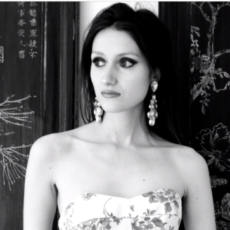
Ruzan Mantashyan brought youthful vivacity and a spirit of adventure to the role of Tatyana. Her eyes were dewy with romantic dreaming, and she paced the stage restlessly, conveying her internal emotional combustions. As she grows older and marries into the ranks of the elite in the third act, she attains a poise that belies the unruly feelings that she now has the dexterity to conceal. Her soprano mirrors this journey of maturation, from a light, sparkling sound, accompanied by soft flutes and breezy instrumentation, to a vocal depth and intensity at the opera’s denouement.
Fiennes even adds authenticity to smaller parts. The Prince (Alexander Tsymbalyuk) moves with stiff, militaristic formality and uses his worldly wise voice to deliver a deliciously ironic aria to Onegin on the power of love. Peter Bronder’s chirpy and lightly satirical Monsieur Triquet was also superb, using his trilling vocals to convey the whimsical humour found in Pushkin’s tale but which is too often ignored in operatic productions.
The performers were accompanied by the vigorous Orchestre de Paris, who remained alert to Semyon Bychkov’s incisive conducting and successfully navigated the peaks and troughs of the score. Throughout, the music was impressively harnessed to provide a measure of the emotional temperature of each scene.
In this Eugene Onegin, Fiennes’ highly intellectual approach informs all aspects of the production. Words nourish gesture, dance and atmosphere. Costume and set create an emotionally visceral world. Its greatest achievement is its staging of the battle between romance and reality. As the opera ended, the tragic irony of Tatyana and Onegin’s love was devastatingly apparent. As Tatyana hardens into a worldly pragmatist, Onegin’s cynicism melts away to reveal a hopeful romantic. The tables turn with a vengeance. The would-be lovers come to sympathise with each other’s perspective, but, heartbreakingly, it’s all too late. This is a haunting interpretation of an opera from a once-in-a-generation dramatic craftsman, attesting to Fiennes’ endless ability to propel himself into new and exhilarating artistic directions. What will Ralph do next?
Eugene Onegin ☆☆☆☆
Music: Piotr Ilyitch Tchaikovsky
Libretto: Piotr Ilyitch Tchaikovsky and Constantin S. Chilovski
Director: Ralph Fiennes
Conductor: Semyon Bychkov
Orchestra and Chorus of l’Opéra national de Paris
Photo credits: Guergana Damianova
Cast includes: Ruzan Mantashyan, Boris Pinkhasovich, Bogdan Volkov, Peter Bronder, Alexander Tsymbalyuk.
Until: Friday 27th February 2026
Running Time: 3 hours and 20 minutes including two intervals.