

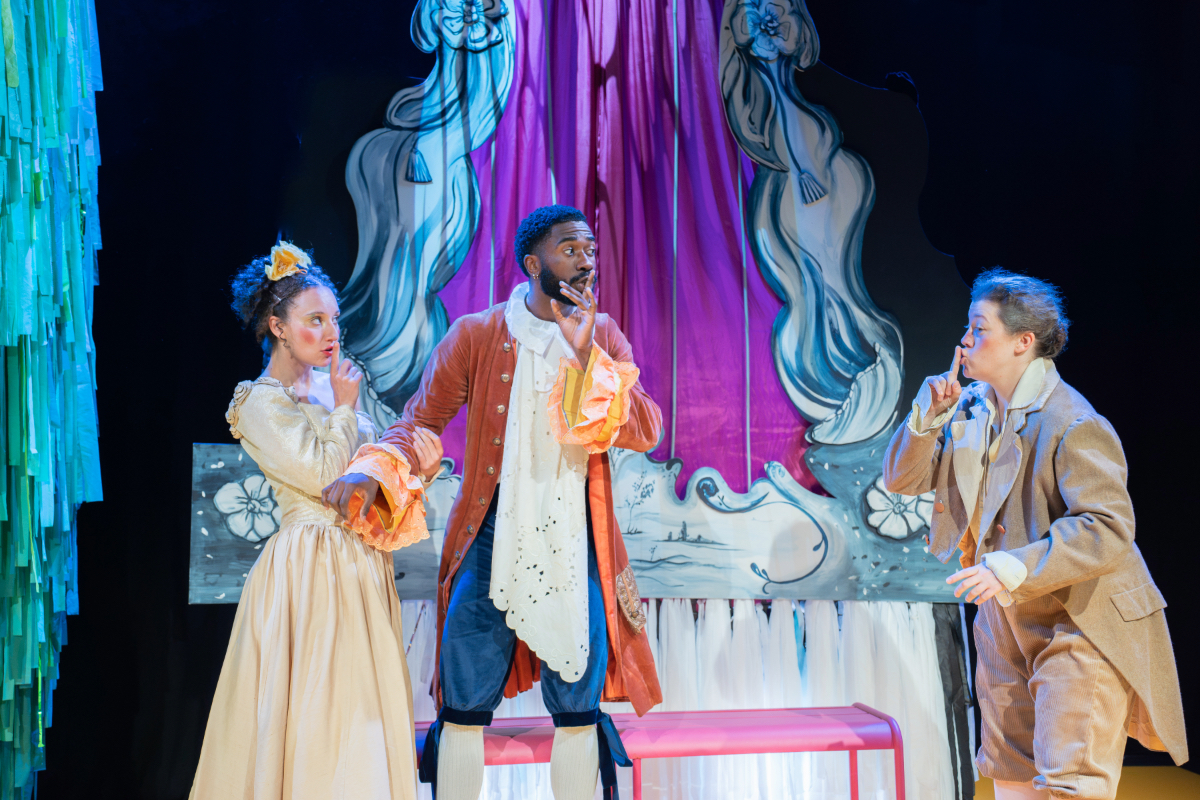

Molière’s The School for Wives is built around an irresistibly comic premise. Arnolphe, terrified of being cuckolded, has raised the young Agnès in ignorance, convinced that an inexperienced and unquestioning woman will make a faithful wife. Flywheel Theatre Company’s lively production at Riverside Studios makes the most of the farce, while allowing the darker implications of Arnolphe’s scheme to remain firmly in view.
Jaemon Anthony Crosby is excellent as Arnolphe, particularly in his encounters with Conor Dumbrell’s Horace. Unaware that Arnolphe is Agnès’s guardian and intended husband, Horace cheerfully confides every detail of his courtship to him. Crosby makes the resulting torment wonderfully visible. Bitterness, panic and fury pass across his face, only to disappear behind forced geniality whenever Horace turns towards him. The joke is that the man who believes himself completely in control is forced to listen to each stage of that control collapsing. Yet Crosby never makes Arnolphe merely ridiculous. However funny he is, there remains something deeply unpleasant beneath the comedy.
Dumbrell’s flamboyant Horace provides an effective counterpoint. His confidence is matched by enough naïveté to make his increasingly disastrous disclosures believable. Small visual jokes, including his little bicycle and recurring physical mannerisms, add to the character, while his suit decorated with blue ribbons offers a playful nod to the cordon bleu and the aristocratic world surrounding the play.
Rachel-Leah Hosker’s Georgette is another comic highlight. Making her overtly sexual works particularly well in a play so preoccupied with the regulation of female sexuality. Her physical confidence contrasts sharply with Arnolphe’s anxious possessiveness and restraint. The joke therefore does more than simply add another laugh; it places female sexuality visibly onstage in a play built around one man’s determination to control it. Later, Hosker’s transformation into Enrique, complete with an enormous beard, produces another excellent visual joke.
That sense of theatrical playfulness runs throughout the production. Actors enter through the auditorium, address spectators directly and occasionally sit among them, drawing the audience into Molière’s comedy. At one point, Hosker accidentally sits on a spectator’s bag of crisps and, without breaking character, simply begins eating them. It is a delightful accident, but also captures something of Flywheel’s approach: classical theatre is not kept at a respectful distance from its audience.
The modern touches are equally well judged. Contemporary songs accompany moments of tenderness between Horace and Agnès, while the stylised, almost handmade quality of the set gives the production a distinctive visual identity. Rather than distracting from Molière, these interventions largely extend the comedy already present in the text. Agnès’s first appearance behind the grating of the balcony is particularly effective, quietly suggesting the caged existence Arnolphe has created for her.
Cash Holland gives Agnès an appealingly understated innocence. Her recollection of her first encounter with Horace produces one of the evening’s biggest laughs, delivered with an almost blasé incomprehension that never turns ignorance into stupidity. Her development remains subtle: she does not suddenly become worldly, but begins to understand what she herself wants. When she later tells Arnolphe that she does not love him, and rejects the gratitude he expects for having raised and provided for her, his attempt to control not only her behaviour but also what she knows and desires becomes especially clear.
Jack Dugan’s Chrysalde is an amused and convincing foil to Arnolphe, while Jessica Temple’s doubling as Alain and Oronte demonstrates the pleasures of the repertory format. Having seen Temple as Varya in The Cherry Orchard earlier in the season, the contrast is striking and a testament to her range.
The School for Wives
By Molière (1622-1673)
Presented by: Flywheel Theatre Company / Rep: Radical Classical
Cast: Jaemon Anthony Crosby (Arnolphe); Conor Dumbrell (Horace); Cash Holland (Agnès); Rachel-Leah Hosker (Georgette/Enrique); Jessica Temple (Alain/Oronte); Jack Dugan (Chrysalde)
Until 19 September 2026
Duration: 70 minutes
Photo credit: Miranda Mazzarella