

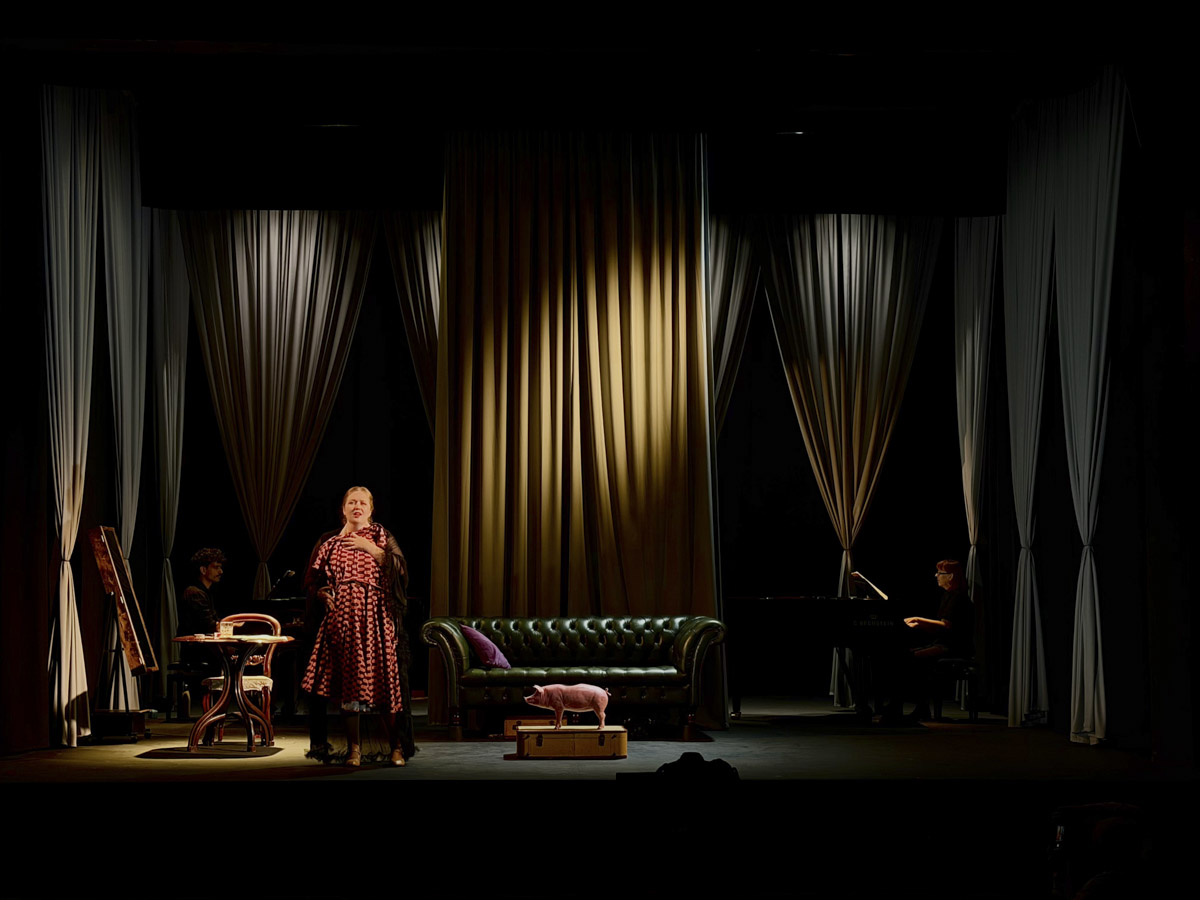

Argentinian-Italian director Alejandro Bonatto presents Anna (The Seven Deadly Sins) and Elle (The Human Voice) as the same woman at different stages of her life, confronting extreme moral, emotional and psychological pressures.
THE SEVEN DEADLY SINS
Anna and Anna II, two sides of the same woman, travel through seven American cities trying to make money. In each, Anna is driven to compromise herself morally and sexually in order to survive and eventually return home with enough money to build a house for her family. The seven episodes correspond to the seven deadly sins.
Following the Nazi seizure of power in 1933, Weill and Brecht fled Berlin for Paris. Edward James commissioned the work for Weill’s wife, Lotte Lenya, as Anna I, and his own wife, Tilly Losch, a dancer who resembled Lenya, as Anna II. The work can be read as a political statement, paralleling Anna’s journey with those forced into exile from Nazi Germany, displaced from their homes and compelled to start again. Anna’s relentless search for money and a place to belong resonates with the experience of artists and refugees who, like Weill and Brecht, suddenly had to make new lives in an unfamiliar world.
Bonatto’s production is economical. A sofa and curtain keep the focus firmly on Anna and, later, Elle. The lighting is effective, particularly the shadows cast behind the curtain. Two pianos replace the orchestra. This works for much of the score, but the more sexually charged passages need the voluptuous colour of strings, something two pianos cannot reproduce.
The most significant issue, however, is the absence of Anna II. The Seven Deadly Sins is an opera-ballet conceived for two performers, and this division is fundamental to its theatrical language. The dancer embodies the physical woman who compromises and debases herself in pursuit of money, while the singer gives voice to her thoughts and feelings.
Here, New Zealand soprano Katherine McIndoe embodies both women, imagining her other self and responding to her as best she can. She is impressive, but the dancer’s physical presence is still missing. Without her, what was intended to be physically witnessed becomes something the audience must imagine. For those unfamiliar with the work, the omission may scarcely register; for those who know it, the loss is substantial.
Baritone Phil Wilcox is endearing in various roles, bringing warmth and humour to the family. Harry Grigg completes the small cast, while Adrian Salinero and Elspeth Wilkes give excellent performances at the two pianos.
THE HUMAN VOICE
This 40-minute monodrama centres on Elle’s final telephone conversation with the lover who has abandoned her for another woman. At its heart are loneliness, grief and suicide; the silence in which she now lives horrifies her.
Here McIndoe comes into her own. She has sung the role before and inhabits Elle with confidence, moving through its different emotional phases with ease. The frequent, unexpected interruptions to the telephone call force abrupt changes of emotional state. McIndoe uses the physical language of the role, with its different poses and shifts of attitude inherited from Cocteau’s play, to make each phase distinct.
Hope gives way to pleading, tenderness to anger and, finally, to the horrific reality of being alone, while she sustains the illusion of a woman in control. For 40 minutes everything hinges upon McIndoe, and she sustains the tension superbly. This is all the more impressive as she had already performed the role at the afternoon matinee.
Poulenc leaves Elle’s fate open-ended. During the call, McIndoe carefully returns the pills to their bottle — a small but revealing action, particularly after her insistence that she had attempted suicide once and would not do so again. That assurance is undermined by her admission that she has already lied to her lover.
The telephone call ends; the pills remain. McIndoe’s interpretation, particularly the way she stresses the unbearable silence now surrounding Elle, suggests that she may take them. It is a conclusion that resonates powerfully with the production’s exploration of grief, loss and isolation.
This ends Saturday. See it if you can. It is a wonderfully accessible introduction to the power of opera to take us beyond the spoken word, as well as an opportunity to see two rarely performed works together in an intimate theatre in the heart of London. Bonatto’s double bill makes a compelling connection between two women pushed to the limits of survival and emotional endurance.
The Seven Deadly Sins
Ballet chanté in seven scenes, with prologue and epilogue
Music: Kurt Weill (1900–1950)
Libretto: Bertolt Brecht (1898–1956)
English translation: W. H. Auden and Chester Kallman
Musical Director: Adrian Salinero
Director: Alejandro Bonatto
First performance: 7 June 1933, Théâtre des Champs-Élysées, Paris
Cast includes: Katherine McIndoe, Harry Grigg, Phil Wilcox, Kepa Malgorzata, Adrian Salinero and Elspeth Wilkes.
The Human Voice
Music: Francis Poulenc (1899–1963)
Libretto: Jean Cocteau (1889–1963)
English translation: Joseph Machlis
Musical Director: Elspeth Wilkes
Director: Alejandro Bonatto
First performance: 6 February 1959, Opéra-Comique, Paris
Cast includes: Katherine McIndoe, Adrian Salinero and Elspeth Wilkes.
Running time: 1 hour 40 minutes, including one interval
Photo credit: Adam King