


Wagner’s epic Tristan und Isolde does more than introduce two lovers in its title; it emphasises the und—the “and”—that binds them. It points to a connection that pushes beyond ordinary notions of love toward something more ineffable.
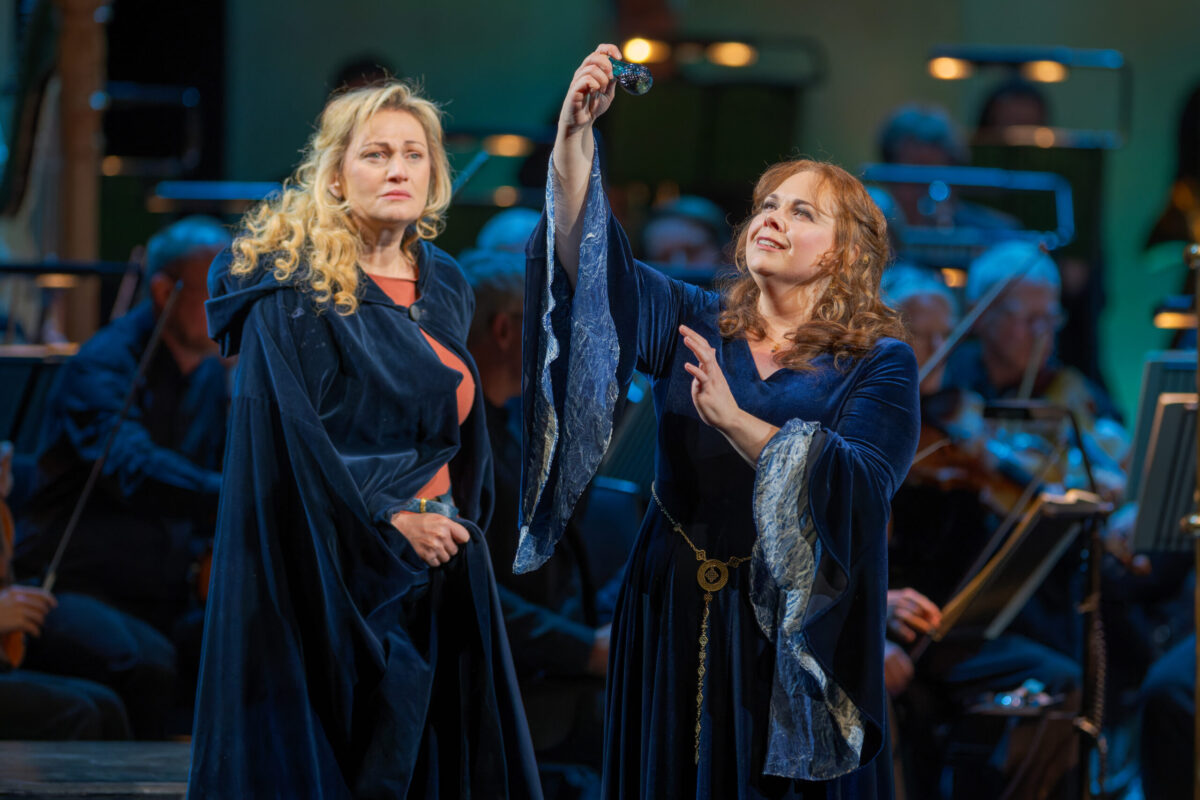
Despite the celebrated Prelude, the opera begins with striking restraint rather than spectacle, and the staging follows suit. Most of the stage is given to the orchestra against a pale, unadorned backdrop, leaving only a narrow strip for the singers and dramatic action. A black square platform stands to one side, functioning less as a scenic indicator than as a visual anchor.
The remarkable Prelude unfolds as the lights dim. Its ten-minute progression, glorious yet ambiguous, conveys an unnameable emotion that only becomes clearer at the opera’s end: an unfulfillable yearning that entangles Tristan and Isolde. Driven by incessant dissonance, the music circles back upon itself repeatedly, as if resolution were endlessly deferred.
Act I takes place aboard a ship bound for Cornwall. The Irish princess Isolde (Katherine Broderick) travels with her maid Brangäne (Khatuna Mikaberidze), escorted by Tristan (Gwyn Hughes Jones), the Cornish knight bringing her to marry his lord, King Marke (Richard Wiegold). Although the political circumstances appear straightforward, the emotional terrain is anything but. The act belongs unmistakably to Isolde: her rage, humiliation, and buried memories dominate the scene. With the orchestra visibly placed behind the singers, the orchestral surges accompanying her furious declamation seem almost to rise like the sea itself.
Wagner tempers this fury with moments of suspended tenderness. When Isolde recalls her earlier encounter with Tristan—who, after killing her betrothed Morold, returned disguised as “Tantris” to seek healing from her—the orchestral tension softens into trembling strings. What might have been a simple revenge narrative instead hints at the opera’s central paradox: hostility transforming into irresistible attraction.
When the pair drink the supposed death potion—secretly replaced with a love potion—the tension reignites. Standing apart on opposite sides of the stage, they consume what they believe will end their lives. The orchestra withdraws slightly while suggesting imminent transformation. A variation of the Prelude returns and the harp enters with luminous clarity. As the lovers awaken to their passion, the orchestra swells restlessly beneath them, already hinting that such illicit love can exist only briefly, and at great cost.
Act II forms the emotional and philosophical core of the opera through its exploration of day and night, reality and illusion. In the spare staging, Isolde waits for Tristan while Brangäne keeps watch. Overwhelmed by longing, Isolde brushes aside every warning. The flowing harp accompanies her anticipation, though darker horn colours subtly destabilise the music. When Tristan finally joins her, the lovers celebrate darkness as the only realm where their love can exist. Their extended duet unfolds in vast musical arcs as their ecstatic philosophy of night blossoms with dreamlike fragility.
Lighting reinforces the theme. At moments Tristan stands in shadow while Isolde remains illuminated, the two figures divided even in union. Their voices and the orchestra seem to edge toward resolution, yet that resolution remains illusory. The lovers’ transcendence collapses abruptly with the arrival of King Marke and the exposure of their betrayal.
Act III mirrors Act I both musically and visually, though in a darker register. Tristan lies mortally wounded after being betrayed by his companion Melot and is brought to his ancestral home in Karéol, where Kurwenal (Hansung Yoo) tends to him. The music grows fragmented and hallucinatory, reflecting Tristan’s delirious oscillation between memory and longing. When Isolde’s ship finally arrives, the reunion lasts only moments before Tristan dies.
The production’s minimal staging rarely attempts to compete with Wagner’s immense musical architecture. Lighting therefore carries much of the visual storytelling. A wash of golden light caught by the theatre’s carved reliefs marks the ship’s arrival in Act I and subtly anticipates royal authority, while in Act III a faint sunrise spreads across the pale backdrop before fading again at Tristan’s death.
With orchestra and singers sharing the stage and few props to support them, the performers must carry the drama largely through voice and presence—and they rise impressively to the challenge. Katherine Broderick commands the stage as Isolde, shaping the character’s volatile emotional landscape with striking vocal breadth; her Liebestod provides the evening’s emotional culmination. Gwyn Hughes Jones portrays Tristan with restrained but persistent intensity, sustained even in the physically awkward position required of the dying knight. Khatuna Mikaberidze brings warmth and quiet authority to Brangäne, while Hansung Yoo’s rich baritone captures Kurwenal’s unwavering devotion. Richard Wiegold’s King Marke is especially affecting, his dignified bearing and resonant tone lending genuine weight to the opera’s moral reckoning.
Minimal in visuals yet overwhelming in sound, this Tristan und Isolde ultimately trusts Wagner’s music to create its own dramatic landscape.
Scottish Opera
Tristan und Isolde
By Richard Wagner
Conductor: Stuart Stratford
Director: Justin Way
Cast Includes: Gwyn Hughes Jones; Katherine Broderick; Khatuna Mikaberidze; Richard
Wiegold; Hansung Yoo.
Next/Last performance: 11 th March 2026 (Edinburgh).
Running Time: 5 hours including two 25-minute intervals
Photo Credit: Christopher Bowen