

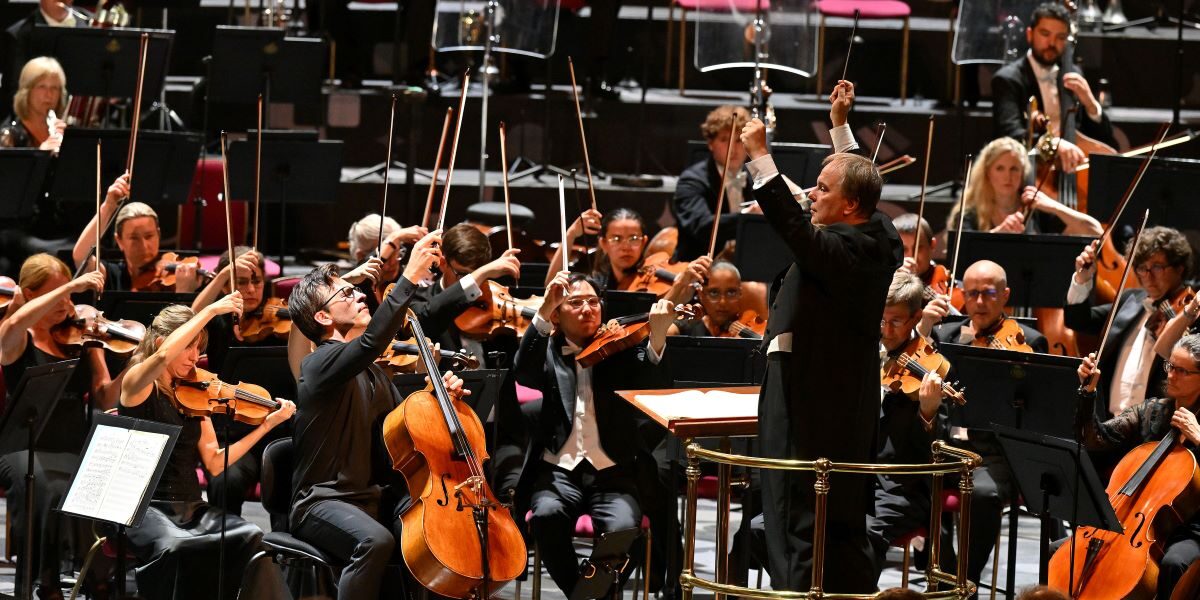

Incredibly it is now 50 years since the death of Benjamin Britten. His music has never really experienced the dip in coverage and enthusiasm that often follows from the death of an established composer, and so it feels as though he has been a continuing presence in concert-going life through the whole of my own adult lifetime. But in a catalogue of around 100 works some pieces are far less visible than others. It is therefore very helpful and rewarding to have Guy Johnston select as his commerorative focus the Cello Symphony, a work that was initially admired by the critics while never finding a regular place in the repertory.
You can see why. It is not a showpiece work, with an inward ruminative quality that does not seek to grab the audience’s attention immediately. In the first movement, in particular, there is an elliptical quality, as though Britten was taking time to work through the gears in his first return in many years to a purely orchestral work structured around sonata form. But as we move through the quicksilver second movement, the severe slow movement with an elaborate extended cadenza and into the final passacaglia, you begin to sense the composer once again revelling in the challenge of these traditional forms. In the end it is very much a dark-toned symphony rather than a concerto, with the soloist and the orchestra in constant dialogue, with equal billing.
You can’t discuss this work without mentioning the close personal relationship between the composer and its dedicatee, Mstislav Rostropovich. First performed in Moscow in 1964 before an audience that included Shostakovich, its technical demands are correspondingly high. However, Guy Johnston took all of this in his stride, putting his own personal stamp on the work and relishing the moments of delicate chamber-music dialogue with the timpanist and principal trumpet, both of whom have a lot to do in this work. His sensitive shaping of the solo cadenza and the music immediately either side of it served to remind this listener of the unique intimacy of Britten’s setting of Wilfred Owen’s ‘Strange Meeting’ in the contemporary War Requiem. Echoes of the comradeship of war and, more immediately, between Britten and Rostropovich seemed to glow like embers in this deeply personal sequence of music. Johnston continued his tribute to this key friendship in a delicate, inward performance of the Coda from the Third Cello Suite, itself built on a foundation of Russian folk tunes.
The concert had begun with a UK premiere of a concert suite by Mark-Anthony Turnage, drawn from his recent opera Festen. I found this much ado about not very much. While in the ninetenth-century there was real need for opera transcriptions and paraphrases to disseminate works, in these days of media access it is hard to see what the purpose is for such a pot pourri devoid of setting. This was a brassy, percussion-heavy affair with jazz and Latin inflections, and a few longer breathed lyrical moments that reminded you of Barber or Copland. But without the dramatic context of the opera it overstayed its prolix welcome.
In contrast, after the interval, the BBC Symphony Orchestra gave a delightfully engaged performance of that symphonic evergreen, Symphony 2 by Jean Sibelius. This is home territory for conductor Sakari Oramo, who took the orchestra through the work at generally fast tempi and without a score. There was an effortless ebb and flow between the strings, wind and brass, and some tastefully taken solos from the woodwind in particular. Indeed it was the quirkiness of much of the writing for woodwind, rather than the grander rhetorical romantic gestures, that caught my attention on this iteration: anticipations of gnomic and dark moments in the next two symphonies in the sequence. Sibelius is often said to be influenced by Tchaikovsky in his earlier works, but it was Mahler I heard more of in this performance. Perhaps especially so in the wonderful brass peroration at the very end of the final movement, where Oramo expertly built the final climax and accelerando so that things did not peak too soon. This was a performance that took me back to the first time I ever heard this piece as a teenage promenader, when it seemed to embody an everlasting optimism, possibility and spirit of aspiration. Looking out over the full and enthusiastic arena, I could only hope the promenaders of 2026 felt the same.
BBC Symphony Orchestra
Conductor: Sakari Oramo
Soloist: Guy Johnston
28 July 2026
2 hrs 30 mins with interval
Photo Credit: Mark Allan