


Feeling the Fracture Before Others See It.
In 1938 Brooklyn, as Europe edges towards catastrophe, one woman suddenly stops walking.
In Broken Glass, Arthur Miller compresses the tremors of history into the body of Sylvia Gellburg, a private paralysis that may be more lucid than the calm around her. Director Jordan Fein’s staging at the Young Vic presents this late Miller play as both a psychological drama and a meditation on the human instinct to look away from disturbing realities.
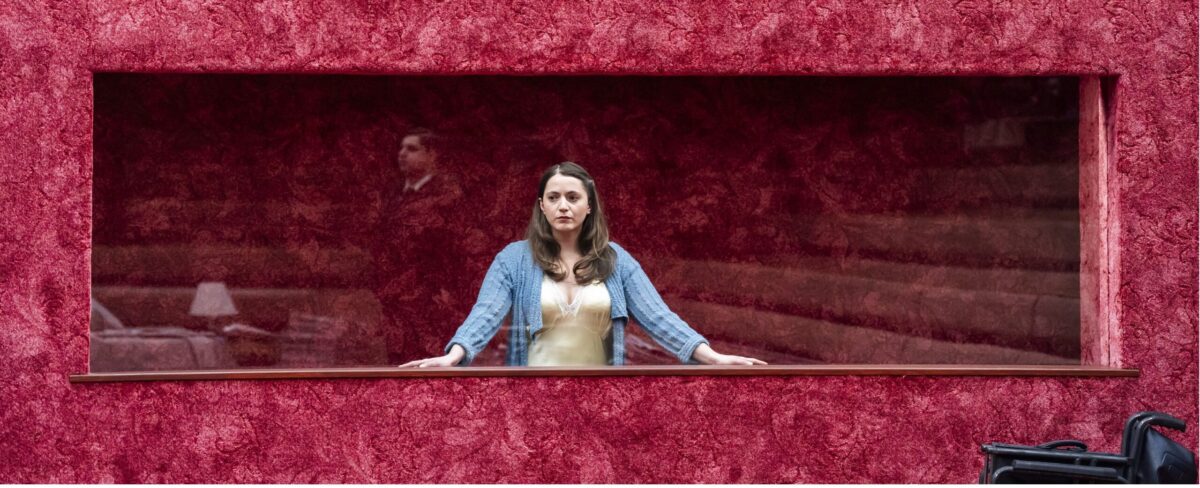
The production opens with a striking image. As the lights dim and the upbeat 1930s song Am I Blue? begins, Sylvia appears dancing alone behind a large oblong glass window at the far end of the stage. Only her upper body is visible, illuminated in isolation. The moment seems light, almost playful. Yet the image already hints at the play’s deeper themes. The glass frames and separates her at the same time, suggesting fragility, distance and enclosure – an early visual echo of the fracture that will later immobilise her.
Rosanna Vize’s set design reinforces the sense of a world saturated with news yet insulated from its consequences. The stage floor is scattered with stacks of newspapers; loose pages spill across a double bed. Headlines accumulate like debris. History is literally underfoot, or stacked in piles, ready to be discarded.
Those newspapers carry the reports that obsess Sylvia – stories of Jewish men in Germany forced to scrub pavements with toothbrushes, humiliations inflicted during the escalating persecution that culminated in the pogrom of Kristallnacht. For Sylvia these reports are not distant headlines. They enter the body. Her paralysis becomes a physical echo of that degradation, collapsing the distance between Brooklyn domesticity and European catastrophe. Miller’s drama quietly suggests that history does not remain safely abroad; it seeps into the most intimate spaces of private life.
The glass window introduced in the opening returns as a recurring visual motif. At one point Dr Hyman and his non-Jewish wife Margaret appear behind it in an intimate embrace, he leaning against the pane as they kiss before disappearing from view. The image quietly contrasts the emotional vitality of their marriage with the desolation of Sylvia’s own relationship. It also hints at the ease with which some characters believe themselves protected by assimilation, as though life behind the glass might shield them from events unfolding elsewhere.
The performances bring this emotional landscape into focus. Eli Gelb’s Phillip Gellburg is superbly drawn: physically imposing, impeccably dressed, his side-parted slick hair projecting the solidity of success. Yet small nervous gestures – a restless tilt of the head, flashes of irritation – betray deeper insecurity. Gelb presents Phillip as a man protected by layers of social armour, his aggression masking anxiety about identity and belonging. His insistence that Sylvia’s paralysis is “all in the mind” feels less like cruelty than desperate self-preservation.
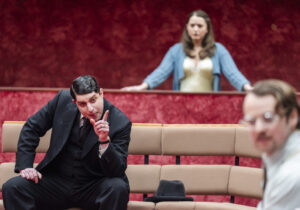
Unexpectedly, Phillip becomes the production’s emotional centre.
By contrast, Pearl Chanda’s Sylvia remains more elusive. The staging carefully constructs intimacy in her encounters with Dr Hyman, isolating the pair in soft side-lighting that creates an almost confessional space. Here Sylvia reveals the depth of her frustration as a woman, confessing that she and Phillip have not been intimate for twenty years. The doctor’s vitality awakens something long suppressed within her. Yet the anguish that must underpin Sylvia’s paralysis, the combined weight of repression, humiliation and fear, does not fully ignite, leaving the play’s central wound somewhat muted.
Around this central triangle, the supporting characters add texture and warmth. Nancy Carroll’s Margaret Hyman introduces humour and wit, her grounded presence offering moments of welcome levity. Alex Waldmann’s Dr Hyman brings perceptive restraint, gently defusing tension while gradually uncovering the deeper dynamics of the Gellburg marriage. Juliet Cowan’s Harriet, Sylvia’s sister, feels entirely at home in the world of 1930s Brooklyn. With her carefully styled period hair, well-cut dress and brisk, slightly meddlesome manner, helped by the finely observed costumes of Sussie Juhlin-Wallén, she becomes instantly recognisable the caring, inquisitive sister whose well-meaning curiosity gradually reveals the deeper tensions in Sylvia’s marriage.
Written in 1994, Broken Glass belongs to Miller’s later period, when his plays often became more discursive and reflective. Performed here without interval and running close to two hours, the text sometimes feels dense, its psychological explanations circling familiar ground. A little trimming might have sharpened its dramatic arc.
Yet the play’s themes remain strikingly resonant. The programme accompanying the production includes an essay on antisemitism, appeasement and the failure of international response in the 1930s. Its title ‘Looking Away’ captures the play’s central tension. Everyone in Miller’s drama reads the newspapers. Only Sylvia cannot look away.
Drama
Broken Glass
By Arthur Miller
Director: Jordan Fein
Cast Includes: Nancy Carroll, Pearl Chanda, Juliet Cowan, Eli Gelb, Alex Waldmann, Nigel Whitmey
Running Time: Approx. 2 hours (no interval)
Until: 27 September 2025
Photo credit: Tristram Kenton