

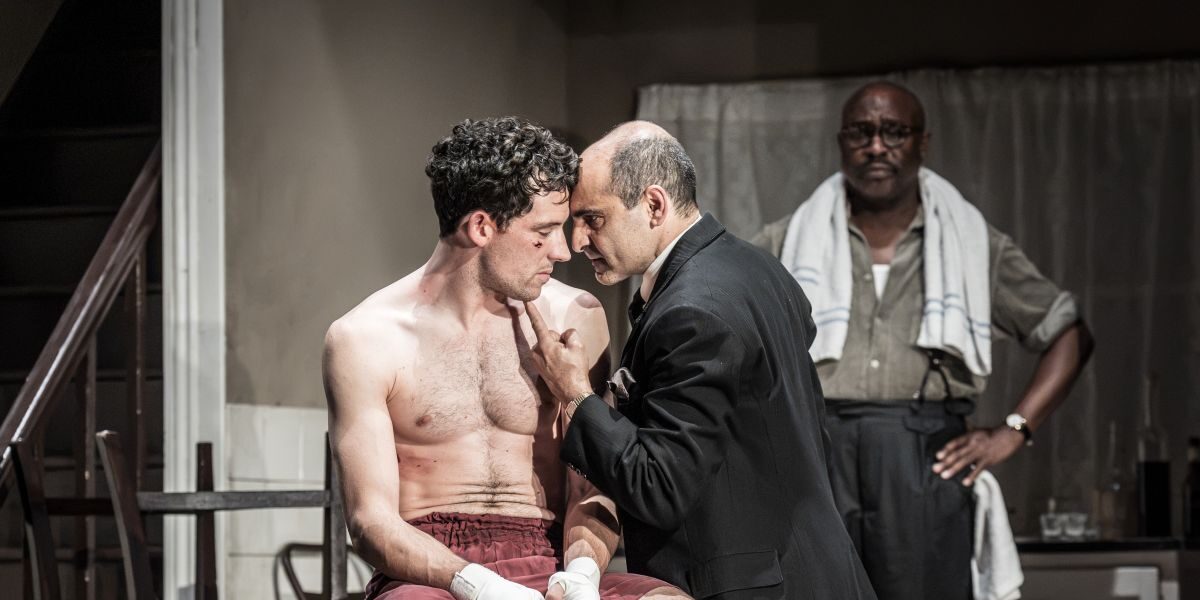

Clifford Odets is not a widely remembered name or regularly produced playwright and yet this play, when you see it, makes it clear how much Arthur Miller and Tennessee Williams owe to his example. There is the engaged social realism and activism of Miller and a dreamy, romantic, wistful aura to the dialogue that anticipates Williams, when gritty reality intrudes too far and an escapist moment is needed. While this play is not without its moments of unconvincing melodrama that betrays its date – 1937 – this is a necessary production, reminding us of a key missing link in American drama.
The evening begins and ends with a man sitting at a table in shadows lit only by a single candle. This man is Joe Bonaparte, a second-generation Italian American torn between a creative commitment to playing the violin, and a desire to find a more materialist American Dream. We see him at the point of decision on his twenty-first birthday, when he plumps instead for boxing, a career that carries with it the promise of money and fame, but also a darker price-tag in the form of corruption and exploitation by investors, irreperable physical harm, and ultimately a loss of personal identity.
The performance by O’Connor is exceptional, and should be recognised as such by award ceremonies before the end of the year. Anyone who saw his breakthrough film role in God’s Own Country will be aware of his capacity for total immersion in the physical demands of a role. His slight frame and sensitive features make him a plausible violinist from the start, but what is astonishing here is his ability to transform himself into a fierce, even vicious fighting machine. Sharp, calculating intelligence and barely suppressed anger crackle through his scenes, helping to conceal some of the inconsistencies in the writing and creating a wholly plausible arc of character.
He is supported by a superb ensemble of actors, each of whom etch in beautifully detailed characterisations, with body-language, New Jersey accents, and shifts of emotional gear that are pitch perfect alongside O’Connor. A short review cannot do justice to all of them, but clear stand-outs are Daniel Mays as his splashy, crudely manipulative, and self-serving manager, who carries on where he left off in Guys and Dolls, Stanley Townsend as Joe’s dignified, disappointed father, Jason Barnett as the quietly dignified trainer, and Zubin Varla, as a sinister minor mobster, with financial and homoerotic fixations on Joe. Odets’ writing is at its most dated in handling the relationship between Joe and Lorna, the one female character in the play. But that does not detract from the strength of Hayley Squires’ performance – bold and brassy, but also damaged and vulnerable, a combination that explains the mutual attraction between joe and herself.
Direction and design by Sam Yates and Rosanna Vize are also important ingredients in the making this play so persuasive in the moment. The set is divided between the cramped kitchen of the Bonaparte family home, on one side, and the shabby, down-at-heel manager’s office on the other. Everything that Joe seeks to escape surrounds him. Within this framework the polarities of his life are memorably embodied and represented in non-literal, suggestive ways. The inspiriational thread of music is taken up from the start as as a boyhood version of Joe (Anton Vehring in this case) takes up the violin. He is joined at key moments by a string quartet, revealed and then concealed again behind a shutter. Isobel Waller-Bridge’s brilliant pastiche score takes us from Beethoven to brutality and back with jarring intensity, fusing too with the boxing bouts, here represented by O’Connor landing blows on a punchbag with video projections around the walls. This is such an apt fit with the language of the play, shifting as it does from crudity to wistful romantic symbolism.
The production of this play therefore could not be bettered, and makes the best possible case for a play that is flawed but still essential.
Writer: Clifford Odets Director: Sam Yates
Cast: Jason Barnett, Richard Fleeshman, David Ganly, Patrick Martins, Daniel Mays, Josh O’Connor, Oliver Ryan, Hayley Squires, Stanley Townsend, Zubin Varla, Anton Vehring and Nicholas Woodeson