


Dramatising the life of a composer is an exercise more than usually full of pitfalls. The devotee will be dissatisfied if there is too much basic exposition and not enough music; while the newcomer needs enough story to relate the life to the work, and sufficient music to get a flavour for this composer’s particular style and unique contribution. Often you can only hope to satisfy some of the audience all of the time. Above all how do you make a life of composition, as opposed to performance, dramatically interesting and engaging? Would this not be better after all as a lecture rather than a play?
Holy Fool is a worthy attempt to meet these challenges, but only succeeds intermittently. This is largely because in the case of Dmitri Shostakovich there are further complications likely to sink all but the very best dramatists. The prevailing context of his life was one of continuous tension – between his own artistic expression and the diktats of the Soviet state, and Stalin in particular. He lived in continuous fear of imprisonment or worse, if he deviated, or was perceived to, from celebration of the interests of the regime. And yet to live as a mere propagandist was impossible – was there a tightrope, however narrow that he could yet walk?
The problem here is that this is, by definition, largely an internal drama, rather than one that can be turned into memorable visual and dramatic form. It might have been better to start the narrative, not with the premiere of Lady Macbeth, personally rubbished by Stalin in a review in Pravda, but in the joyful decade beforehand when Shostakovich blithely forged ahead with radical musical experimentation. Then we might feel the contrast more meaningfully in a visible dramatic shape. While there are some fine musical moments, particularly when the 5th and 7th Symphonies come into the frame, these moments are illustrative rather than viscerally compelling.
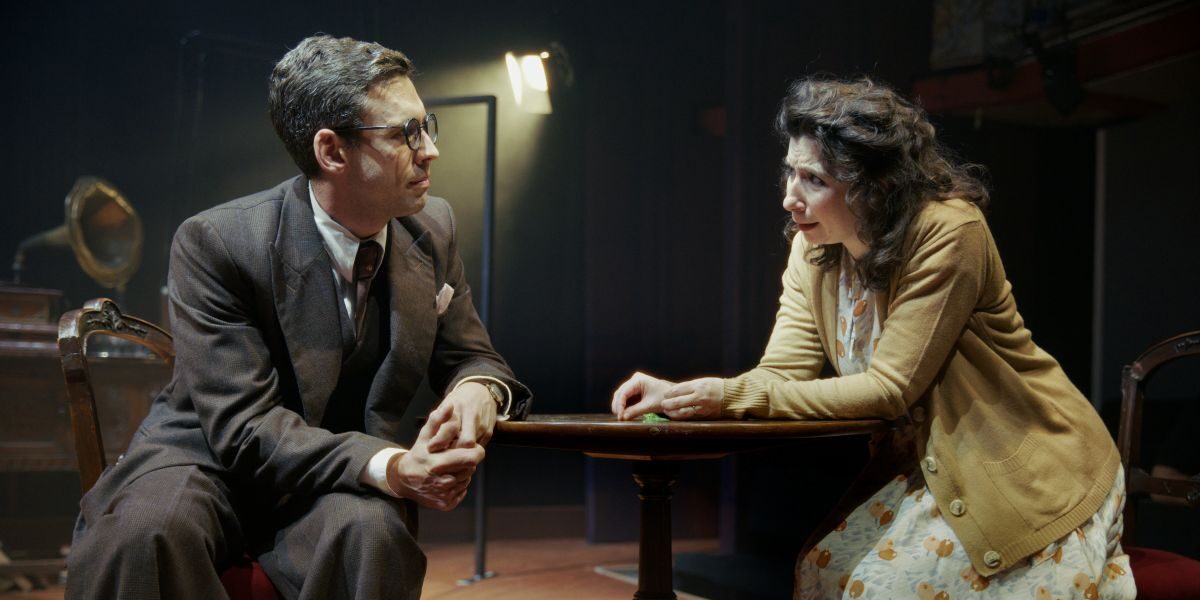
Benjamin O’Mahoney does his best in the lead role. He begins in a state of almost puppyish innocence and then you see him shrink and diminish inwards under the force of the necessary compromises. By the end of the play ha presents a convincing hard carapace to the world behind which it is hard to work out what he is really thinking and feeling. This is a view with which we are broadly familiar, but there are some real strengths in the portrayal and inclusion of other figures in the composer’s life that really do add to our understanding. It is hugely welcome to have a major role allocated to Nina, his first wife, an eminent scientist in her own right, and someone who made huge sacrifices to keep their family afloat. She is brought to life with fierce, conflicted intensity by Jenna Augen. There are also memorable moments from Fergus O’Donnell as a friend and admirer, Izaak. The character of Katya, part admirer and part critic, seems more of an unassimilated plot device despite forceful playing by Phoebe Pryce. It might have been better, perhaps, to have Shostakovich’s internal turmoil expressed as Hamlet-style monologues instead.
There are many solid virtues to this production, with a workmanlike set and well-chosen musical illustrations, however brief and tantalysing they have to be. I would have preferred to hear more music chosen from the world of stark inwardness that is the string quartets, but there is a separate concert taking place at the Park where this aspect will be pursued further.
Overall, the show needs further involvement from a dramaturge to provide a more incisive and memorable theatrical presence.
Writers: Rosalind Adler and Lea Sellars
Director: Kate Fahy
Cast: Jenna Augen, Fergus O’Donnell, Benjamin O’Mahoney, Phoebe Pryce
Until 10 October 2026
2 hrs 20 mins with interval
Photo Credit: Mark Douet