


Philip Glass and Phelim McDermott have many fine collaborations behind them, especially in iconic operatic productions, but this quirky, intermittently brilliant, collaboration is unfortunately not one of them. Originally put on at the Royal Exchange, Manchester some seven years ago, it now comes to Soho Place for the summer. There were some truly lovely episodes and incidents here, especially musically and visually, but there was little sustained dramatic pulse and acres of tedious thematic repetition (and I am absolutely not talking about the music, where by the composer’s usual standards there was in fact a lot of textural, melodic and harmonic variety). The show could have lost half its length to advantage. Towards the end McDermott describes the wall in his studio where he illustrated the themes he wanted to address, and that sums up the problem – ultimately this evening is a ‘mood board’ rather than an integrated show. Many important issues arise, particularly on the nature of creativity, and many arresting images are created; but they are not fully developed or meaningfully connected.
That said, the first fifteen minutes or so are immediately arresting. Without giving too much away, the opening sequence offers a heartening testament to the power of live theatre to change lives and is full of McDermott’s trademark folksy charm, expert comic timing and ability to bring serious themes down to earth with quirky humour. What follows is a series of episodes, punctuated and accompanied by the musical ensemble, that explore the philosophy of Taoism, a planned collaboration with Maurice Sendak,, the healing properties of Kintsugi, the experience of spending time in a floatation tank, anger prompted by the loss of a glass coffee table and, finally, the relationship between music and consciousness as Glass composes in reaction to McDermott feigning a coma.
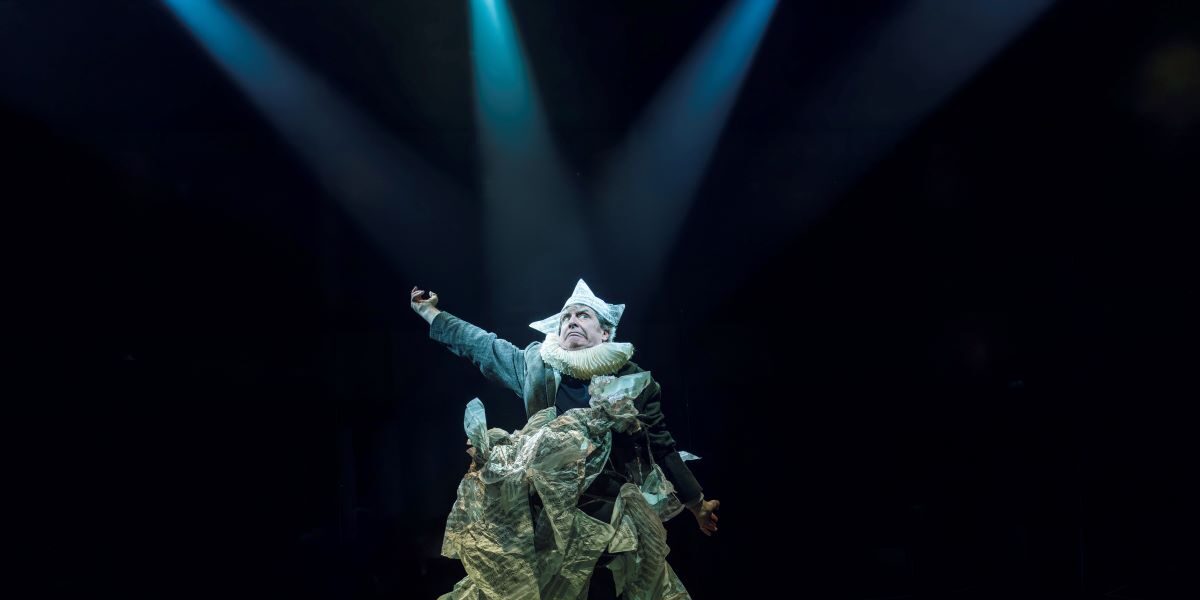
This list, by no means complete, indicates a variety of contrasting incident and thematic profusion that stimulates and irritates in equal measure. Ideas and images abound but are not really developed to their full extent or integrated with one another. What does hold attention, though, are the skills of the performers, musicians and designer. McDermott leads a group of three adept puppeteers who assist him in opening out each episode. One operates a charming puppet of a young boy who either represents Phelim’s younger self or the child from Sendak’s In the Night Kitchen. At other points all three collaborate to assemble impressive tableaux vivants. At one point they bury Phelim in scrunched up paper printed with musical notation and at another they entomb him in strips of sellotape. The four instrumentalists (violin, clarinet, piano and percussion) also engage physically with the action on the stage while providing a vivid underscore to each scene. Designer Fly Davis sets the action on a revolve set with three concentric rings that rise and fall to provide a representation of the three levels of consciousness that McDermott calls ‘Deep Democracy.’ The skills of the performers and creative team come together most memorably in the beginning and finale of the second half of the evening in images that linger long on the retina.
Overall, the show seems to be trying to demonstrate the process through which the failure of one project can lead the same participants to the creation of a different one of equal worth. But in this case the Kintsugi is not emough to make the pieces cohere. Consistently less than the sum of its intriguing parts, this is a frustrating experience and perhaps ultimately an illustration of how and why it is not a good idea for the writer and lead performer also to be the main director of the production. Its needs someone to stand back and take an overview and a grip on the whole.
Composer: Philip Glass
Writer/Performer/Co-director: Phelim McDermott
Co-Director: Kirsty Housley
Musical Director: Chris Vatalaro
Until 12 September 2026
2 hrs 30 with interval
Photo Credit: Johan Persson