

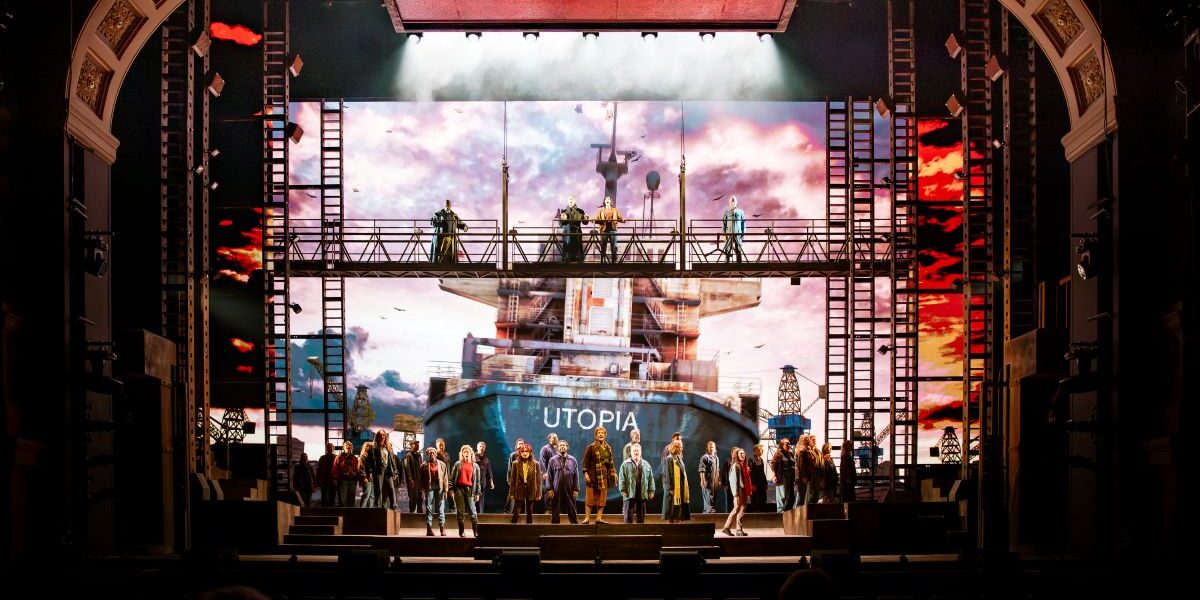

The Theatre Royal Drury Lane has one of the most impressive pedigrees of any theatre in London. Home to Charles II and Nell Gwynn, the great actor-managers of the eighteenth and nineteenth centuries, and to many a great musical in more recent times. It requires a large statement to fill the stage and the house, and when you enter you have the sense of encountering a show on the right scale: reams of scaffolding on different levels, and a projection of the prow of a huge ship in the final stages of construction. However, as the evening unfolds you realise that the musical is rather less than the sum of its all-too-many parts, despite the best efforts of a top-notch cast and technically accomplished creative team.
This is The Last Ship, with music and lyrics by Sting and a new book written by Barney Norris. It is a celebration of the final years of the Wallsend shipbuilders on Tyneside, Sting’s home territory, as they come together to complete work on the final ship to be built in their shipyard, despite the best efforts of government to shut them down. Sting himself plays the charismatic, but fatally ill foreman of the yard, Jackie White, who galvanises the workforce to complete the apparently hopeless task. Together with a variety of characters in the community they take over the yard from the local boss and find a new meaning and social cohesion in the task, as the women of the town join forces with them, led by Meg, the local pub owner, and Gideon, a prodigal son of the neighbourhood who returns to rediscover his roots.
This is well-intentioned and well performed stuff, but the tone of aggrieved social protest begins to pall over an evening especially when the many songs – some 25 in all – blur into one another in their similarity of tone. Three hours of minor key melancholy, sometimes attractively orchestrated, modulating into major key affirmation of an often saccharine blandness is just too much, and too little. Even when you have Declan Bennett, Frances McNamee and Jackie Morrison, as well as Sting himself, to deliver it. Social grievance from the Thatcher years is very familiar territory: to justify another outing you need to have something new to say, and I did not find it here, despite the best efforts of a committed cast.
Moreover, for all the grandeur of the design the visual impact was underwhelming. The different levels and zones of the stage area remained significantly underused, and until the final scenes there was far less choreography and significant group action than one might expect. Characterisation remained quite thin, and not always plausible; and too often there was no natural inevitability about the emergence of the next song, just a predictability that there would be another one.
Frances McNamee and Jackie Morrison always give good value, injecting a great deal of passion into their leading roles, and Hannah Richardson showed herself to be a truly promising newcomer. Sting himself sang very creditably too. It was hard to see the rationale for the character of the Wallsend Ferryman, played by reggae artist Shaggy, who seemed wholly out of his comfort zone. This commentator and chorus role seemed lost for words.
So while there were scenes and songs that were fleetingly engaging, the action and mood of this overlong and too readily sentimental musical were far too predictable to sustain interest and plausibility. I found myself sympathising with boss Freddy Newlands, well portrayed by Matt Beveridge, who in his attempts to find some viable future for the shipyard, seemed a much more believable character than almost anyone else.
Music & Lyrics: Sting
New Book: Barney Norris
Director: Leo Warner
Cast includes: Declan Bennett, Matt Beveridge, Duane Gooden, Frances McNamee, Jackie Morrison, Hannah Richardson, Shaggy, Sting
Until 3 October 2026
3hrs with interval
Photo Credit: Nienke de Groot